July 5th, 2026
Réunion, known as Île Bourbon before 1848, is an island in the Indian Ocean that is a region of France. Part of the Mascarene Islands, it is located east of the island of Madagascar and southwest of the island of Mauritius. Its capital and largest city is Saint-Denis. The island is slightly larger than Luxembourg, half the size of the province of Prince Edward Island and roughly the size of the state of Rhode Island.
The first European discovery of the area was made around 1507 by a Portuguese explorer, but the specifics are unclear. By the early 1600s, nominal Portuguese rule had left the island virtually untouched. The island was then occupied by France and administered from Mauritius.
The French took possession of the island in the 17th century, naming it Isle Bourbon after the House of Bourbon which then ruled France. The name was changed in 1793 to La Réunion (“réunion”, in French, usually means “meeting” or “assembly” rather than “reunion”). The island changed its name again in the 19th century: in 1806, it was renamed Isle Bonaparte (after Napoleon), though, in 1810, it became Isle Bourbon again. It was eventually renamed La Réunion in 1848.
Its tropical climate led to the development of a plantation economy focused primarily on sugar for which slaves from East Africa were imported as fieldworkers, followed by Malays, Vietnamese, Chinese and Indians as indentured laborers. Slavery was abolished in 1848. Today, the greatest proportion of the population is of mixed descent, while the predominant language is Réunion Creole, French remains the sole official language.
Since 1946, Réunion has been governed as a French region; consequently, it is one of the outermost regions of Europe and part of the euro zone but not the Schengen. It is one of the two euro zone areas in the Southern Hemisphere and in Africa. Owing to its strategic location, France maintains a large military presence on the island.
The opening of the Suez Canal in 1869 reduced the importance of the island as a stopover on the East Indies trade route and caused a shift in commercial traffic away from the island. Europe increasingly turned to sugar beet to meet its sugar needs. Despite the development policy of the local authorities and the recourse to compromise, the economic crisis became evident from the 1870s onward. However, this economic depression did not prevent the modernization of the island, with the development of the road network, the creation of the railroad, and the construction of the artificial harbor of the Pointe des Galets. These major construction projects offered a welcome alternative for agricultural workers.
By the 1990s, Réunion was transitioning from its traditional sugarcane-centered economy to service and tourism sectors. The opening of Pierrefonds Airport near Saint-Pierre in 1998 catalyzed visitor growth. Within a few years, tourism revenues surpassed those of sugar production: by 2000, nearly 426,000 tourists visited annually, transforming economic patterns especially along the north and west coasts, and prompting the creation of Creole heritage villages to strengthen cultural tourism.
In 2005 and 2006, Réunion was hit by a crippling epidemic of chikungunya (we caught it in Brazil in 2020), a disease spread by mosquitoes. According to records, 255,000 people on Réunion had contracted the disease as of 26 April 2006. The neighbouring islands of Mauritius and Madagascar also suffered epidemics of this disease during the same year.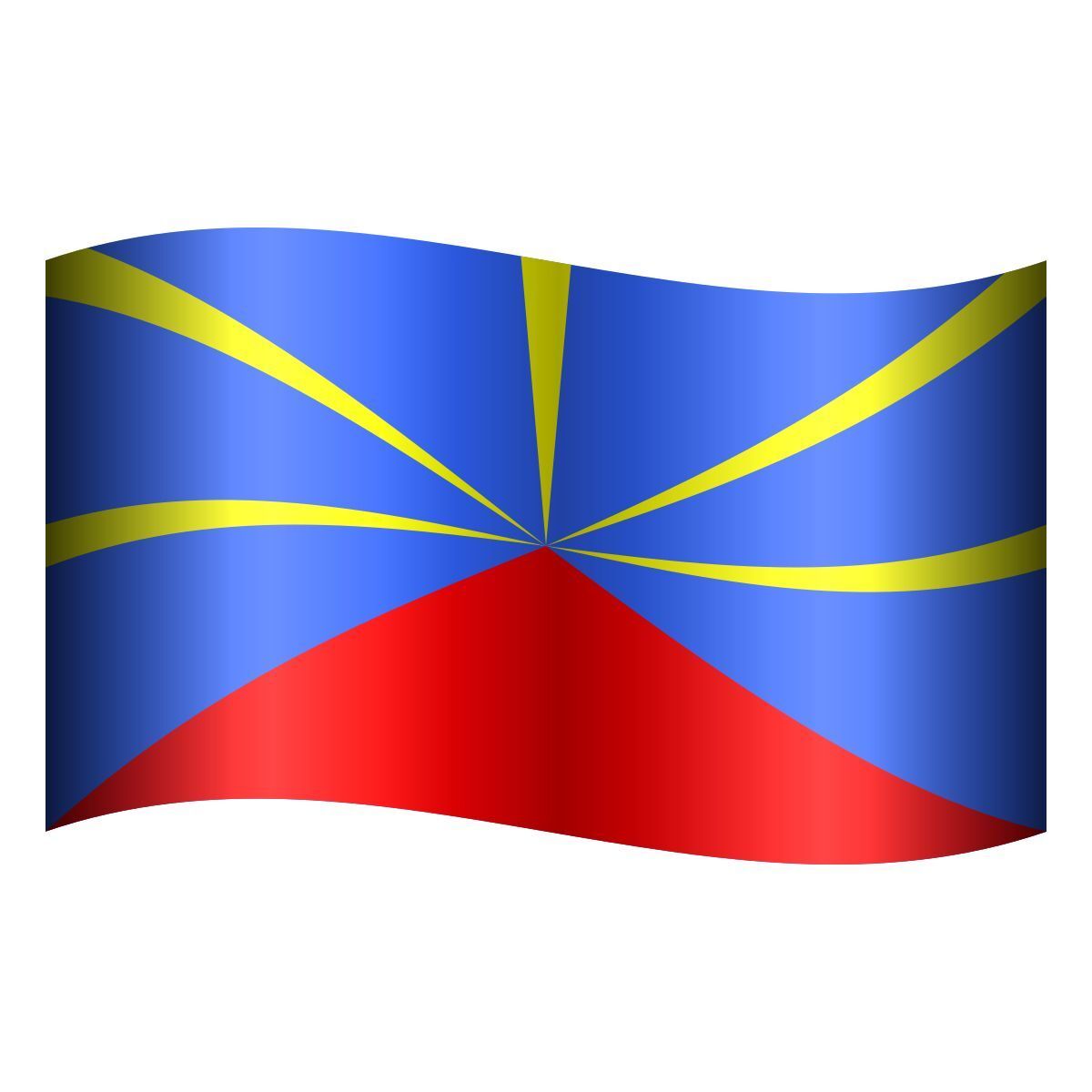
As an overseas department of France, Réunion Island’s official flag is the French Tricolore (blue, white, and red). However, the most widely recognized local and cultural flag, known as “Lo Mahavéli,” features a radiant, stylized volcano against a blue background.
Currency: The Euro (being part of France) $1.14 USD and $1.61 Canadian
Gas: €1.82 – $7.88 USD per gallon; $2.96 CDN per litre
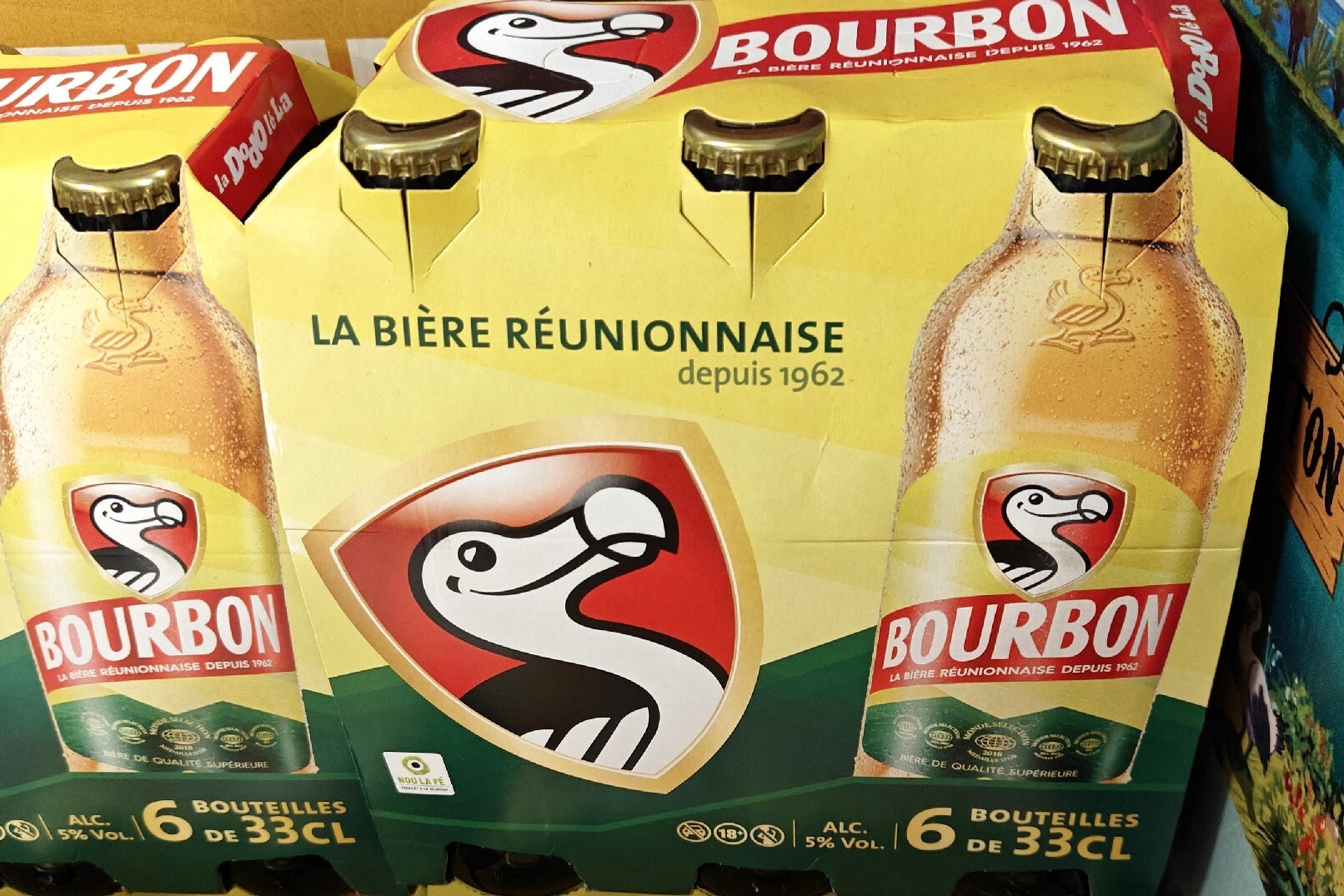
Beer: Bourbon
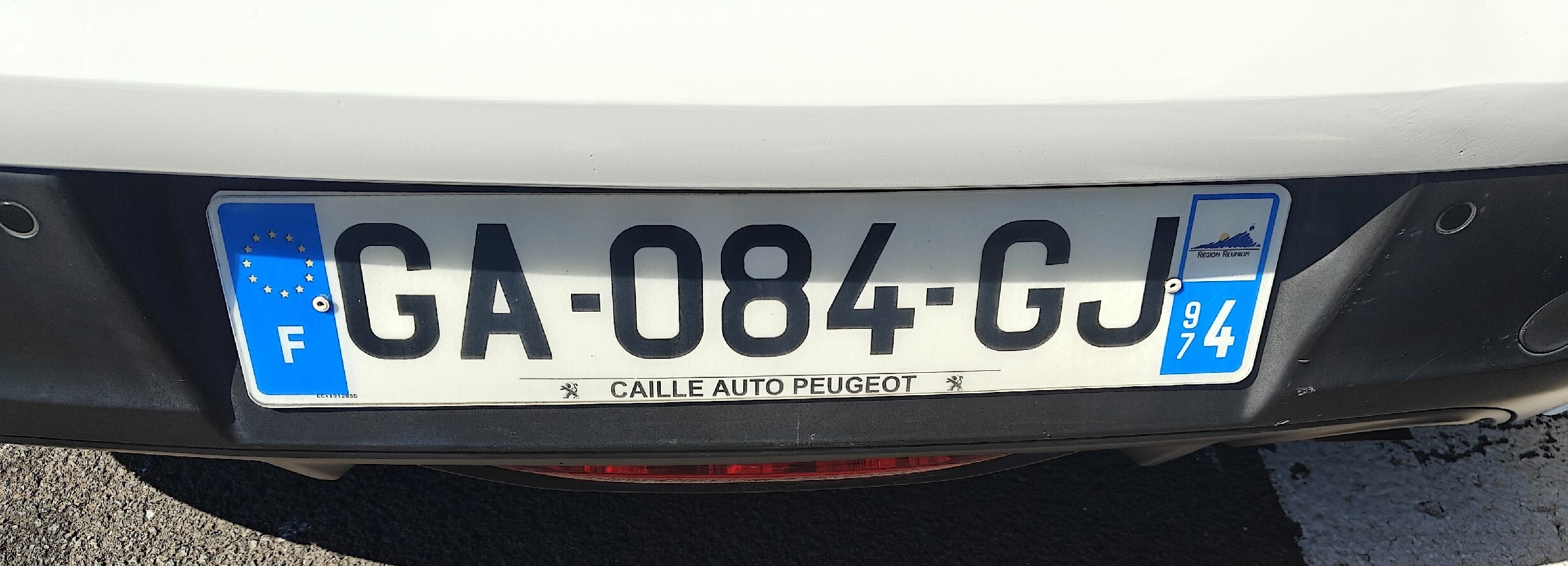
License plate: France
(Now if you recall from our last posting, we had to cancel our trip to Uganda and Rwanda due to Ebola so we flew to Mauritius two weeks earlier than planned. If we’d thought about it harder, we would have gone straight to Reunion but hindsight is 20/20, right?)
Our flight out of Buffalo to JFK on Saturday, the 4th of July, left a bit late but we’d planned for this. We did not check our bags (we are traveling with one roller board carry on and one back pack each) so we left Terminal 5 and found the train to Terminal 4 for our international flight on Kenya Airways schedule to leave at 1:45pm. This left over an hour late and we were concerned about our connection in Nairobi to Mauritius. Our layover was supposed to be 1.25 hours only and we’d landed at 11:40 not 10:45 the next day. We were fed three meals on this plane and tried to sleep. We both think we slept a bit as the flight didn’t feel like 14 hours.
Nothing was said on the plane about connections that people might be late for, but heading up the escalator to the Transfer Station, there was an agent pulling people aside to a few destinations, one of which was ours. He sent us along to the Transfer Station up ahead, to have a fellow “tick us off a list” and then we were escorted to the gate. At Gate 9 they were still boarding so the flight was going to leave a bit late. At this point we had no issues until the plane went to back away – now there was a mechanical issue so back to the gate we went for about ten minutes. So our noon flight took off at 12:25.
It was upon boarding the plane that we found out that Morocco knocked Canada out of the Round of 16 with a score of 3-0. It was too bad but it was historical that Canada got this far with a total of 8 goals! Congrats to the team.
Instead of landing at 5:15 at Mahebourg, Mauritius, we landed at 5:40 and then the real frustration began. Immigration lines were long and it took nearly two hours to get through. (This reminded of us landing in Paris!) Lots of booths but few agents. Our luggage was still on the carousel once we got through, Doug got cash and we went to the booth to activate our E sim cards which we had purchased online in advance. We then grabbed a taxi to our prebooked accommodation.

Le Jardin de Beaux Vallon gave us a cabin with a master bed, a single bed, a desk, a sitting area and a full bathroom. It came with WiFi, AC and breakfast as well as nice swimming pool which we didn’t get to use. We got into the room after paying (this was the only hotel on this island that we had prebooked but not paid for) and doing the paperwork. We then walked over to the mall for something to eat. It was a five minute walk and the food court was still open. By the time we got back to the room and organized, it was 9:30 so we settled in to watch some TV as we didn’t feel tired until 25 minutes later. We both slept a few hours, were awake for a few – dealing with an eight hour time difference.
Doug was up before six and got in a run before we both showered and headed over to the main building to try and get some brekkie – it doesn’t normally start till 8 but when we checked in she said if we got there at 7:30 there might be something ready. We managed to wolf down a yoghurt, a yummy pineapple smoothie and some crepes before getting in the taxi that the manager had arranged for us.
The temperatures here are around 25C / 77 F during the day and 20C / 70F at night so not a big change. Sun rises before six and sets around six.
We arrived at the airport by 8ish and things went way smoother than yesterday. No lines at the check in, shorter lines at immigration (but only two agents again), security was a bit disorganized and we went to our gate to wait. They changed gates on us and it was a good thing Fran noticed as the announcements for Air Mauritius flights were all in rapid French. Fran speaks some French and understands a good amount but if it’s too fast, forget it. The flight left on time and landed on time and as there were not many passengers, immigration here didn’t take too long.
Then more hassles started. Doug had arranged a rental car and on the confirmation it advised that an agent would “greet us at Arrivals”. Well, that didn’t happen. We tried to call unsuccessfully and then asked a young woman to call for us and she was told we need to go to P4 where the shuttles are located. We walked down there and there was no signage for the rental company on our voucher. We walked all the way back and asked her to call again. She very kindly did, and then they told her the same thing, so she walked back with us and didn’t a fellow show up asking for us! Our paperwork said the car rental agency was called “Final Rentals” but the van he had was “Cool Location” – how were we to know that!?
Anyway, we got to the office and after about ten minutes got served painfully slowly – there was a bit of a language barrier – English does not seem quite as common here as it did in Mauritius (we discovered that much more going forward too – just like in France).
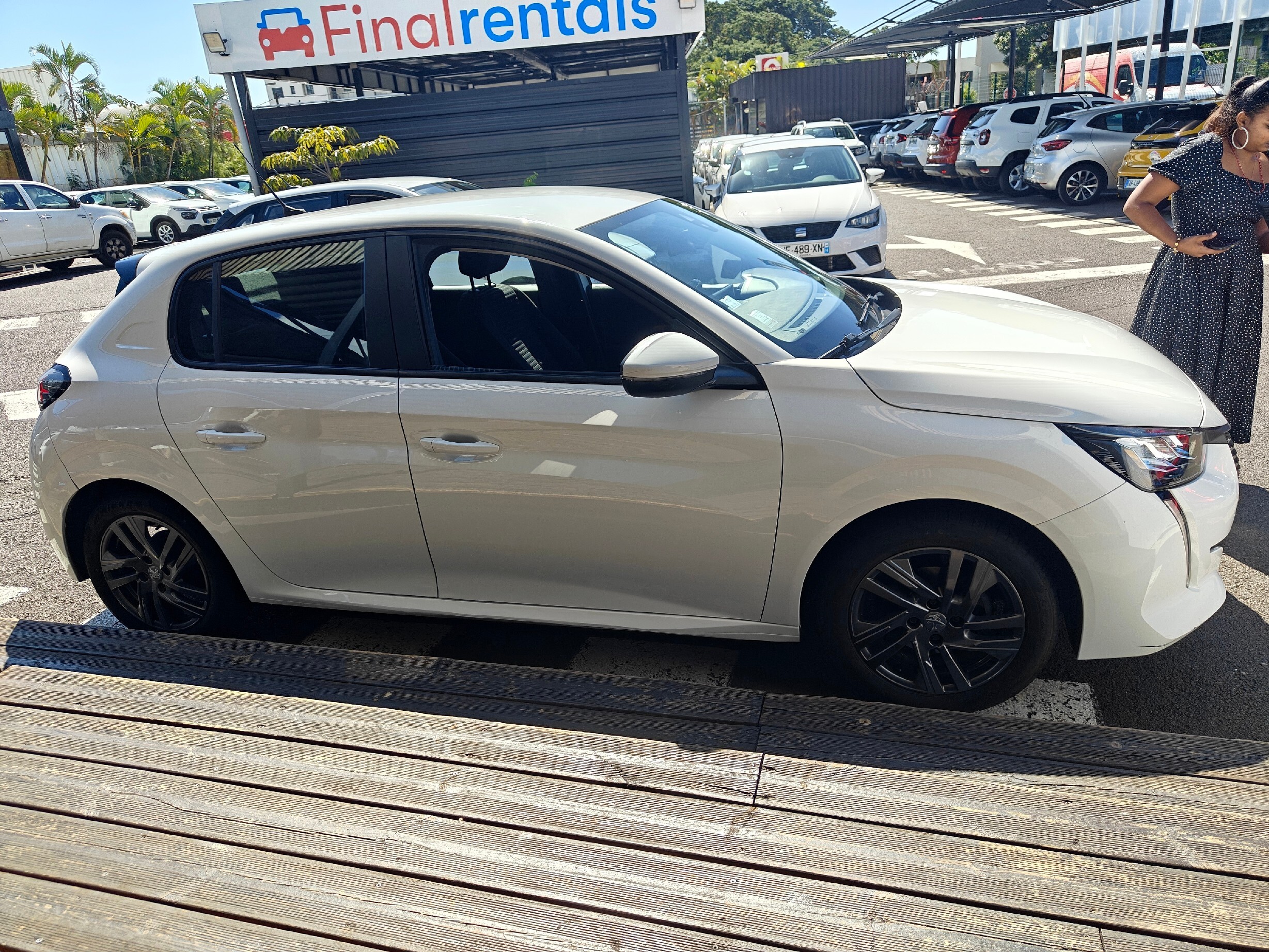
We finally left the off site car rental place and pulled off the highway shortly after heading to our hotel downtown to make a plan. Fran worked out the parking with the accommodation and they allowed us to check in early. We parked and got our luggage inside. Doug sorted out the spare phone we were going to use for navigation and then we went for a walk for a couple of hours stopping for a Coke Zero at one point and a beer later before returning to the room.
Saint-Denis, does not have a great deal of tourist sites but does have some historical buildinngs:
The Conseil General – built in 1804
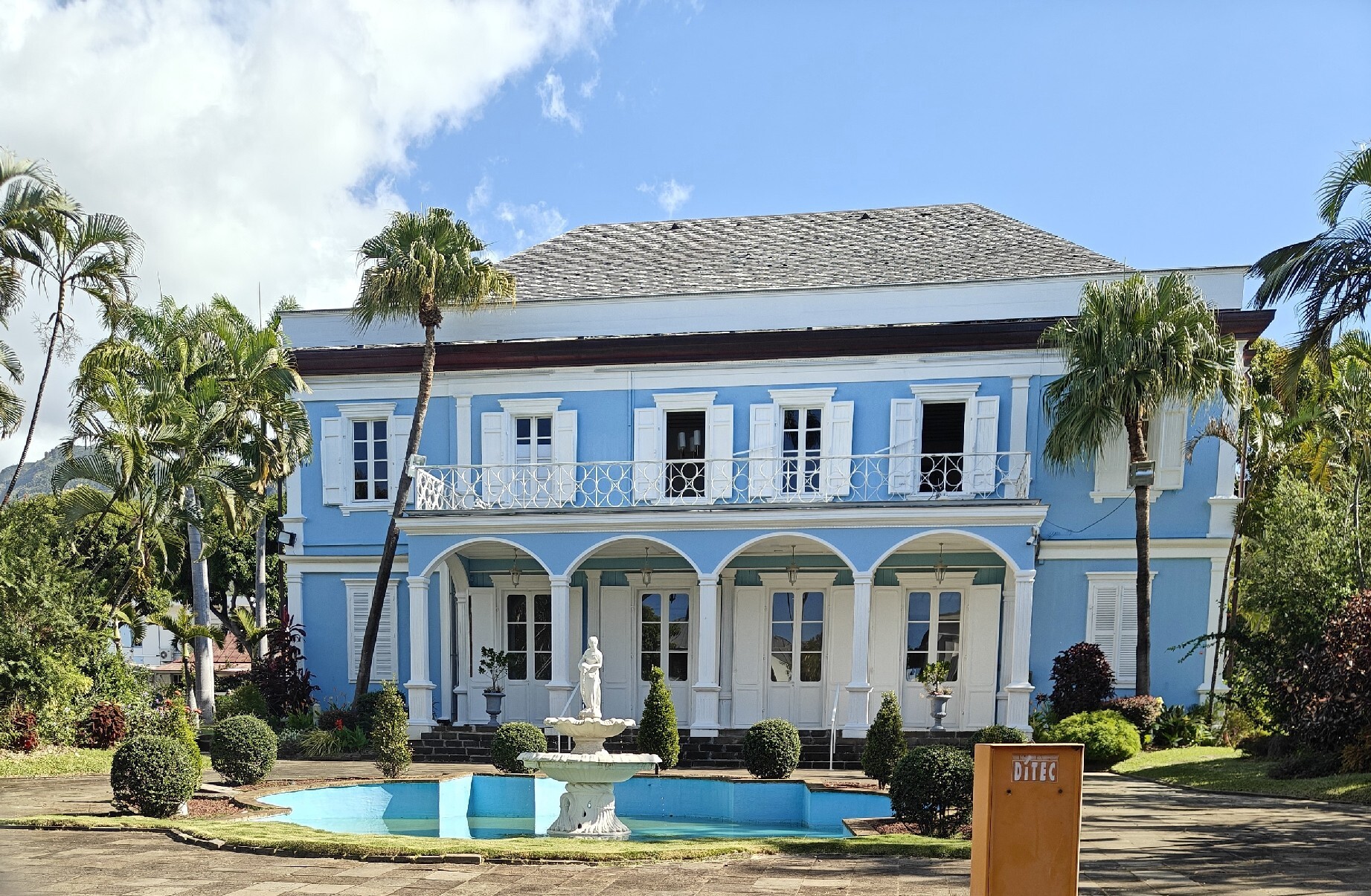
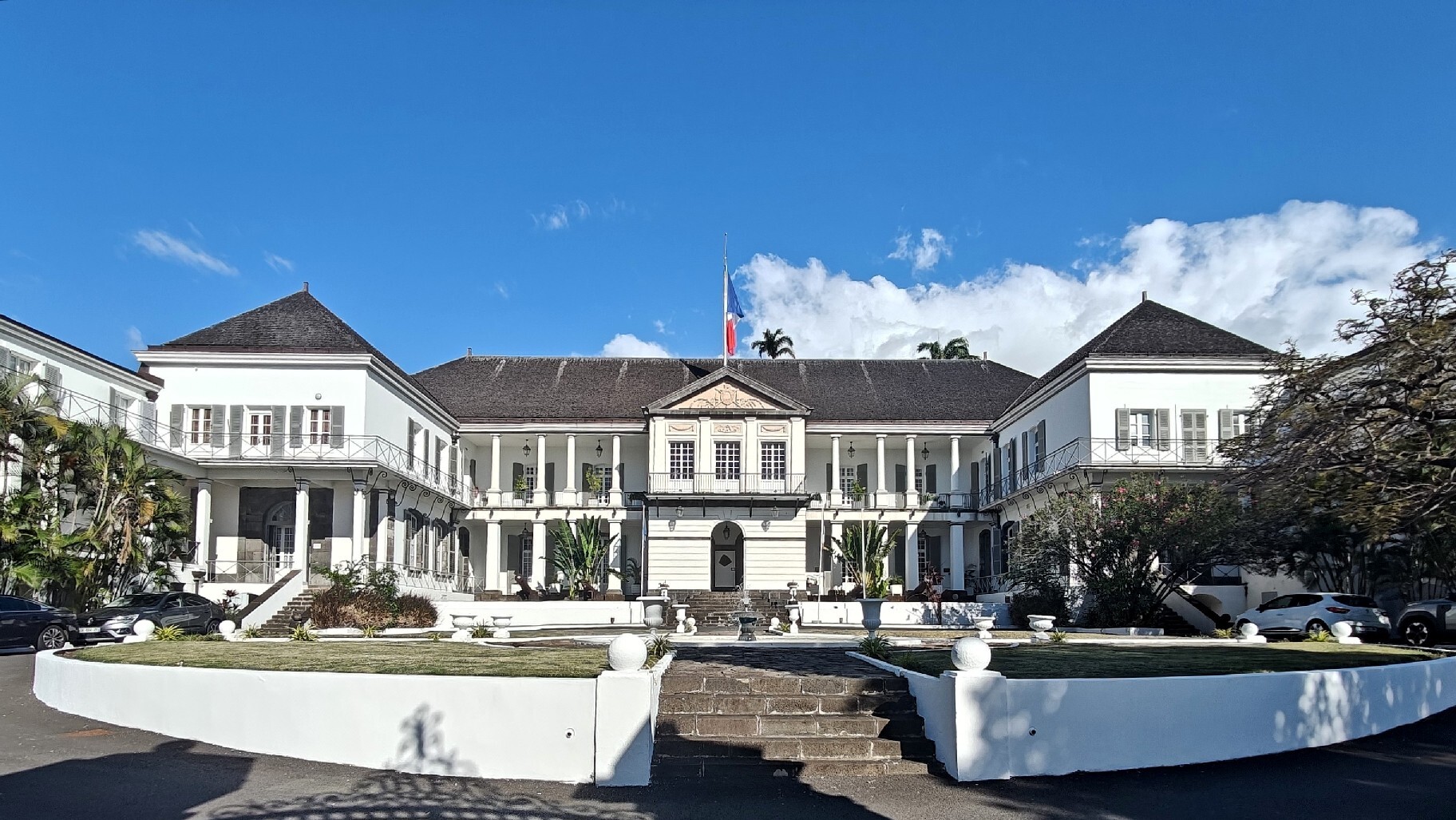
The Prefecture – grandest building in the country – used to be a coffee warehouse in 1734
statue of Roland Garros – first man to fly across the Mediterranean Sea.

It’s winter here and many business were closed and to top it off, it’s Monday so that affected restaurants and museums.
We saw Creole architecture: (alot of curly qued edgings)
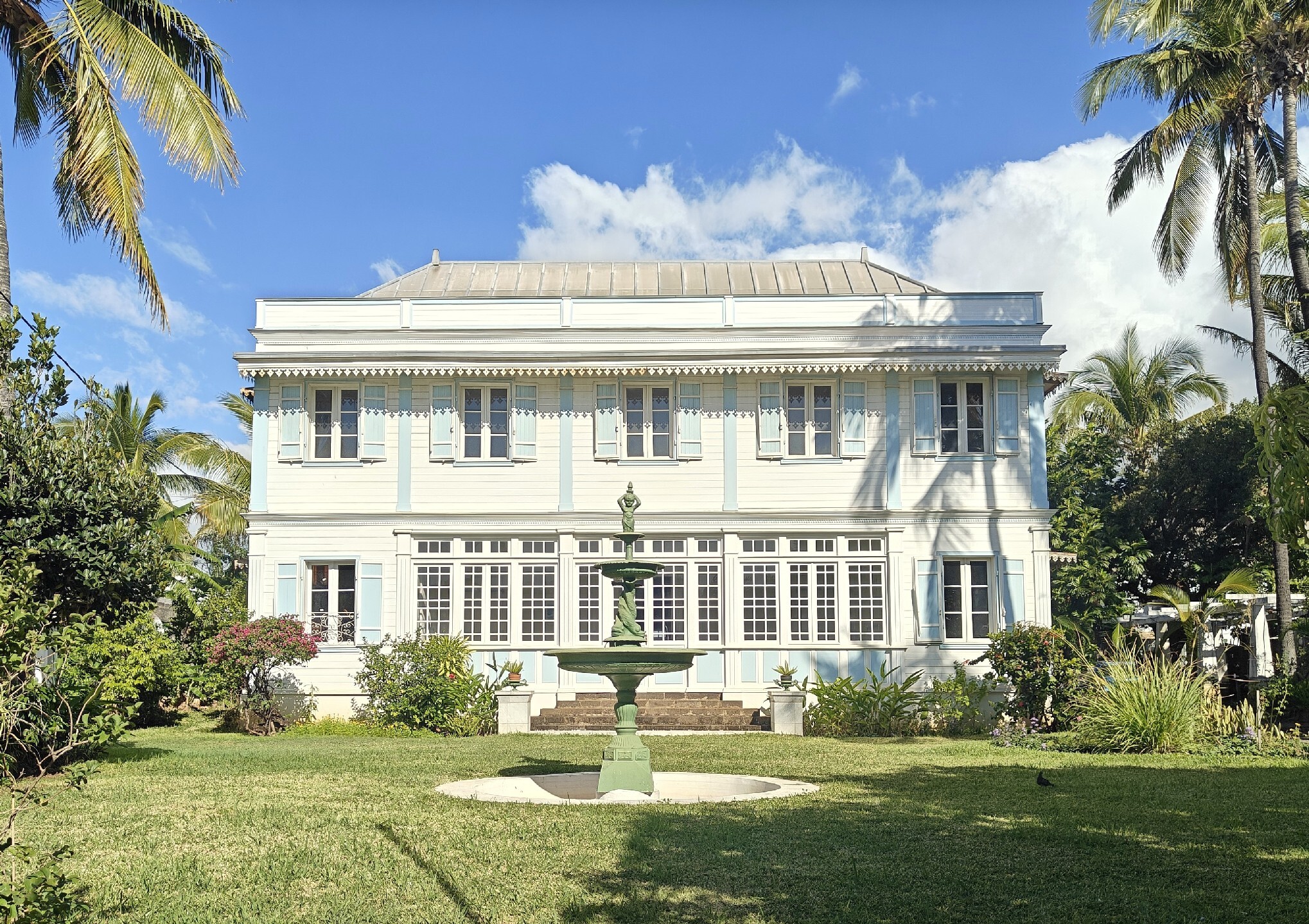

Creole is a mother tongue formed from the contact of a European language (especially English, French Spanish or Portuguese) with a local language (especially African languages spoken by slaves in the west Indies. In Réunion, it’s a blend of French, African, Indian and Malagasy.
We also strolled some of the corniche in the beautiful sunshine (the beach is rocky). This side of the island is not really known for its beaches, but rather it’s lushness. The island is known for shark attacks and swimming is only in certain protected areas – sometimes a shark net, sometimes a large enclosed tidal pool.
Réunion is situated in a so-called “shark highway” between Australia and South Africa, two countries with shark dominated waters. Many large sharks who use this shark highway find Réunion home due to its diverse aquatic ecosystem and coral reefs, offering sharks a thriving home. A study released in 2015 showed Réunion had recorded a remarkable 3.15 shark-related deaths per one million people, by far the highest in the world. The next highest rating was that of South Africa, with 0.76 per one million residents, while the USA had a rate of 0.0013 per million.
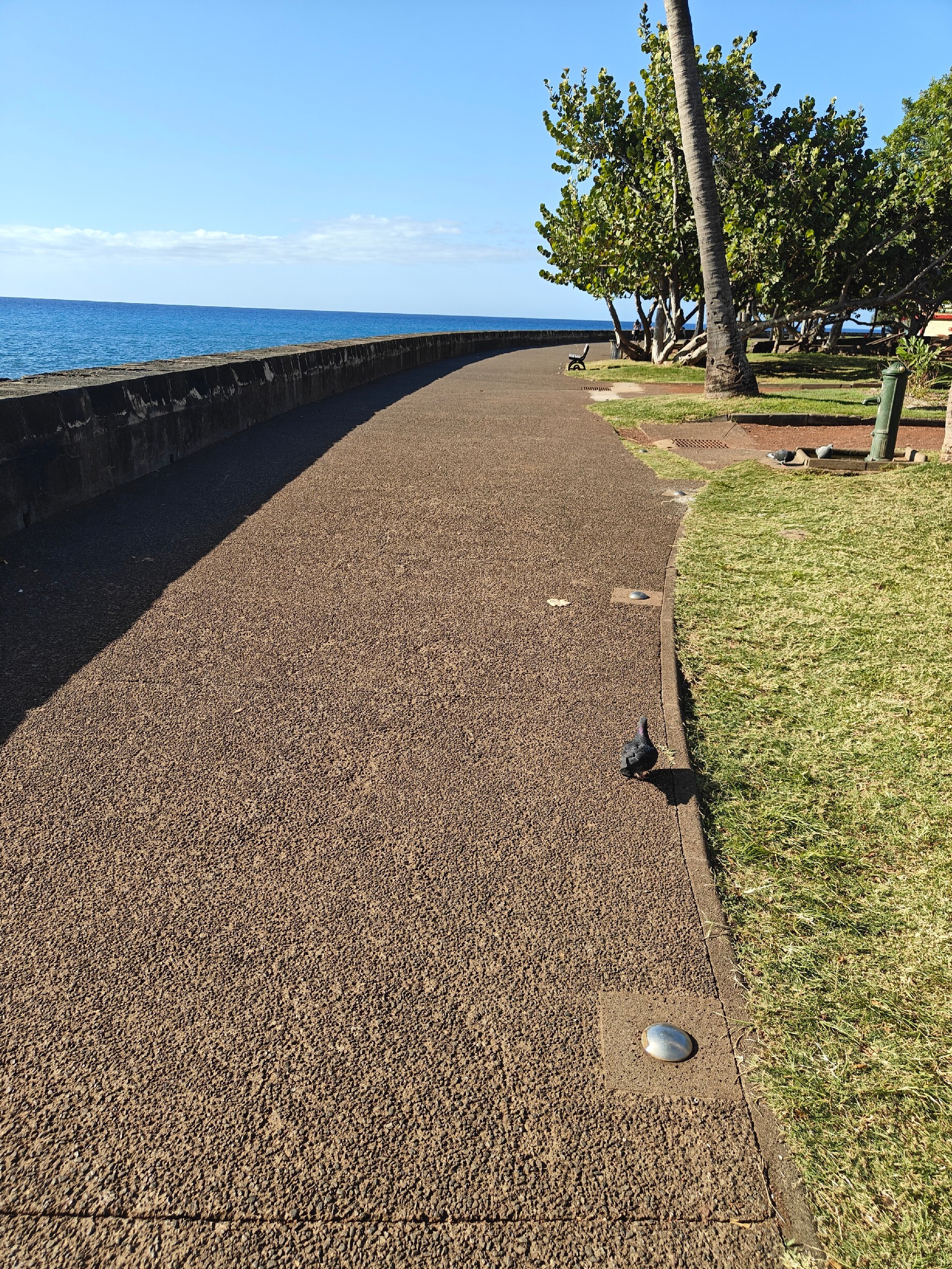
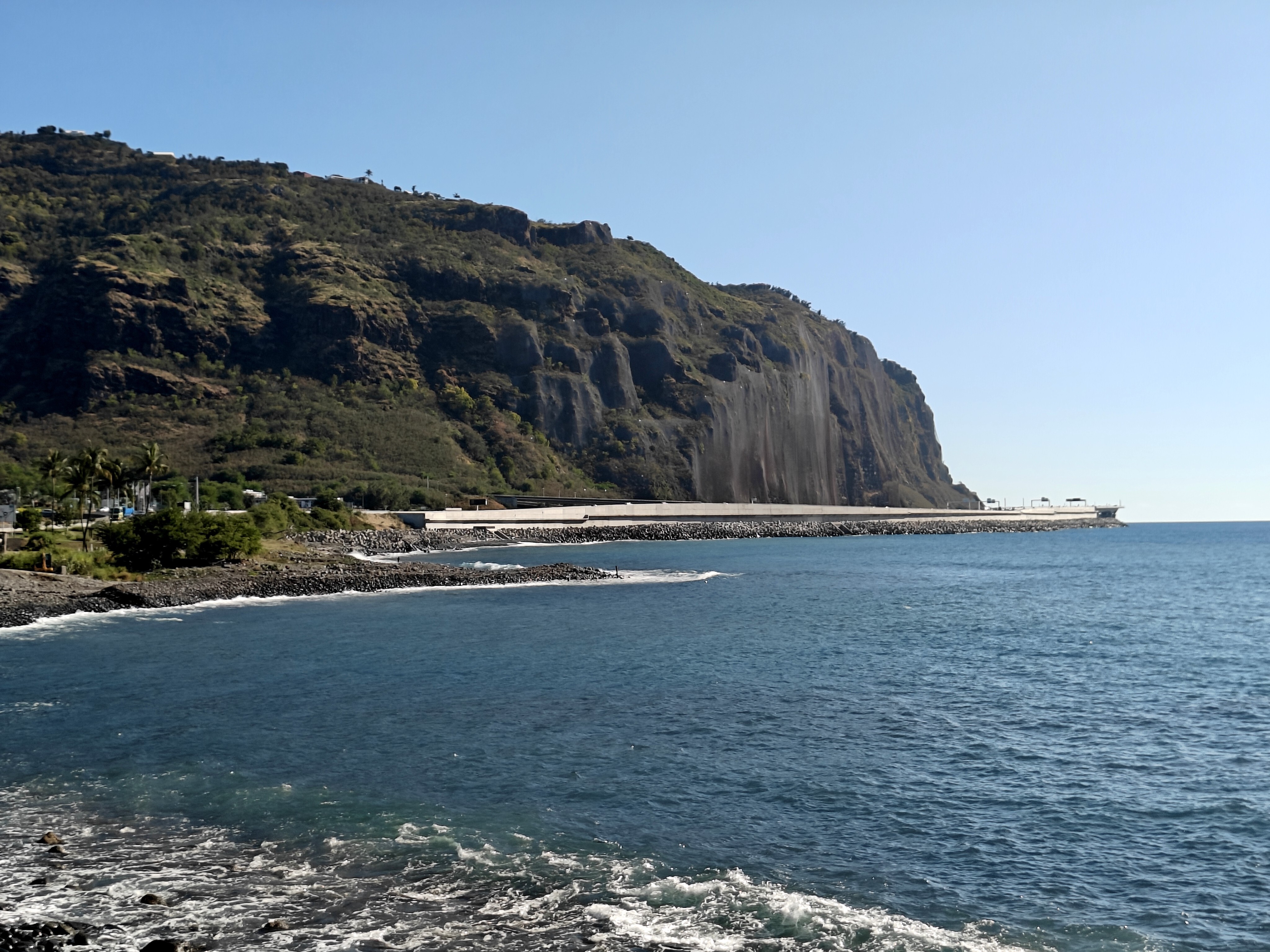
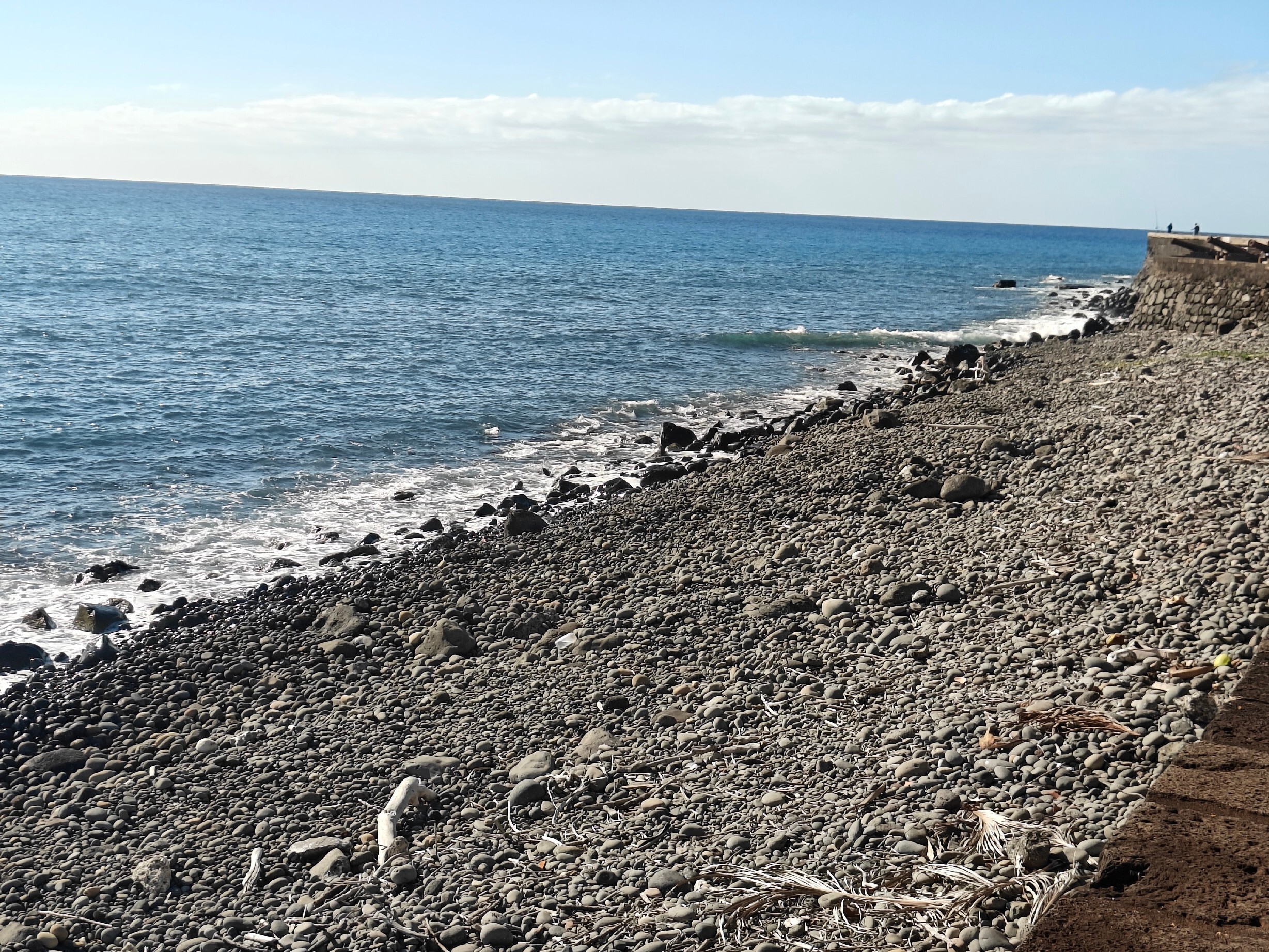
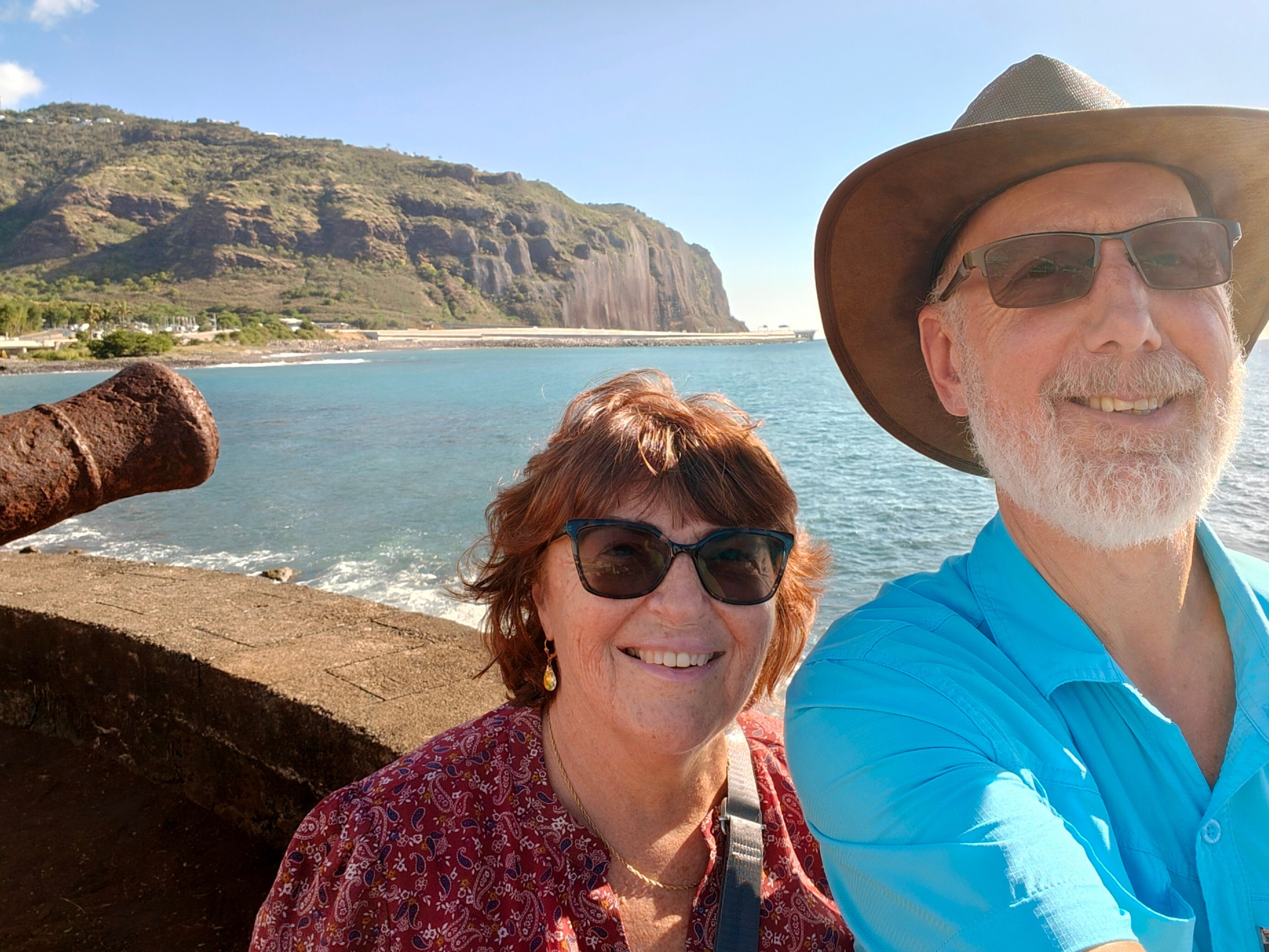
By four o’clock, we were back at the room to chill before going out for dinner.
Here at La Platinium Barchois we have a tiny apartment downtown, two blocks from the corniche, with private parking. The place has a kitchen, sitting area, dining area, queen bedroom and a large bathroom as well as a little terrace outside. There is WiFi and a television – too bad the world cup games are at such awful times this side of the world!
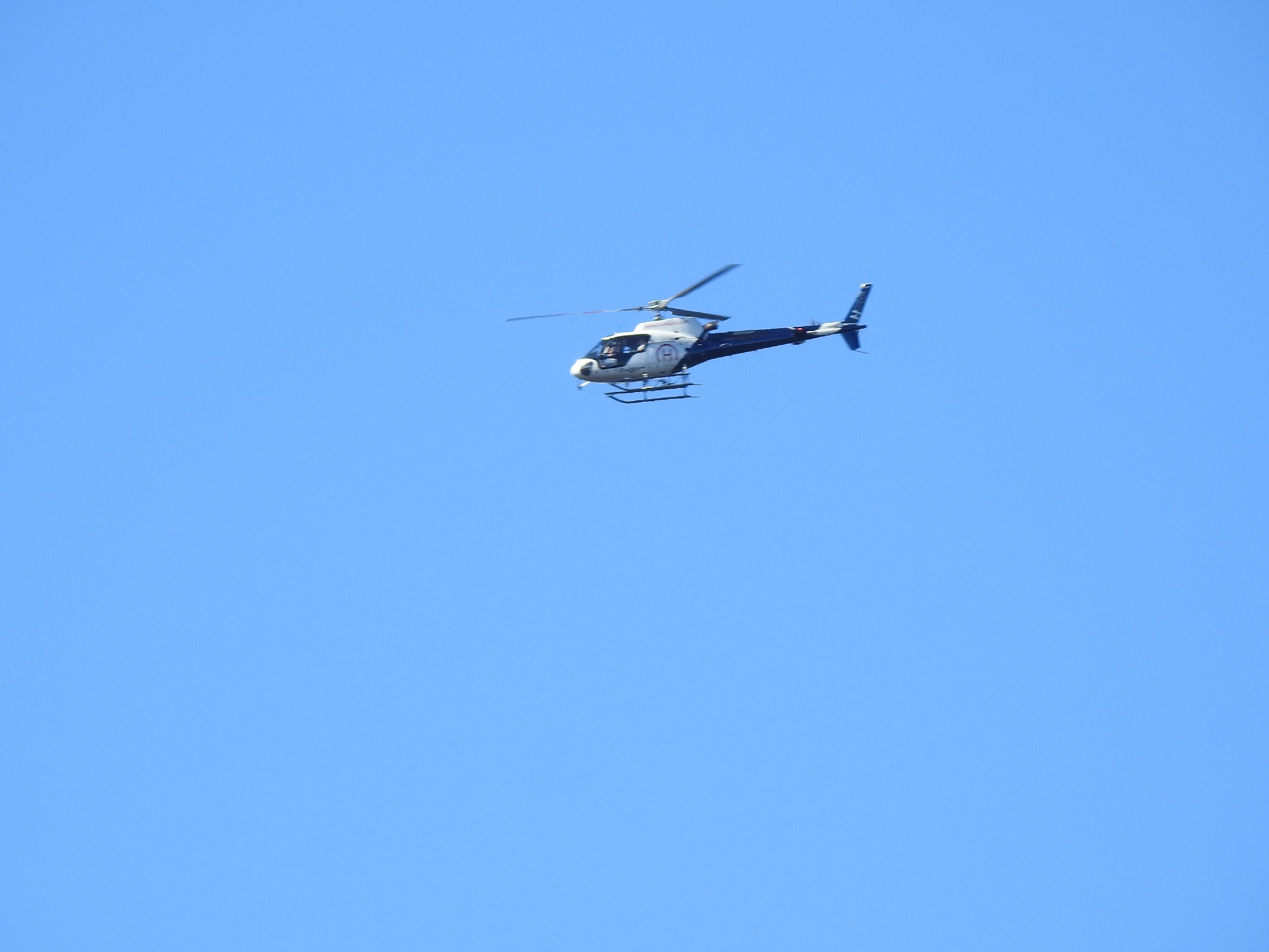
We had a quiet night with decent sleep. Next day, Tuesday the 7th, was Fran’s birthday and we had planned a helicopter ride around the island’s centre to see the mountains, waterfalls, volcanos and plains. We were glad we booked the first date possible as upon arriving at the heliport we learned today’s ride was canceled – they had tried to call 4 minutes before, but Doug’s phone sound was off. We have two or three more opportunities timing wise in other cities, so we rebooked for July 10th in Saint-Pierre. Too bad.
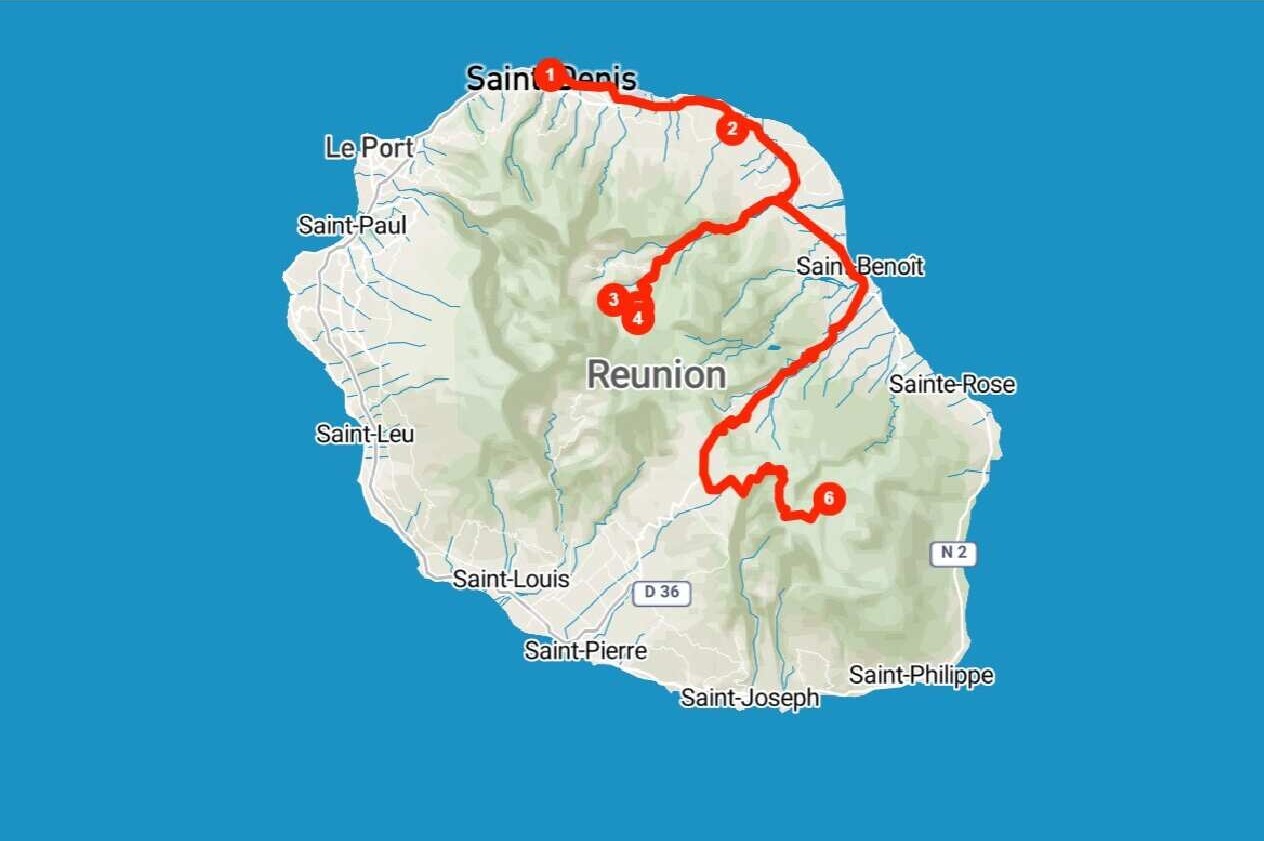
We are going to drive clockwise around the country returning to Saint-Denis so we began our drive with our next overnight to the village of Hell-Bourg. Enroute we couldn’t resist checking out “the Niagara waterfalls”. We had to on a road through sugar cane fields and a one point we took a wrong turn.
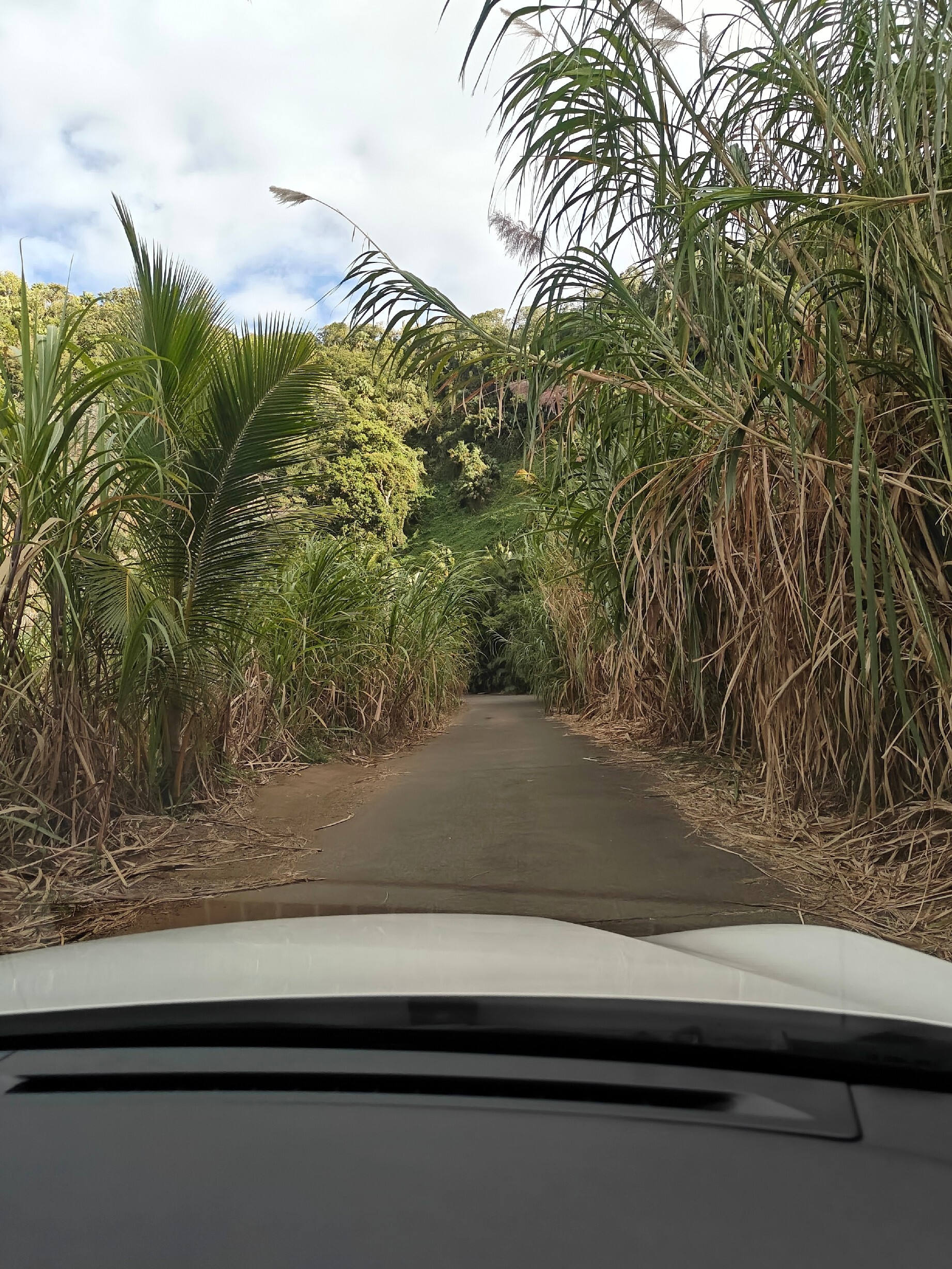

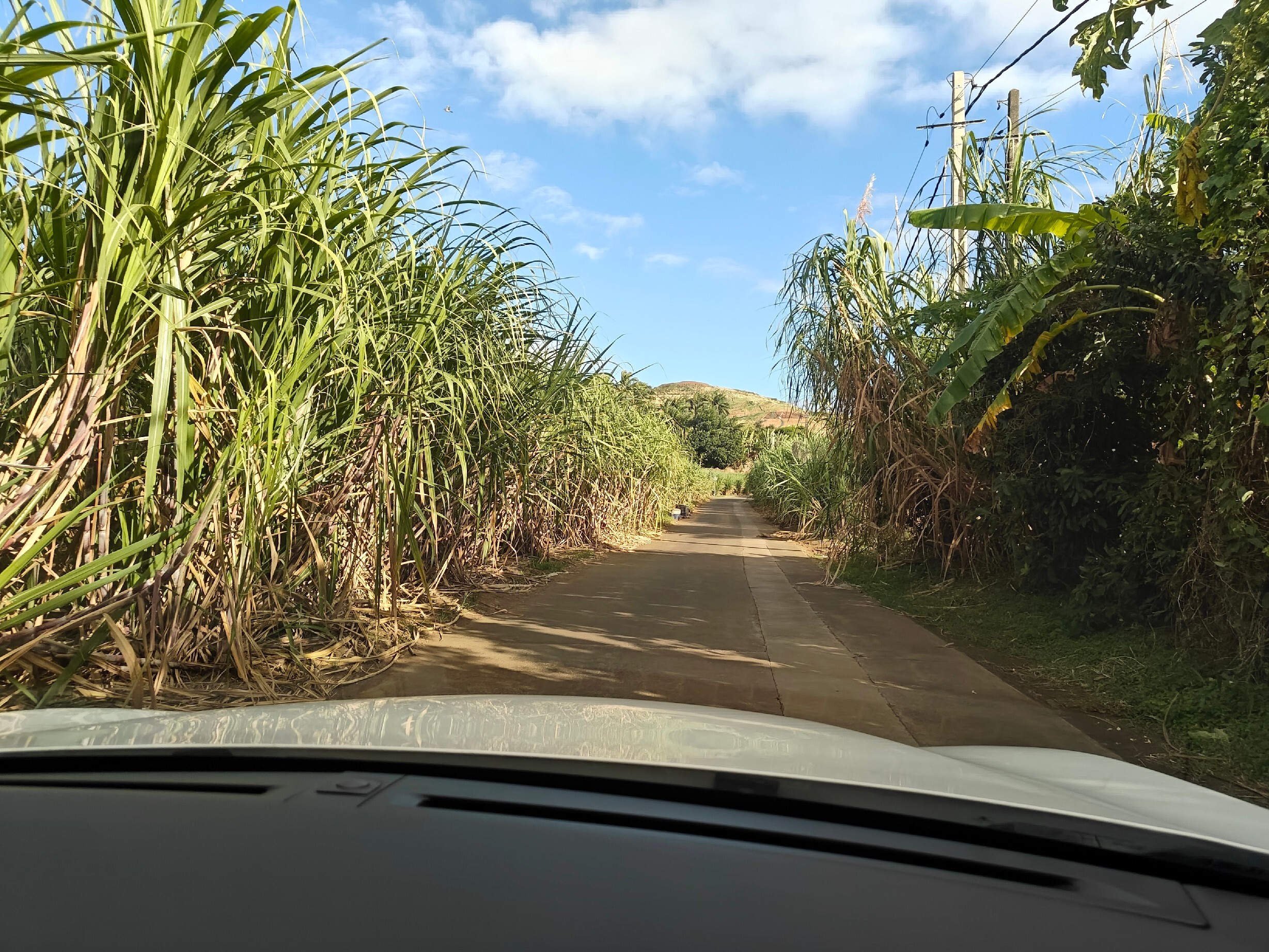
We had a very good laugh!
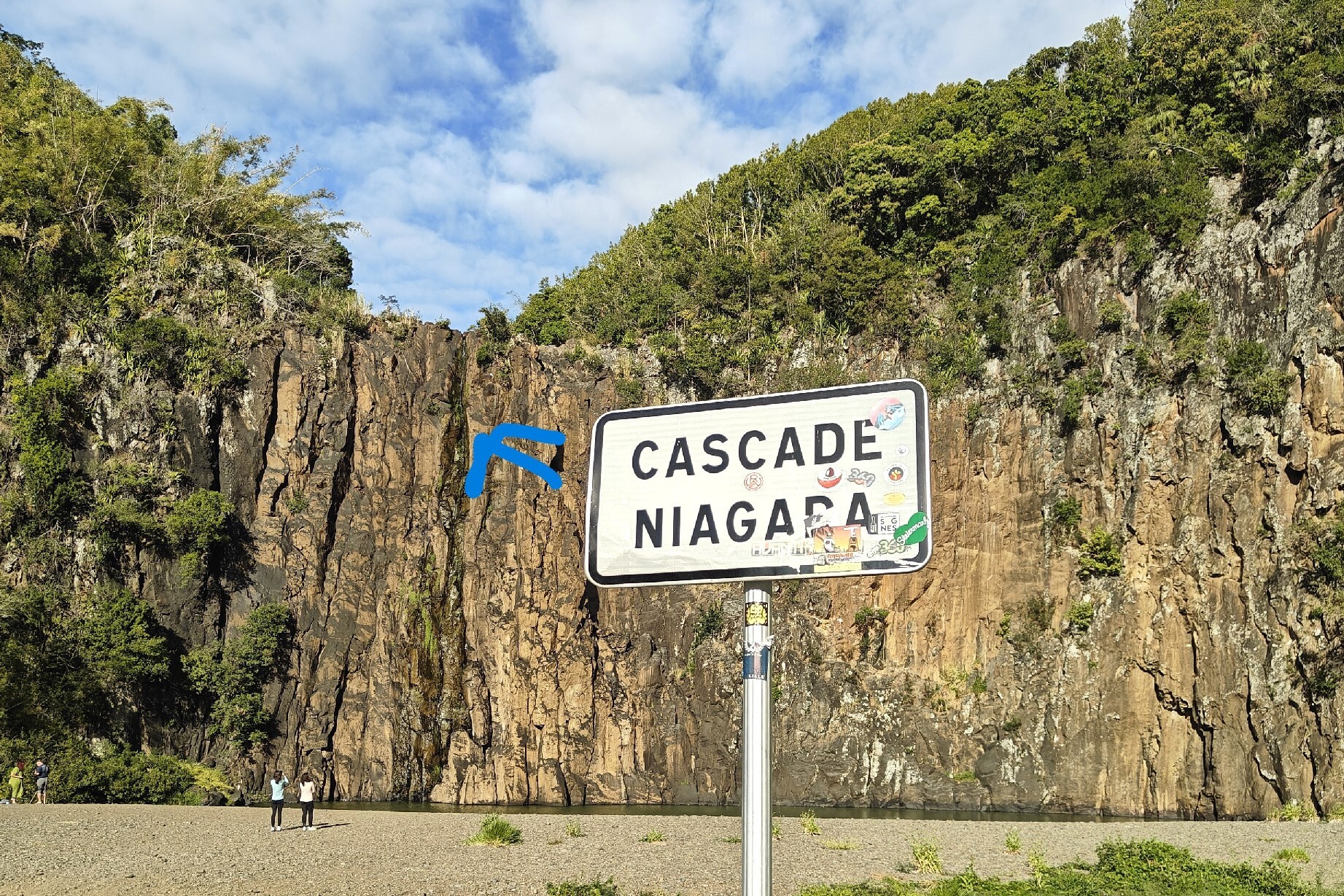

This so much reminded us of a 22 km / 14 mi hike we took in South Africa in 1986 with our friends, Pat & Therese, to Tugela Falls! The amount of water dropping 25 m / 82’ into a pool was like a man standing atop the cliff pissing!
Doug picked up a baguette and some fruit for our lunch later.
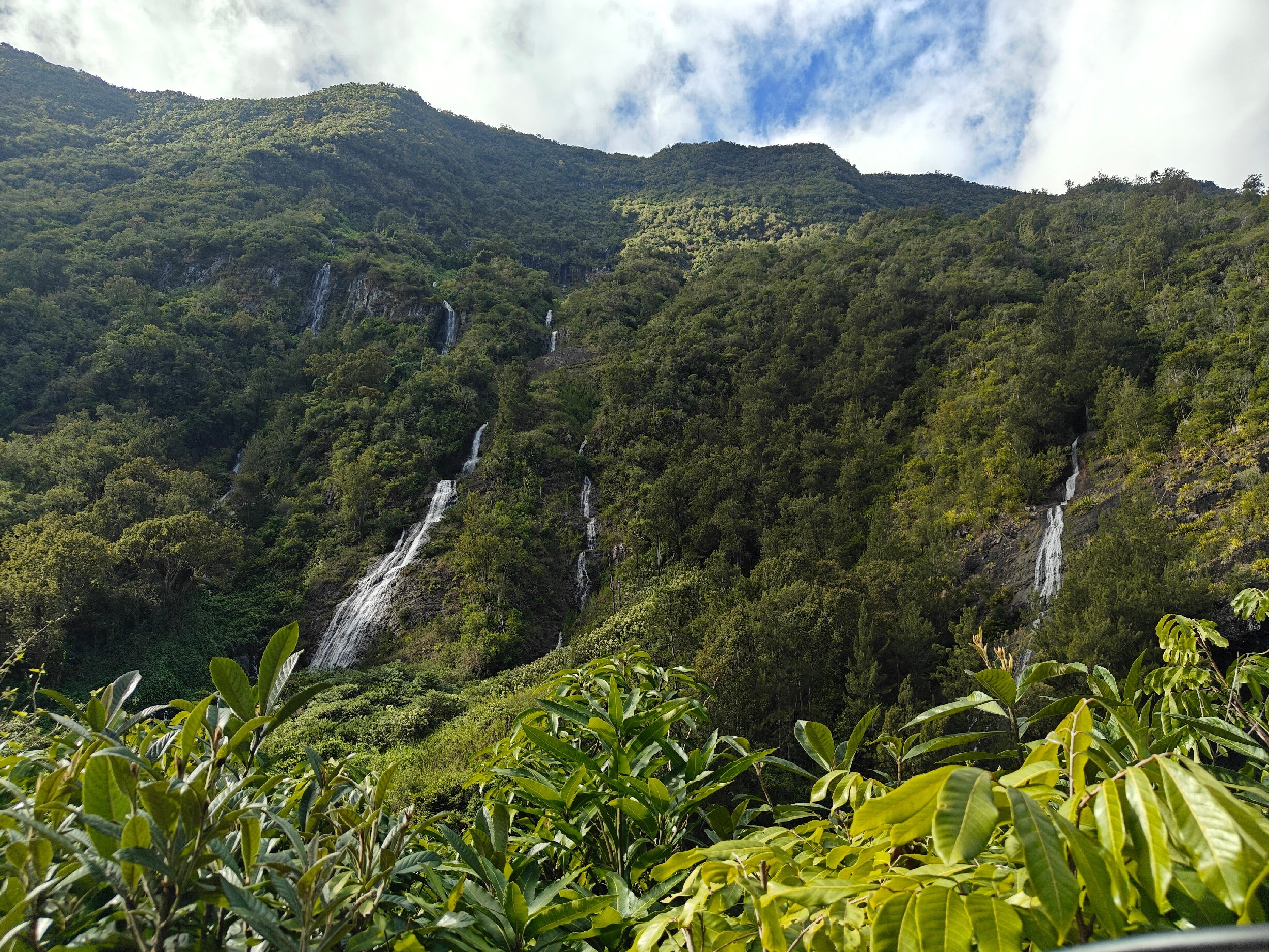
The drive after that stop was spectacular with mountains, waterfalls (many are dry) and just so lush.


We stopped at Bride’s Veil Falls which were better but it being winter and the dryer season, there was not an abundance of water at it either. At this point we were entering the Cirque of Salazie.
What is a cirque you ask?
Cirques are bowl-shaped, amphitheater-like depressions that glaciers carve into mountains and valley sidewalls at high elevations. Often, the glaciers flow up and over the lip of the cirque as gravity drives them down slope. In the case of this island, there were no glaciers but collapsing craters creating the cirques.
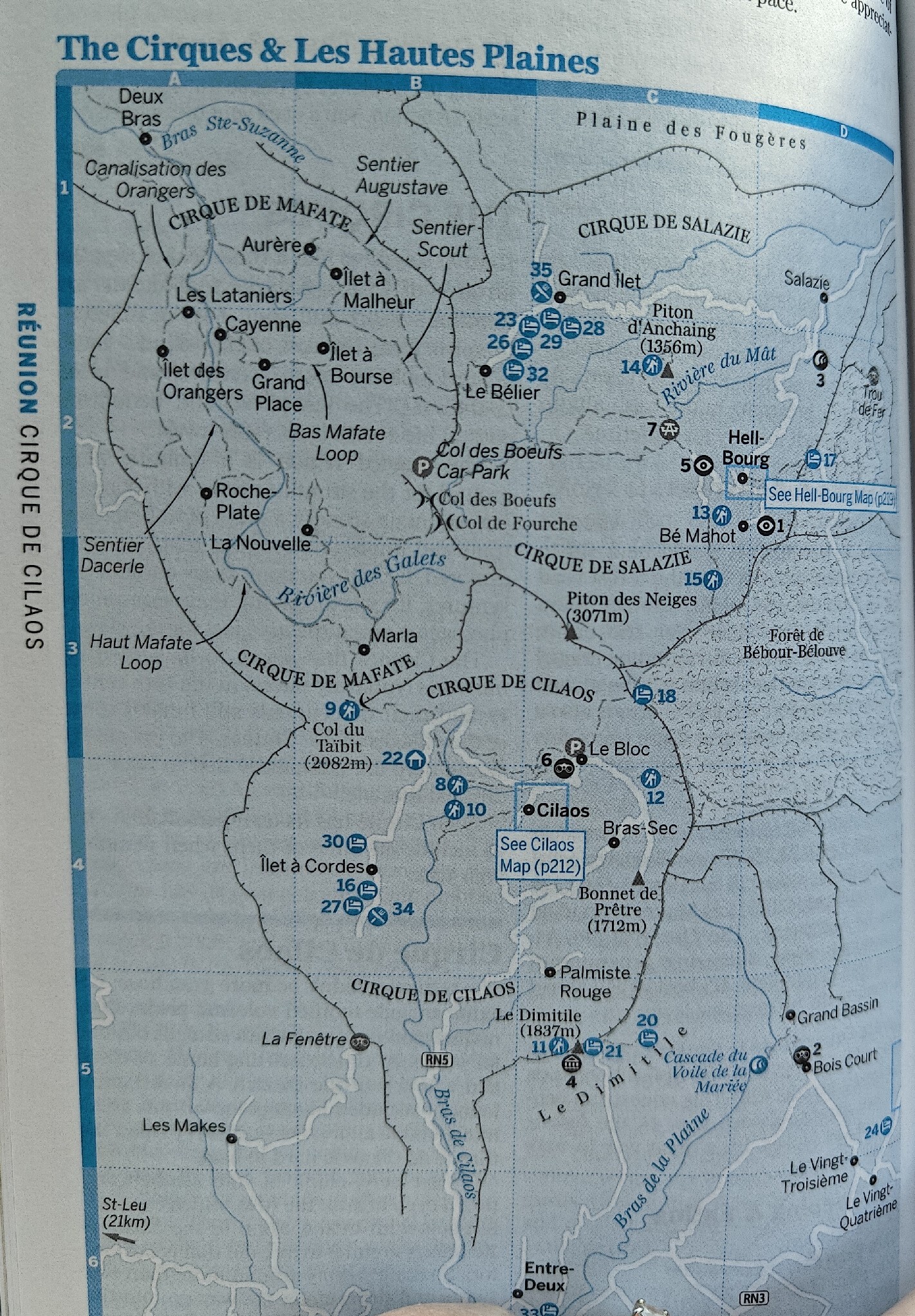
There are three cirques in Réunion and we hope to visit all three and really hope we get to fly over them later this week. Here is a map of them.
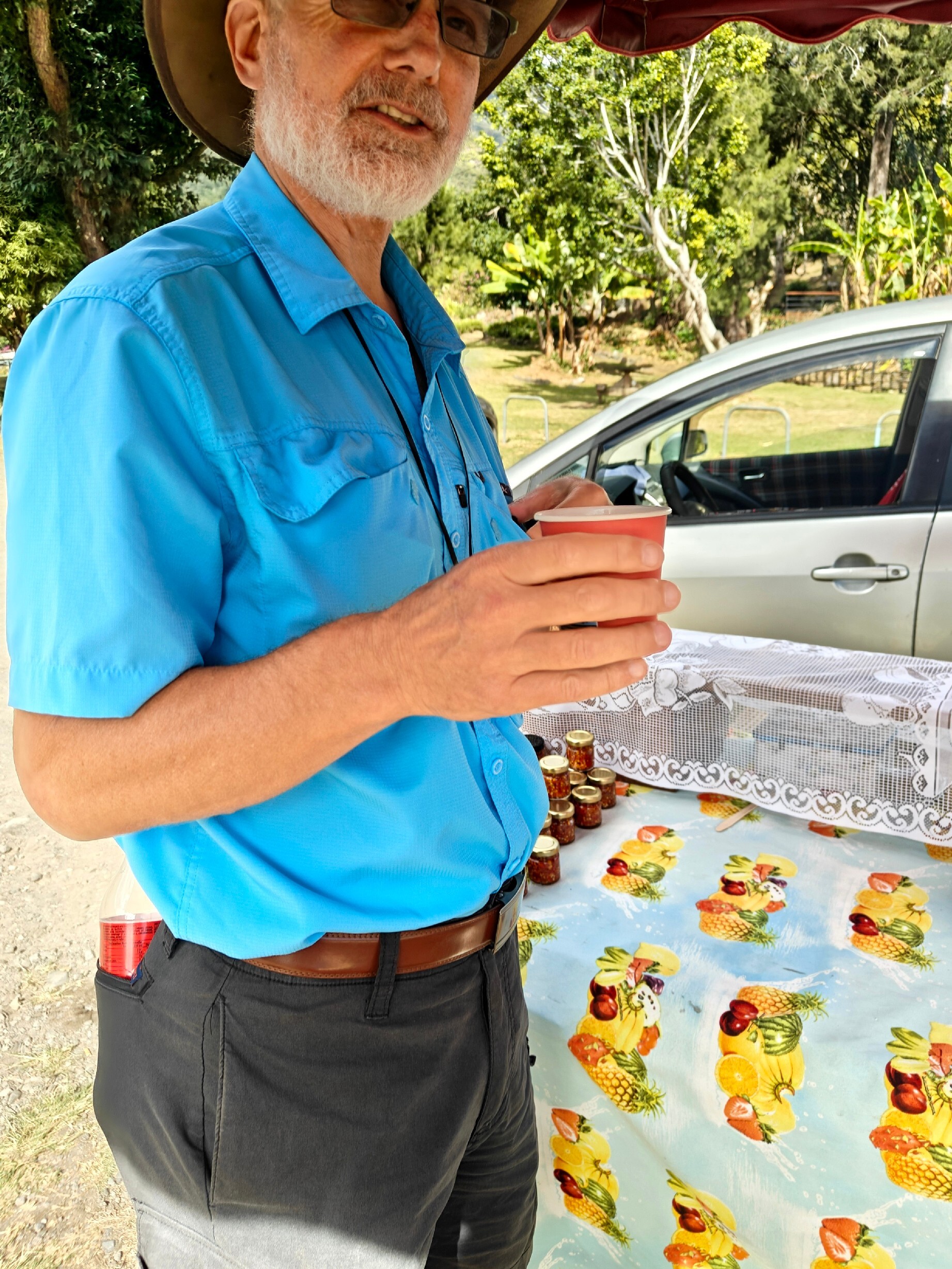
We made a stop at a lovely viewpoint where there were two stands: one for honey and one for can sugar juice. We bought a small jar of honey to put on our baguette for lunch and sampled the yummy cane juice.


After this point in the drive, the clouds began to take over the sky. Before reaching Hell-Bourg we drove a bit past to check out Ilet de Vidot for the views which were not great till we got to a trailhead where we had a picnic lunch to which we had added some pastries in town. Here we had a view of Piton d’Anchaing that we took before leaving as it clouded over.

The city of Hell-Bourg was named after an Admiral Hell and the town was born because thermal hot springs had been found here. Unfortunately, access to them was blocked due by a landslide in 1948. The town is a tourist destination and very small. There are good examples of the creole architecture here. Next on the recommondation of our guide book, we drove just a little further south of town to the tiny village of Be Maho – it is/was a Creole town with some old homes, some even shanties. (some of the pics did not turn out)
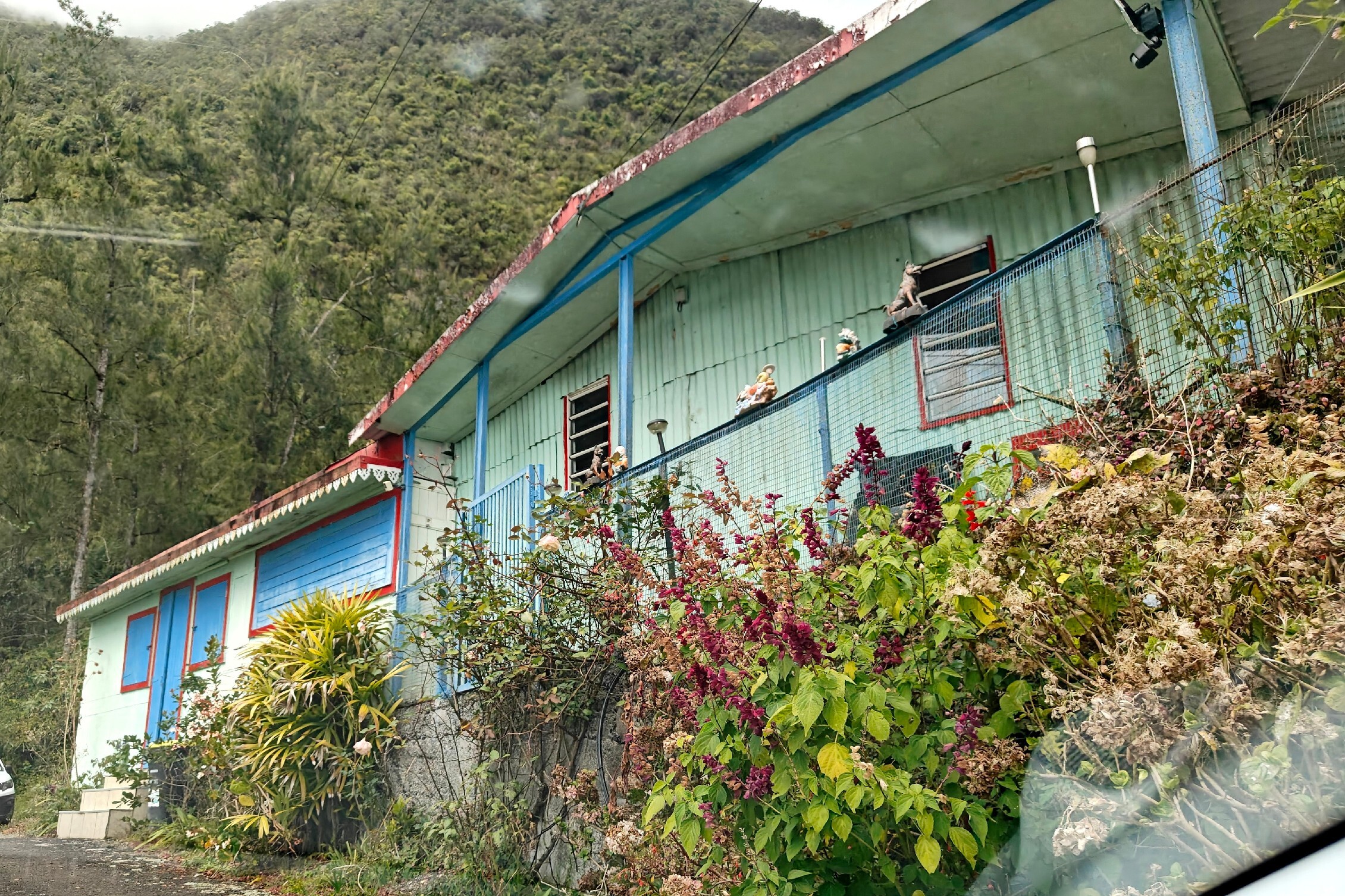
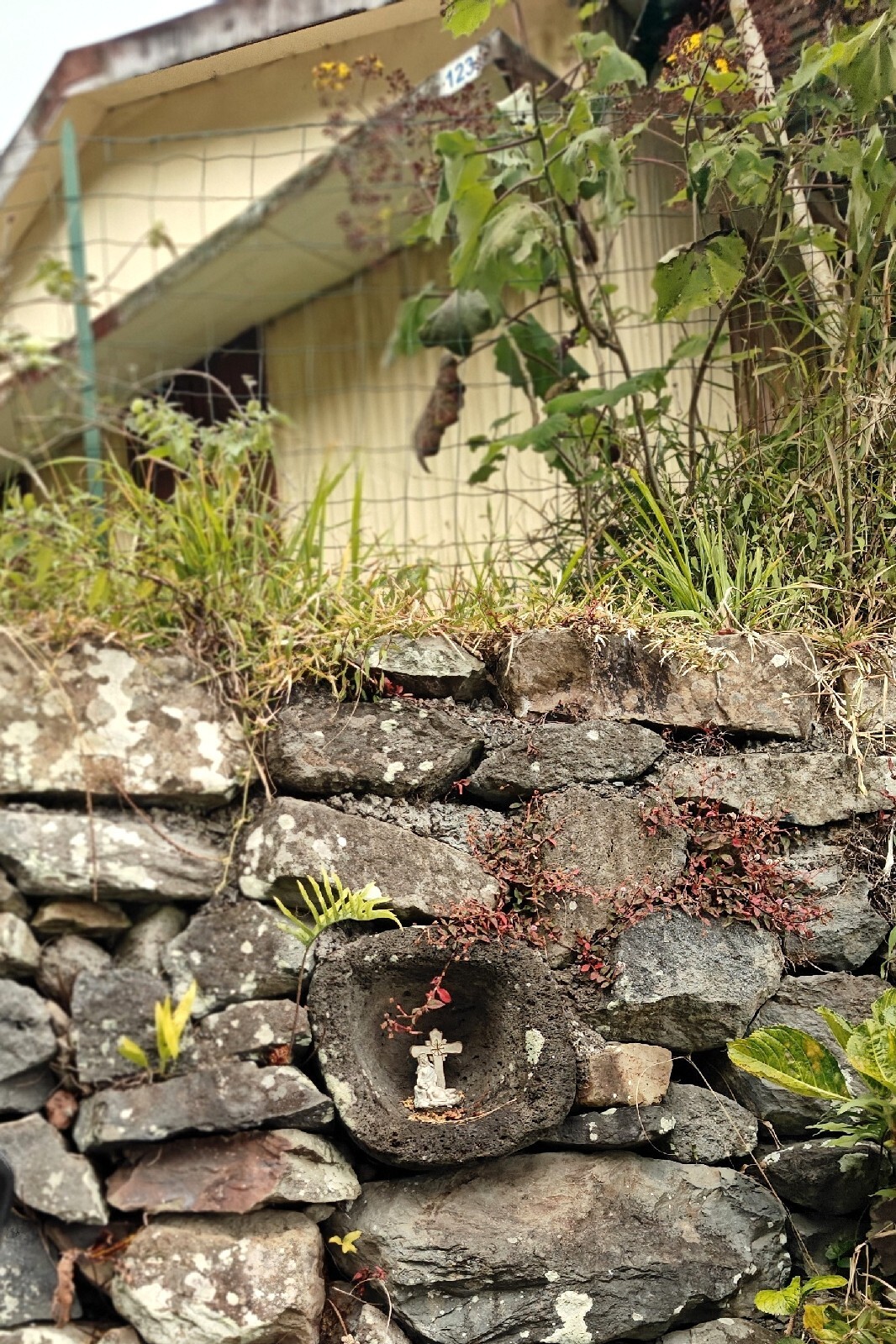
There was a lovely spot where we got a decent shot of the tops of the mountains as much of the time, they were clouded over:
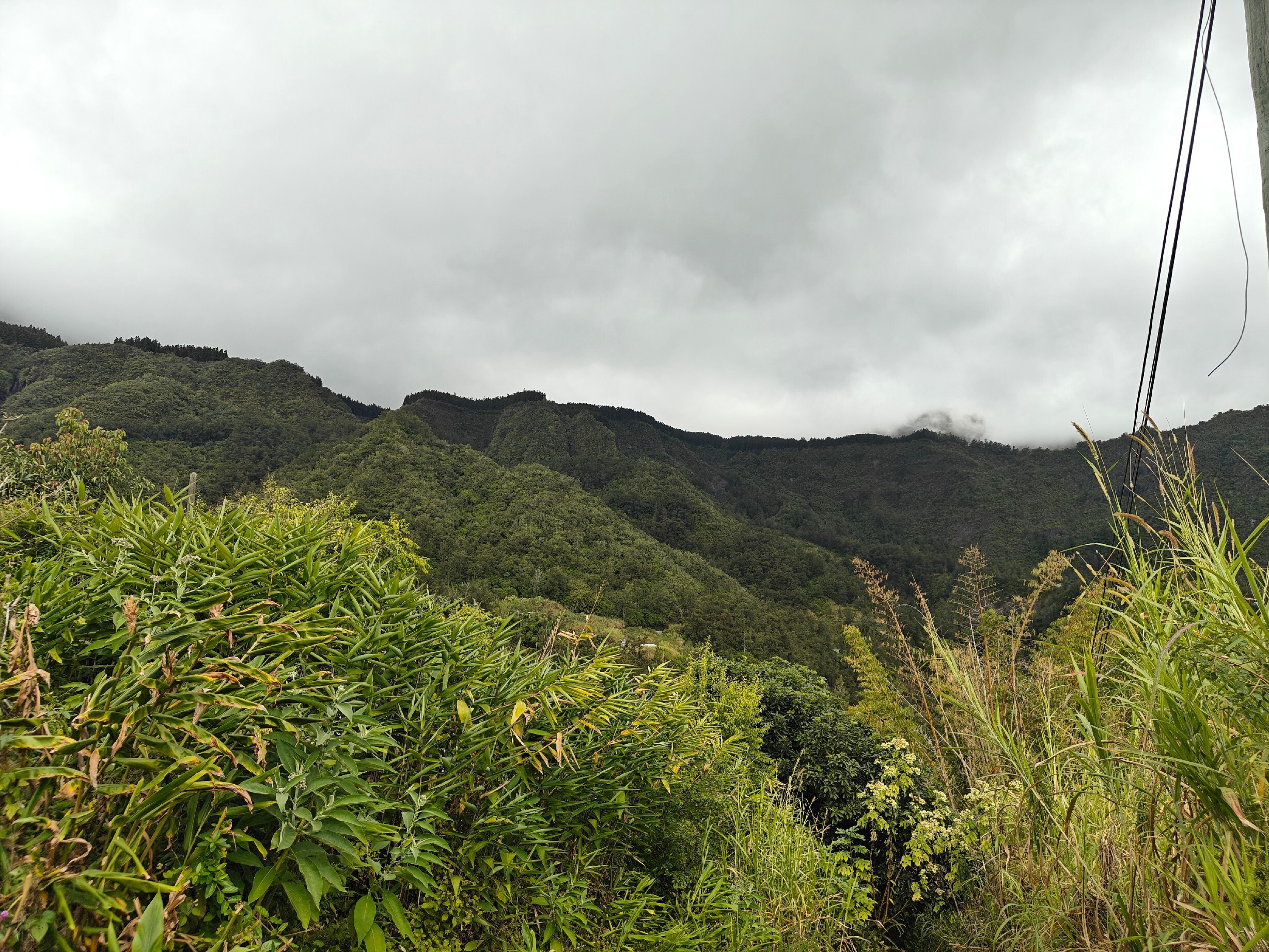
We tried to get into our lodgings early, but we received no response to our request via the Booking.com app but upon arriving at the hotel, discovered reception does not open until 3 so we guess that’s why we did not hear back.
We parked the car in a lot behind the hotel and went for a walk hoping to see a few sites. The first, Maison Maronge (a creole mansion that houses the Museum of Musical instruments of the Indian Ocean region) was closed for renovations. Across the street, another house of creole architecture was closed for several hours. We took a stroll down the main drag, checked out a few souvenir shops, bought some jam and a couple of cold Bourbon beers and sate for a bit.
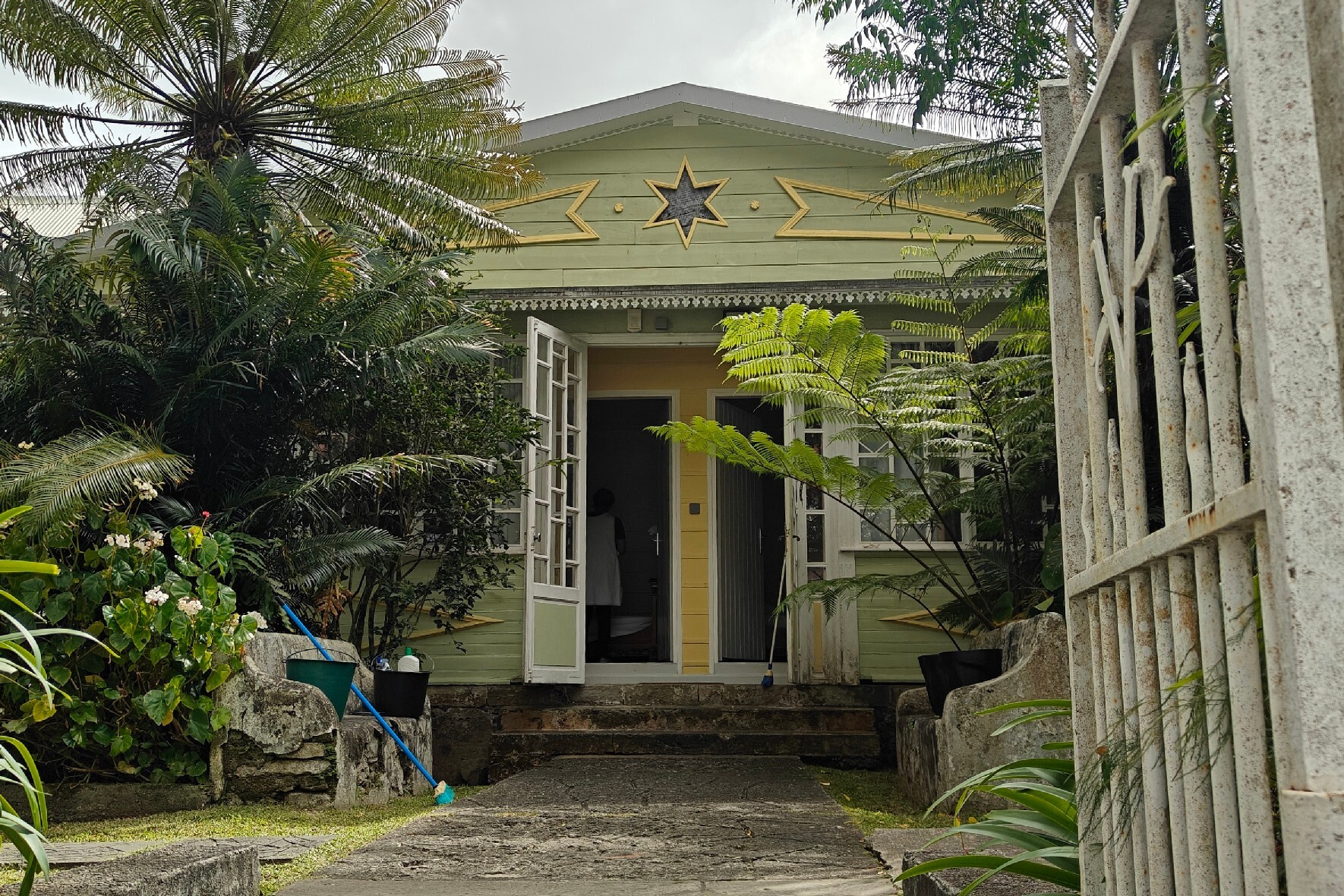
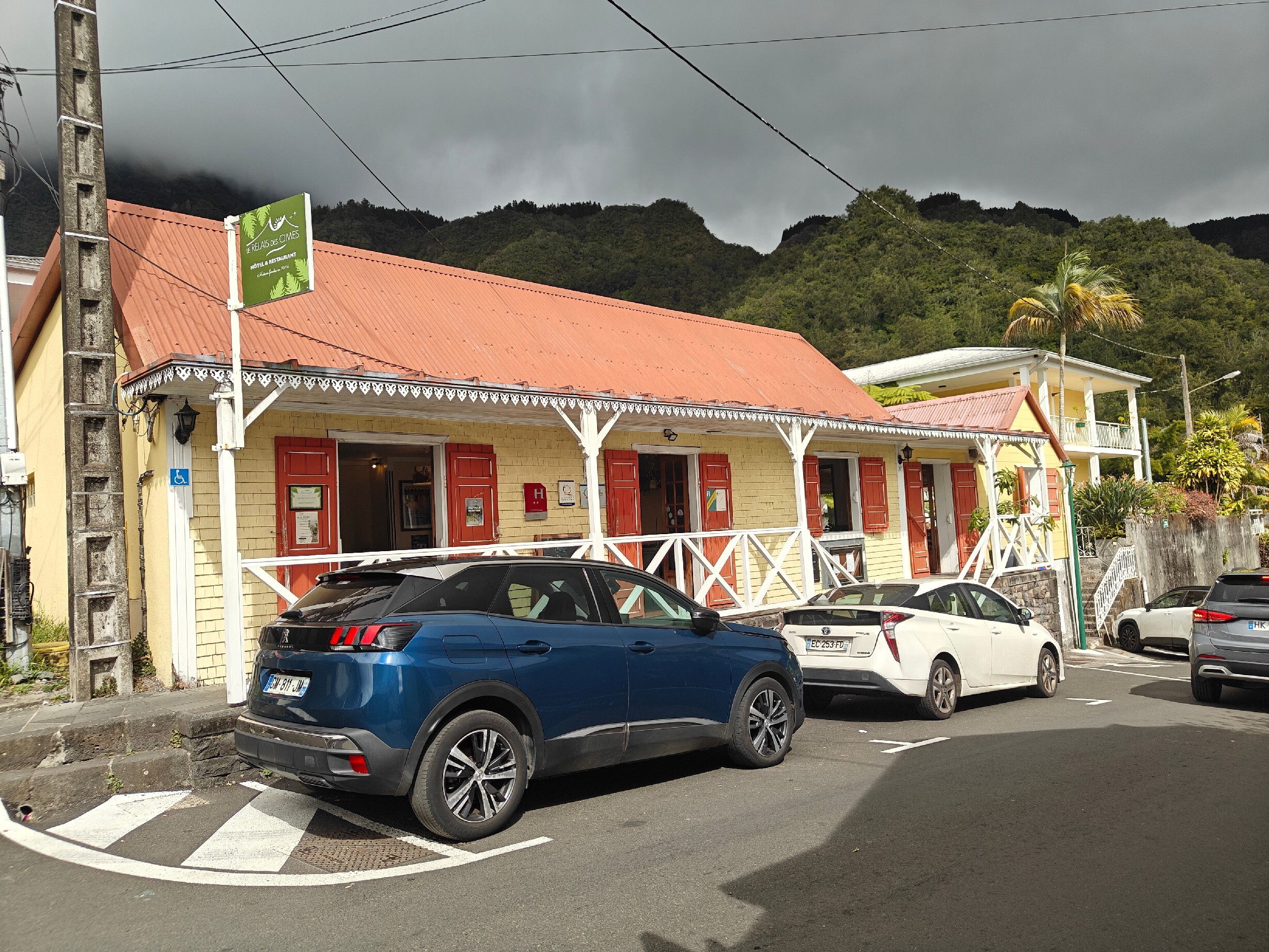

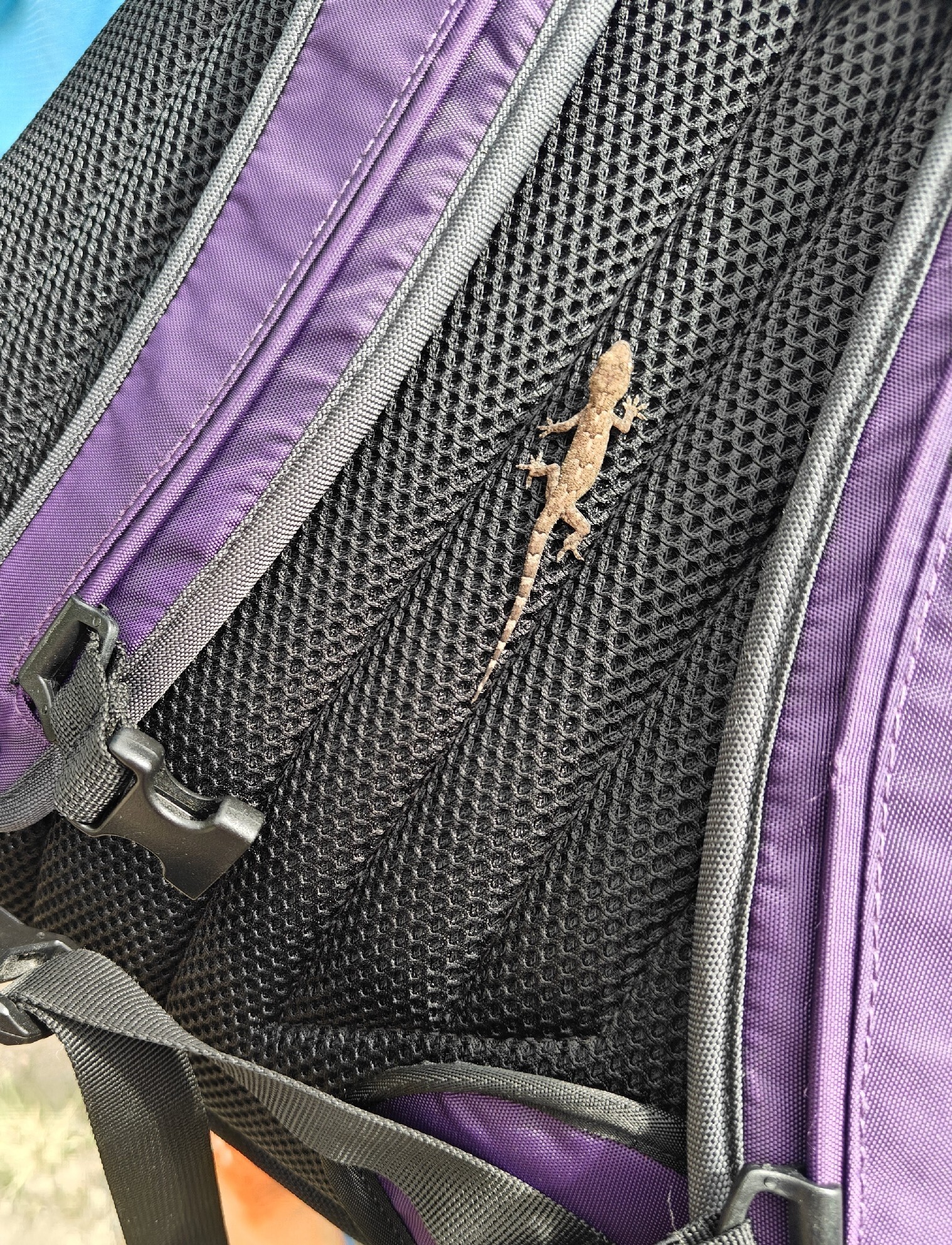
We returned to the hotel, still not open around 2. There was free wifi so Doug brought our bags over and we sat on the terrace at the tables set out there, getting online. When we pulled Fran’s backpack out of the back of the car, there was a small gecko on it!
The weather up here at 949 m / 3113’ is much cooler and as the afternoon progressed, the sky became quite overcast. The low for the evening was 10C / 50 F so no need for AC like we needed last night – Saint-Denis was 31C / 88F yesterday.
We got checked in at 3 and chilled for a few hours before heading out to dinner. At the Le Relais des Gouverneurs, we had a “comfort” room which consisted of a queen bed, sitting area, big bathroom, WiFi and a kettle. There was no television or fridge but there was a few extra blankets.
Being winter here, and fewer tourists, many places are closed. We found that in Saint Denis but a lot of that was because it was Monday. Finding a place to eat was challenging as many places even just said “closed this evening”. But we found a nice place at another large hotel and as it only just past six we could order drinks but dinner service didn’t start till 6:30 or 6:45 – ah the French. Luckily we had a waitress who spoke perfect English and she got us our drinks before we ordered about 40 minutes later.
We enjoyed King Prawn for main course with double scoops of homemade ice cream for dessert (they had NO cake!) but Doug managed to get them to put a candle in Fran’s ice cream.
We walked uphill back to our room and watched the ARG v EGT game online which was very exciting. We both had a second good night’s sleep – feel like we’re about adjusted now.
Doug went for a run Wednesday morning and we left Hell-Bourg before 10. Today we were returned to the coast and then further south headed inland once again heading to the National Park (40% of the country is dedicated to this park!).
Unfortunately, the weather gods were not completely on our side again today; it could have been worse as we did get some sunny periods but a few of the view points we skipped hoping the weather will be better tomorrow on the return trip to the east coast. We decided to stop at the National Park office, but again – it was closed for three weeks!
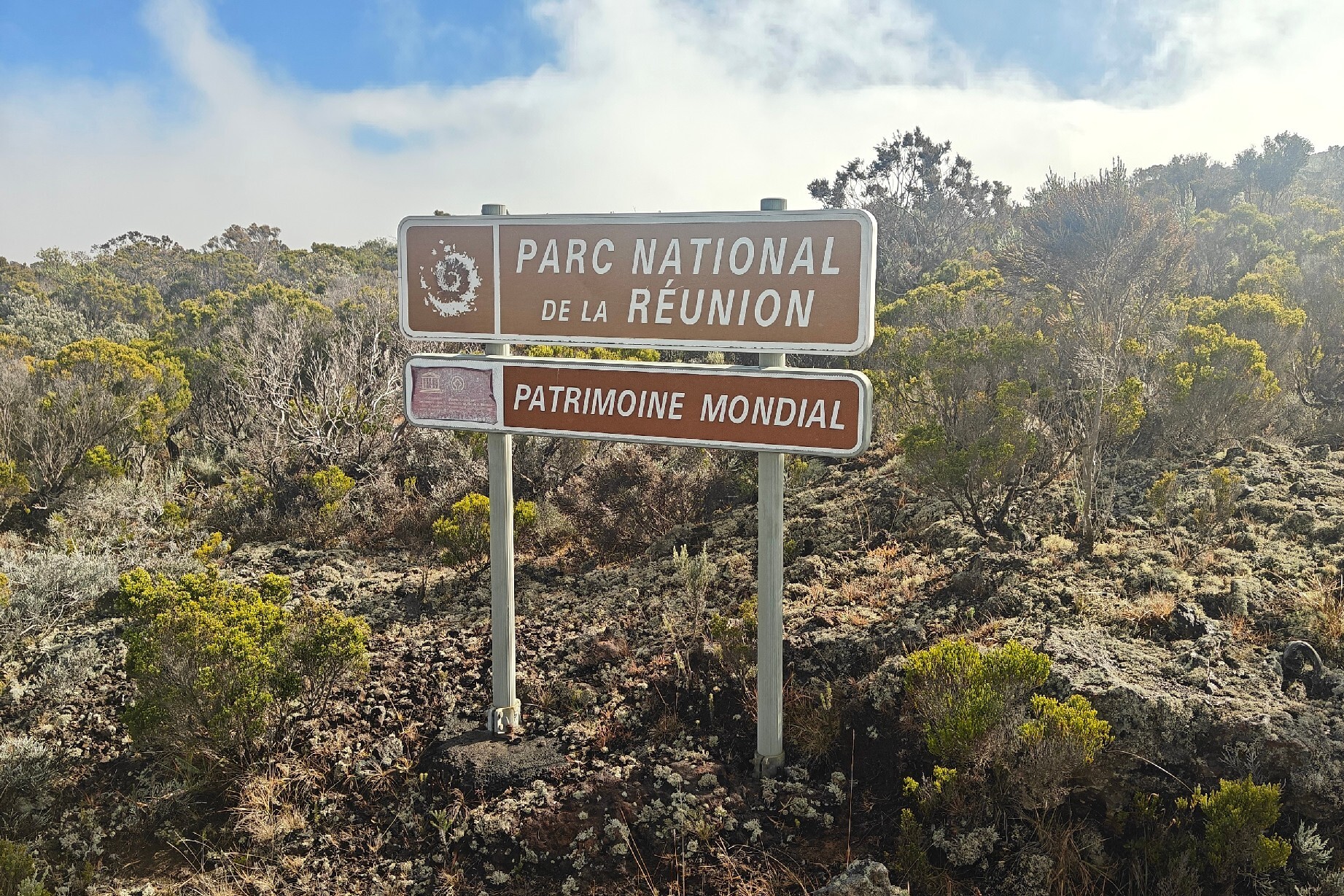
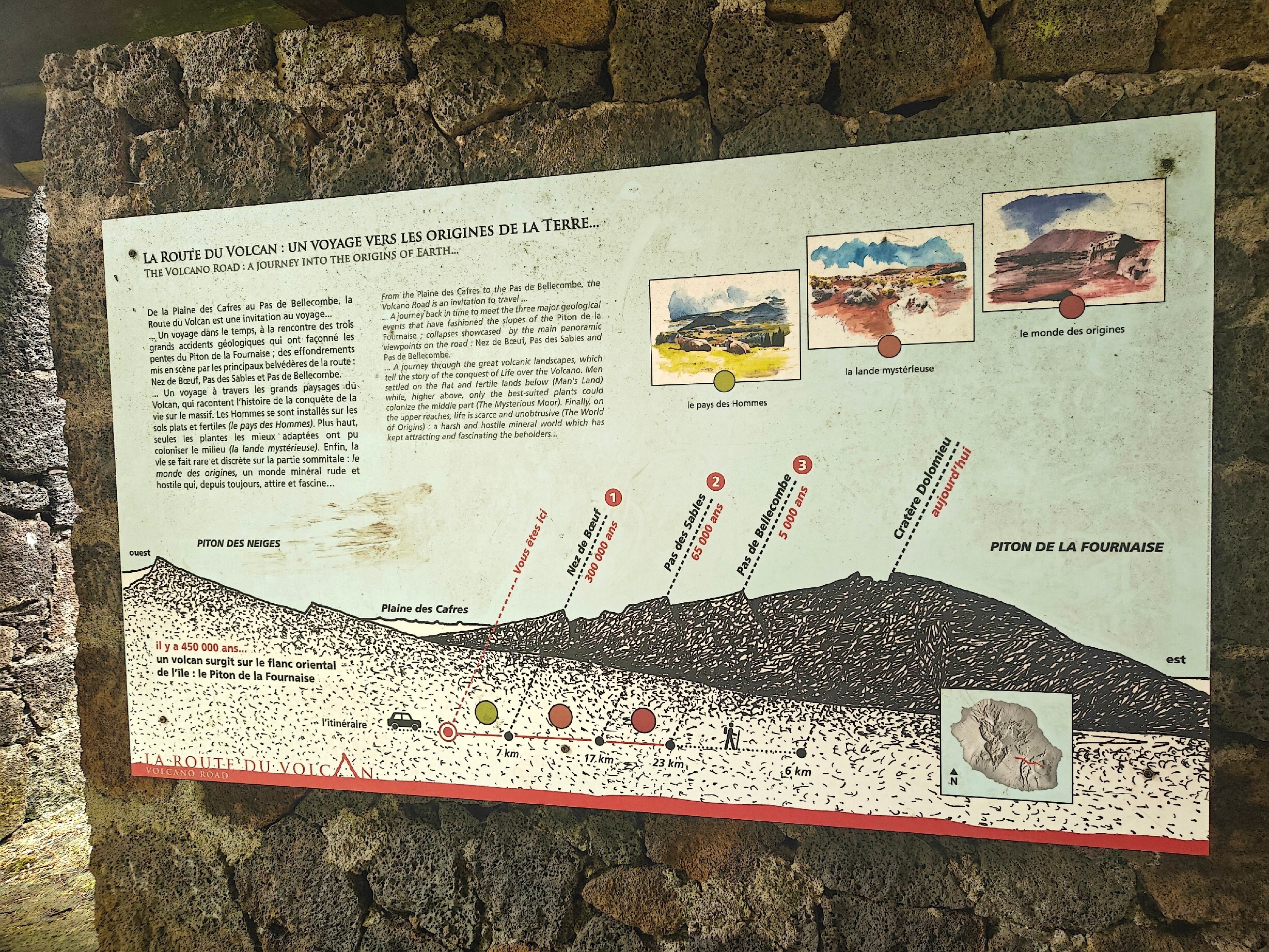
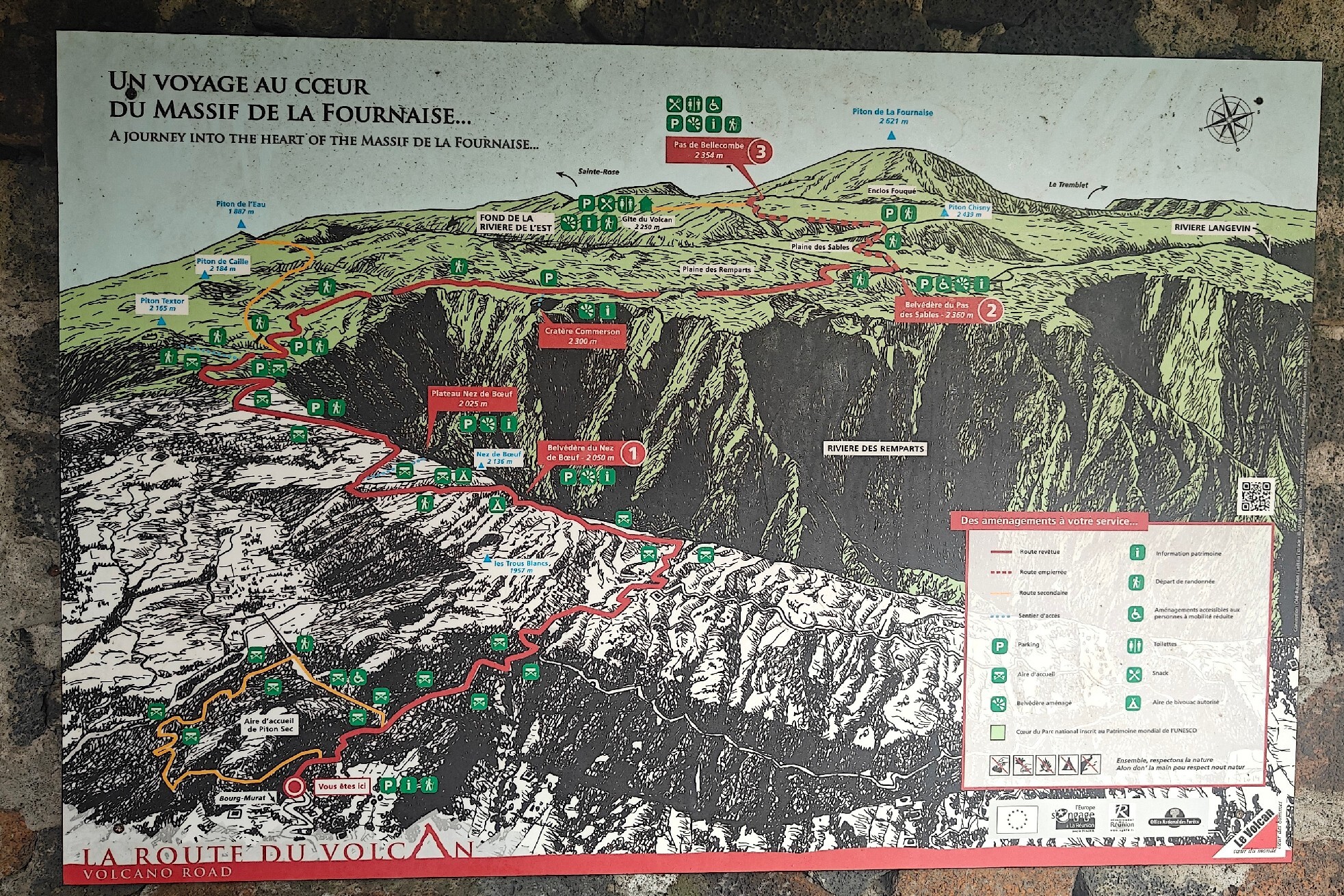
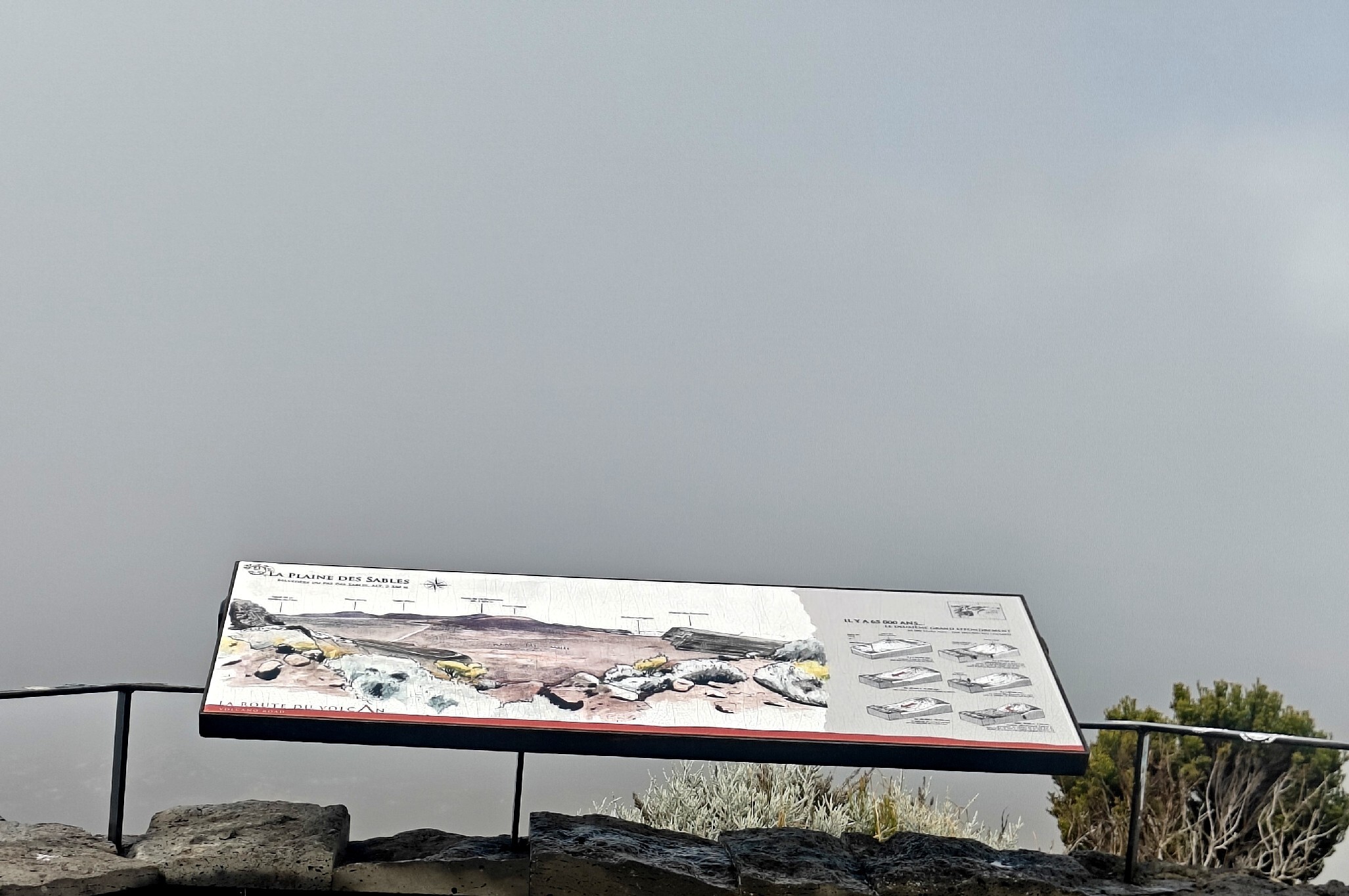
As we began to climb, and it was misty raining, we stopped at a pullout that had a little shelter to eat our fruit and baguette lunch. It had a few interesting (all in French) information boards.

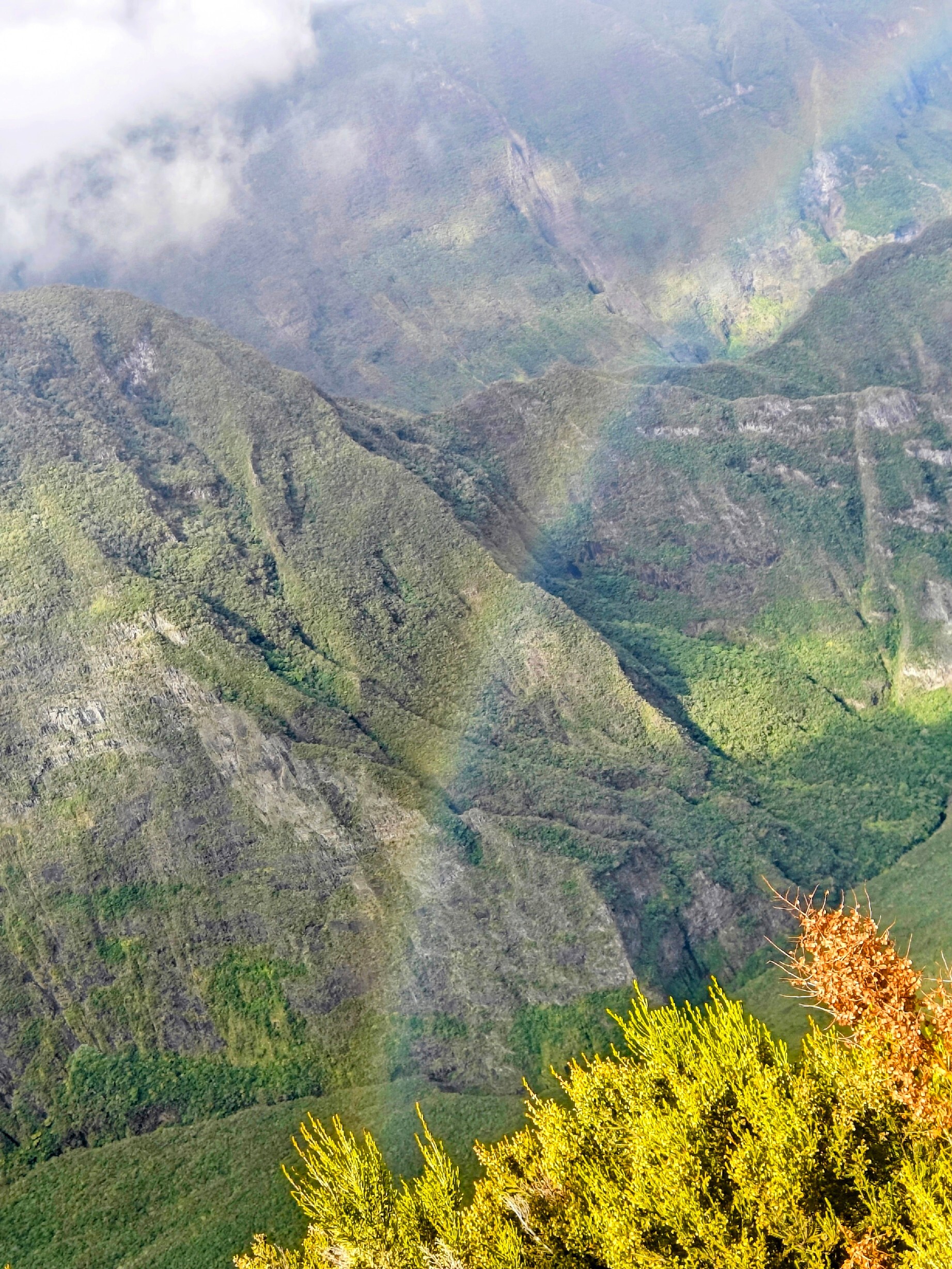
As the sun peeked out one of the times, we saw a pullout that might have view into the valley and man, was that a worthy stop:
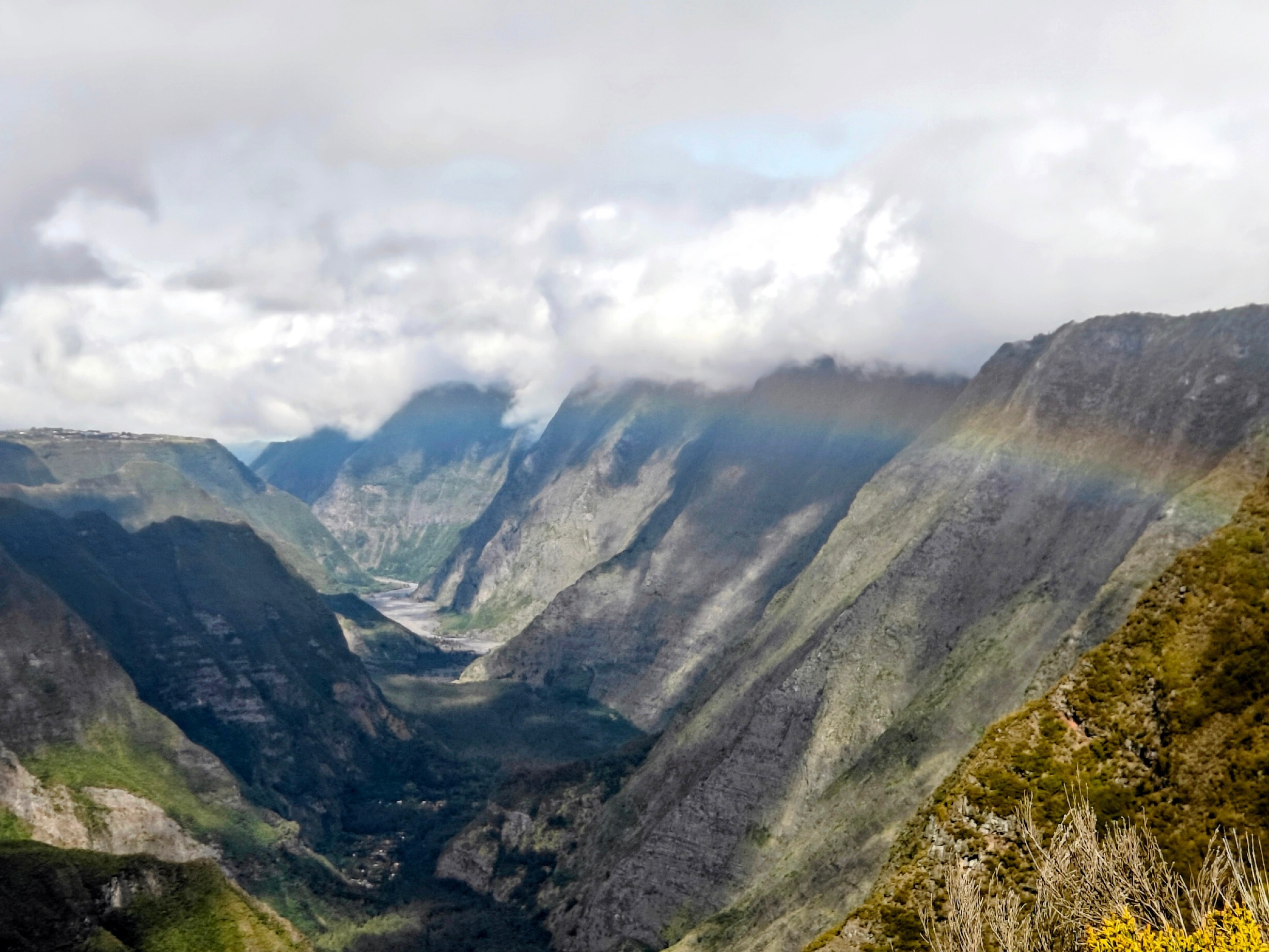
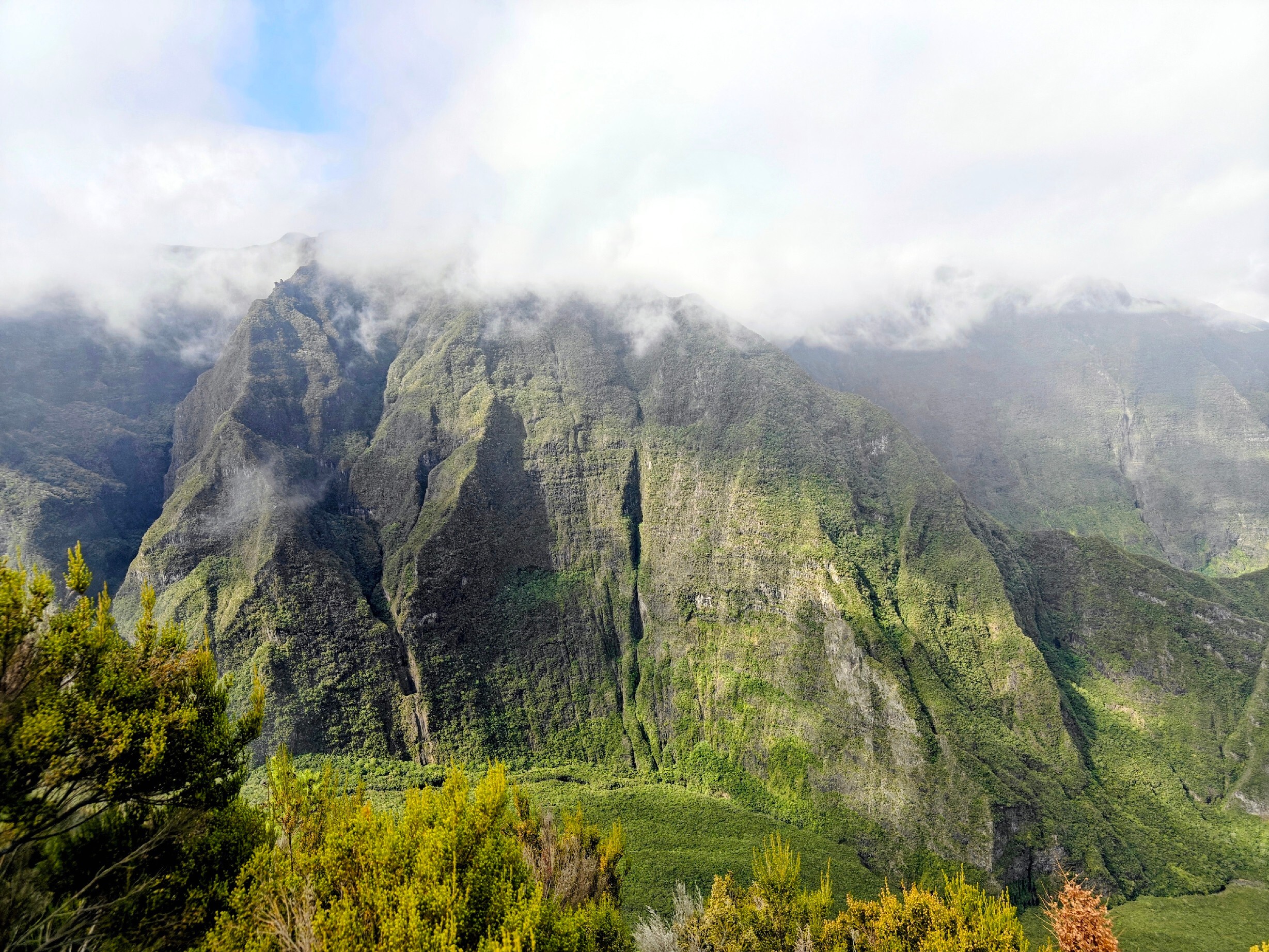 A few minutes later, a rainbow appeared below us and then the fog and misty rain began again.
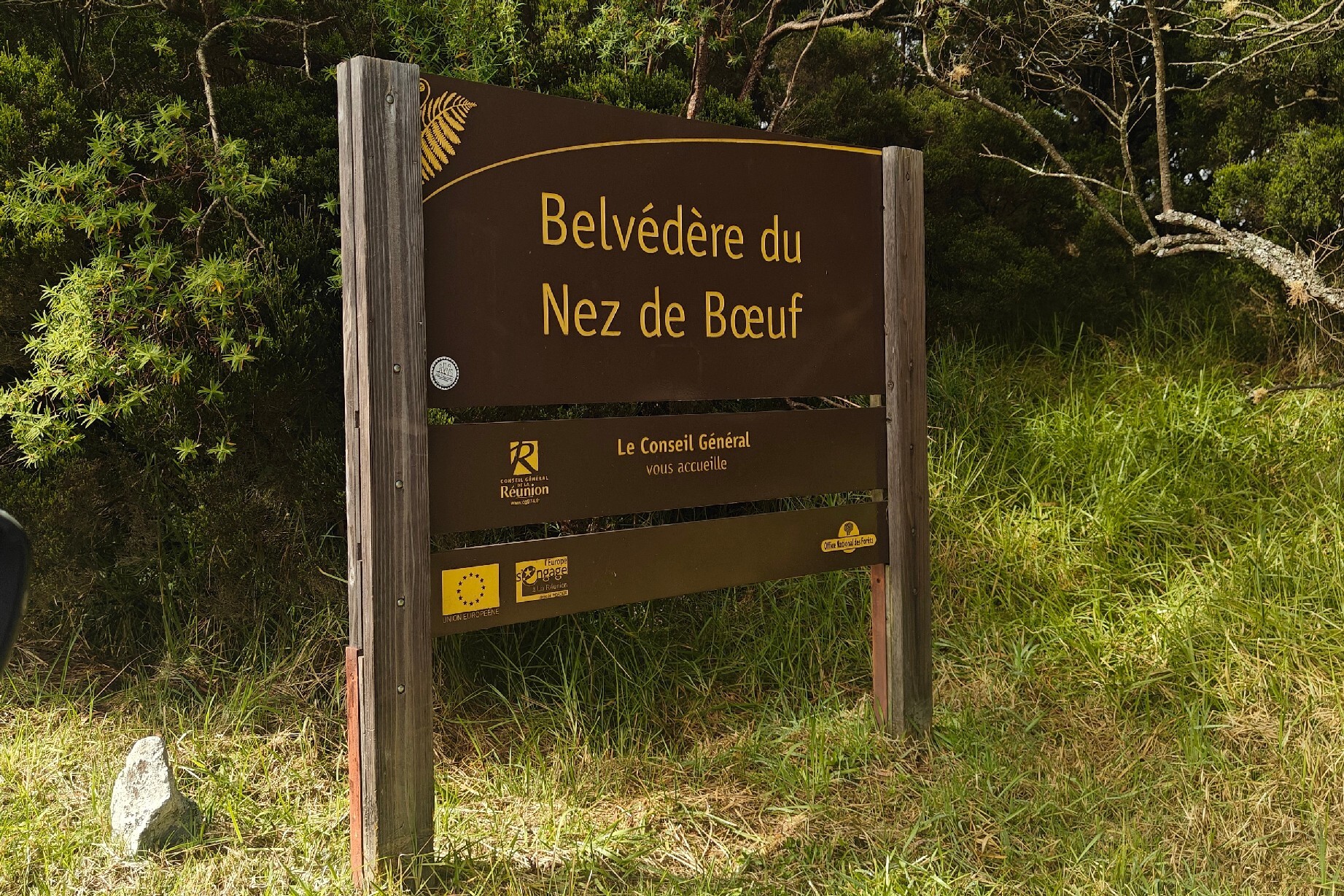
We drove a little further to see first Nez du Boef (“bulls nose” ) viewpoint with lots of picnic tables.

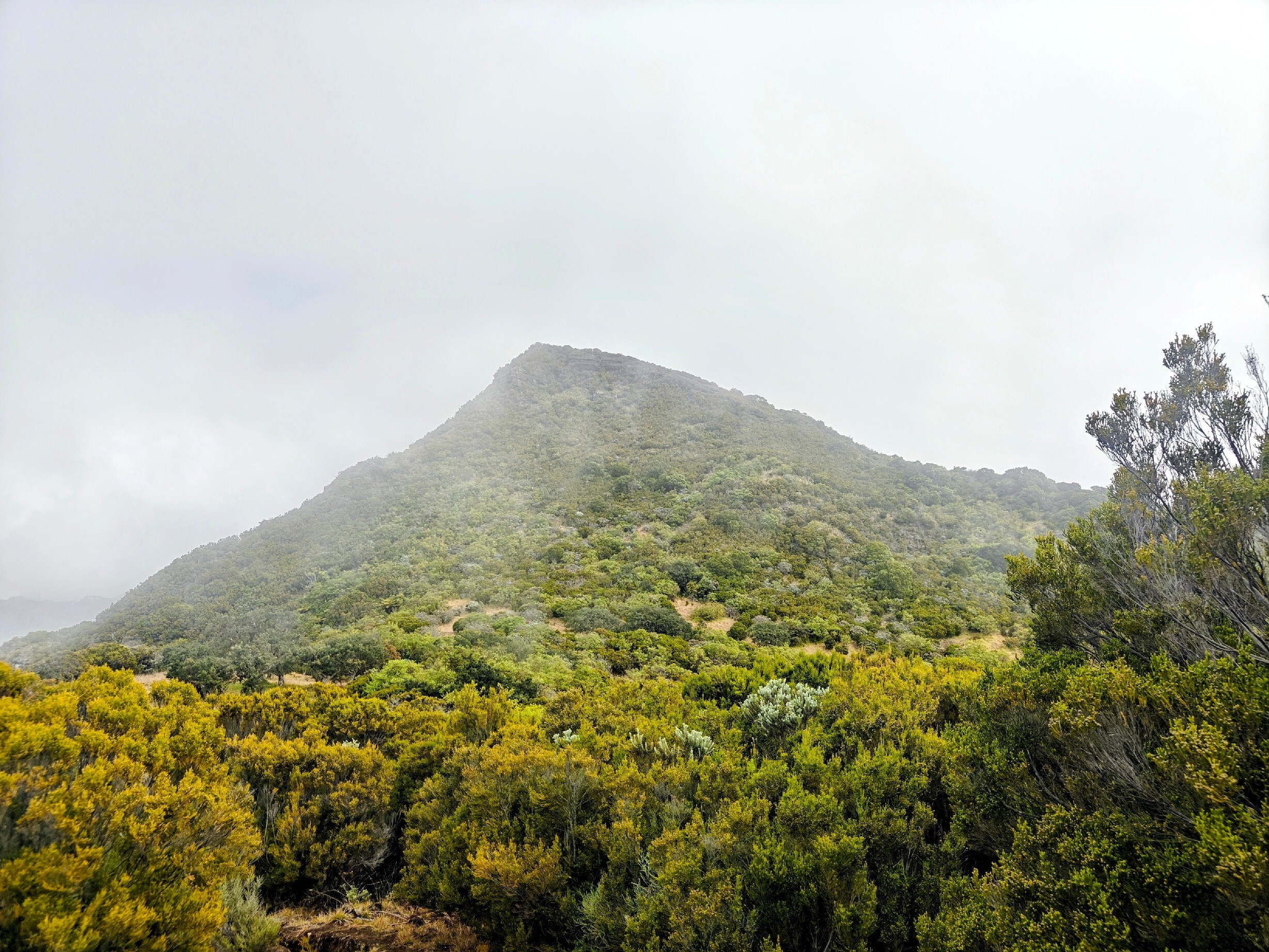
The actual closer view point was a bit further and it was in an out of the mist with the views below completed covered in fog:
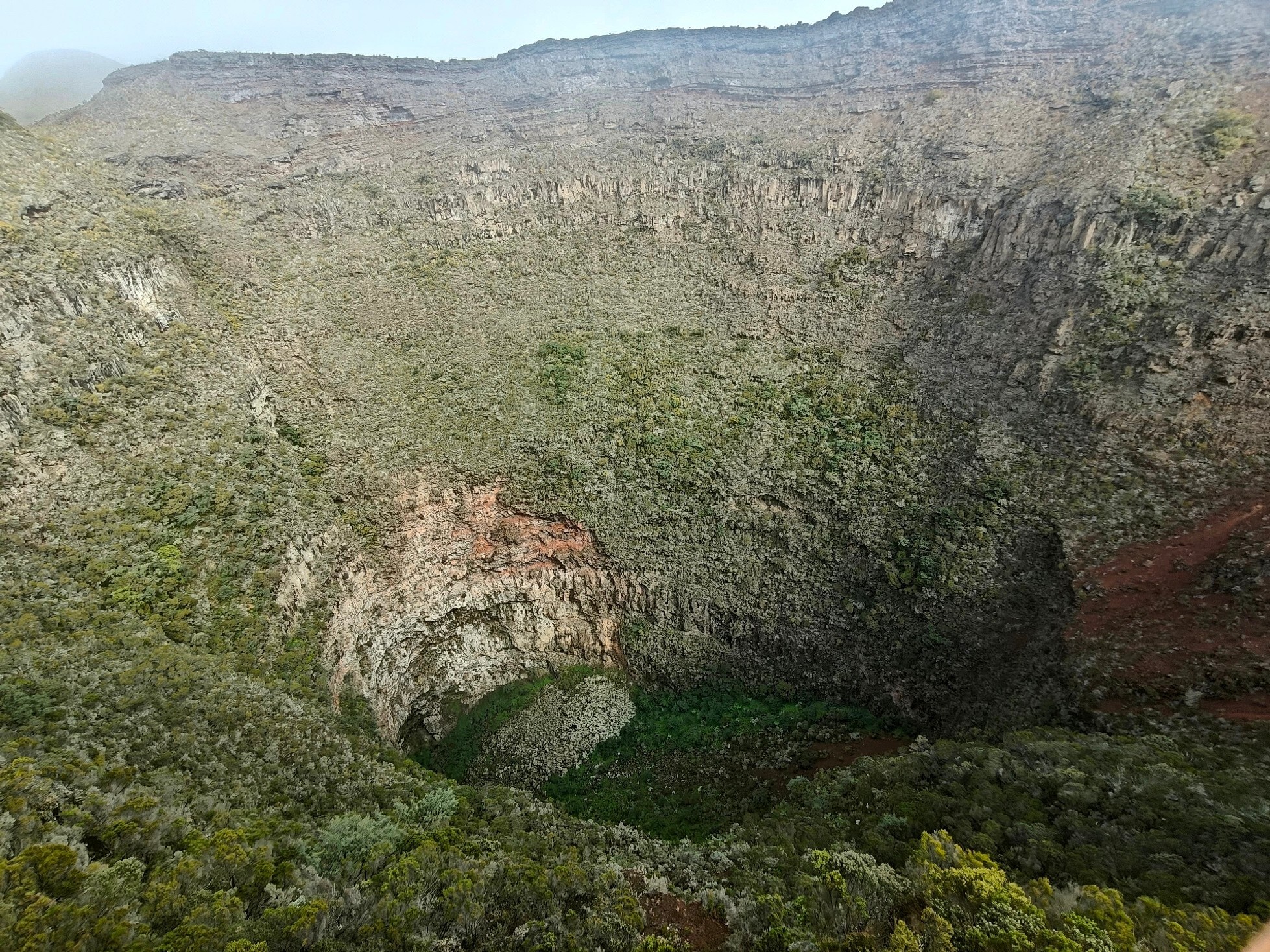
The fog got thicker and we continued on to the Crater Commerson where we pulled off and waited about 15 minutes for the sun to try and peek through. It never fully came out but the fog lifted quite a bit, the mist stopped and after a 3 minute walk to the crater’s edge, we had a decent view:
By this point in the drive, we were up over 2100 m / 6890’ and it began to look like we’d not see the sun again today. We drove down a few switchbacks and hit the dirt road across the Mars like landscape of the Plaine de Sables and took a few pics and videos in the fog:
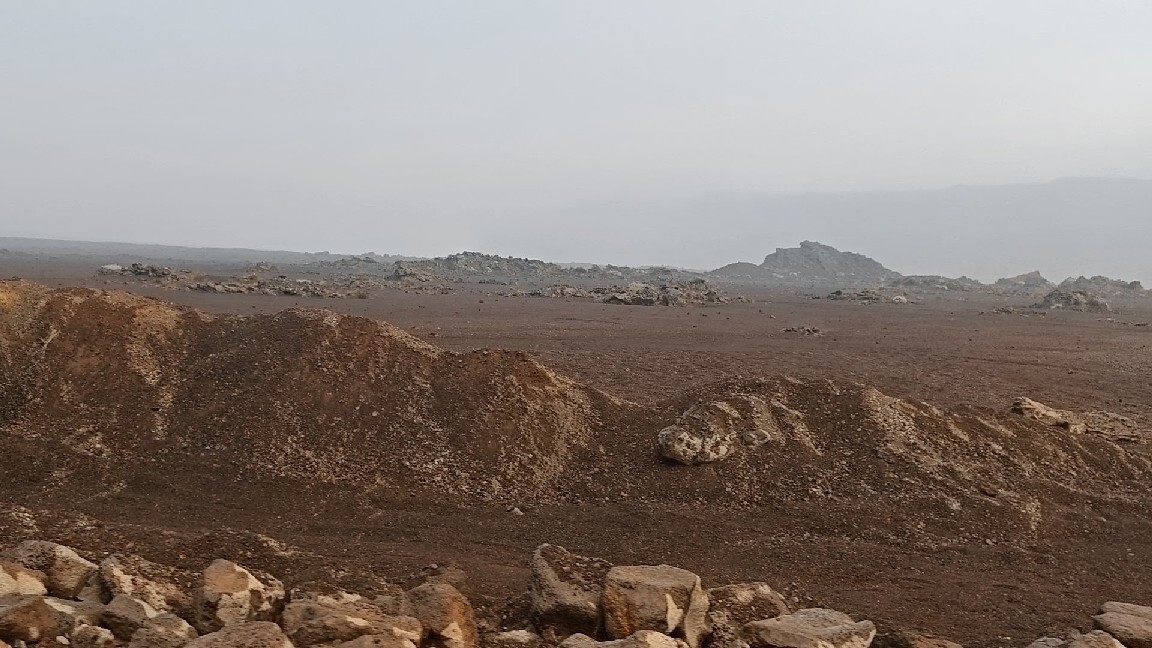
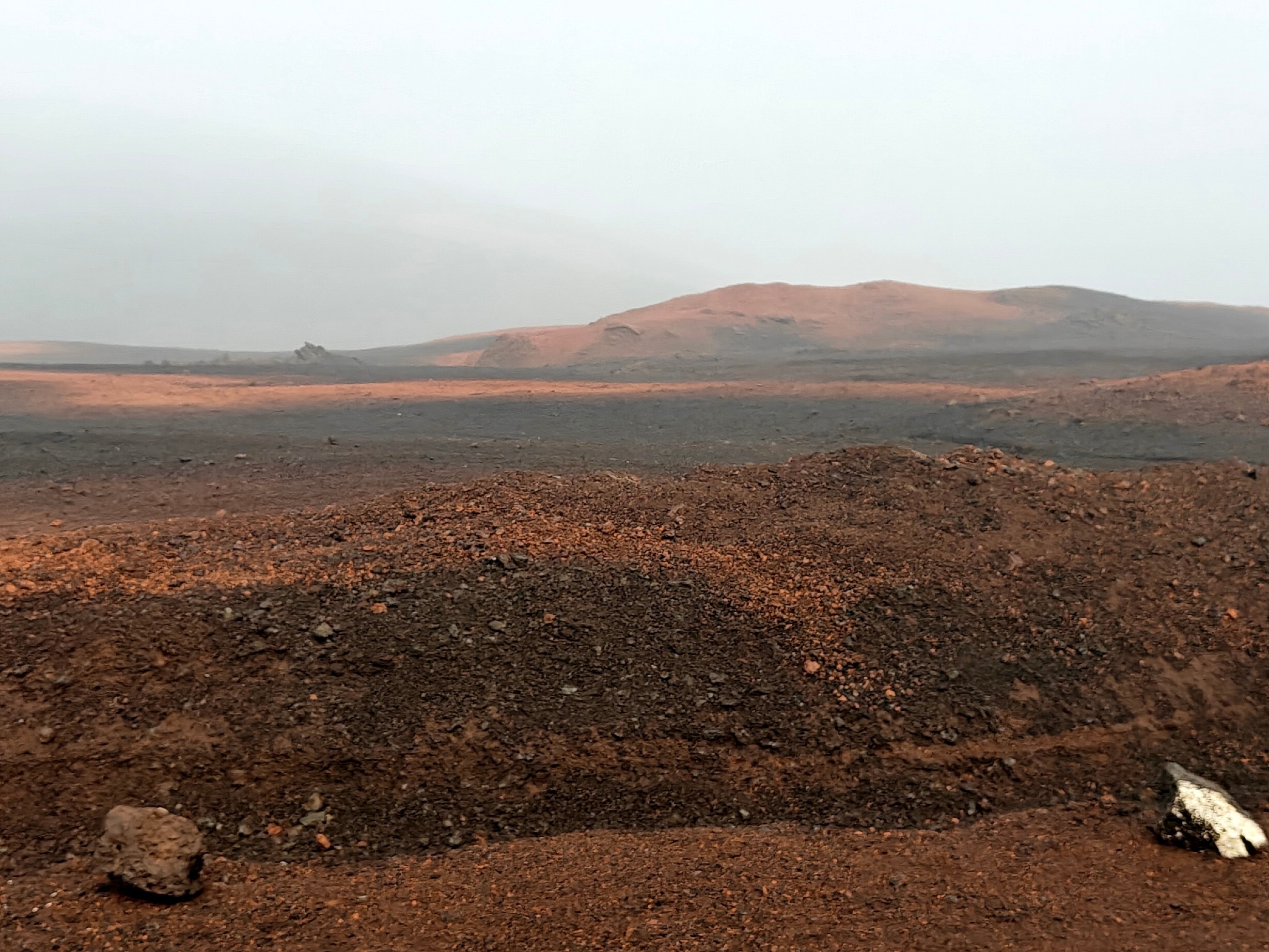
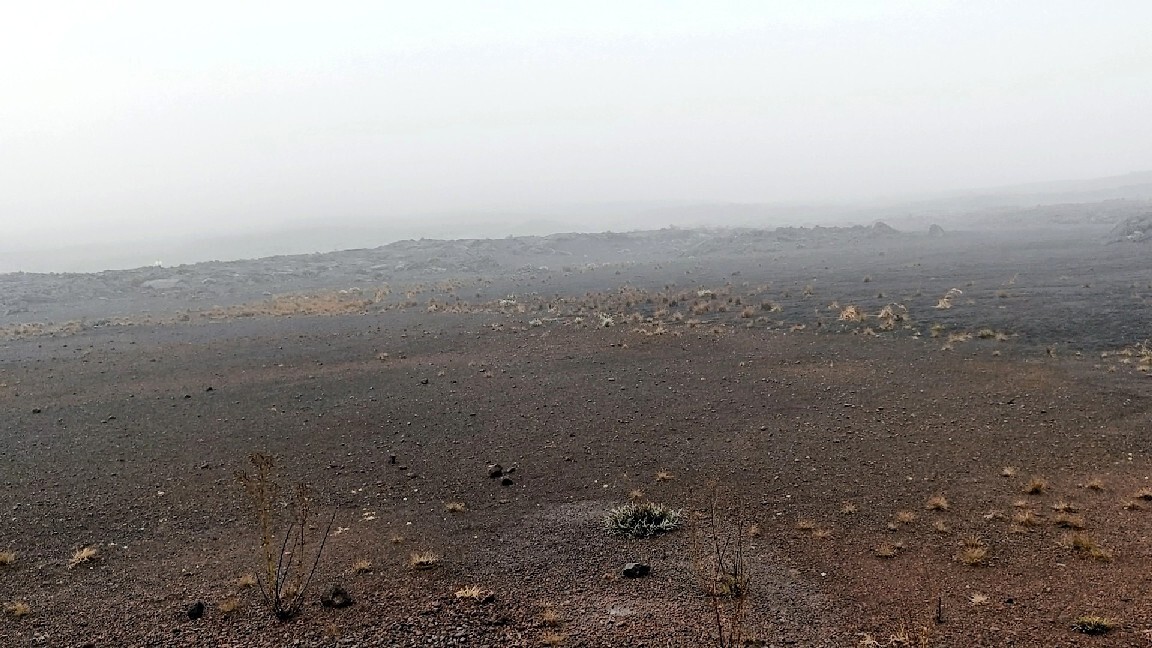
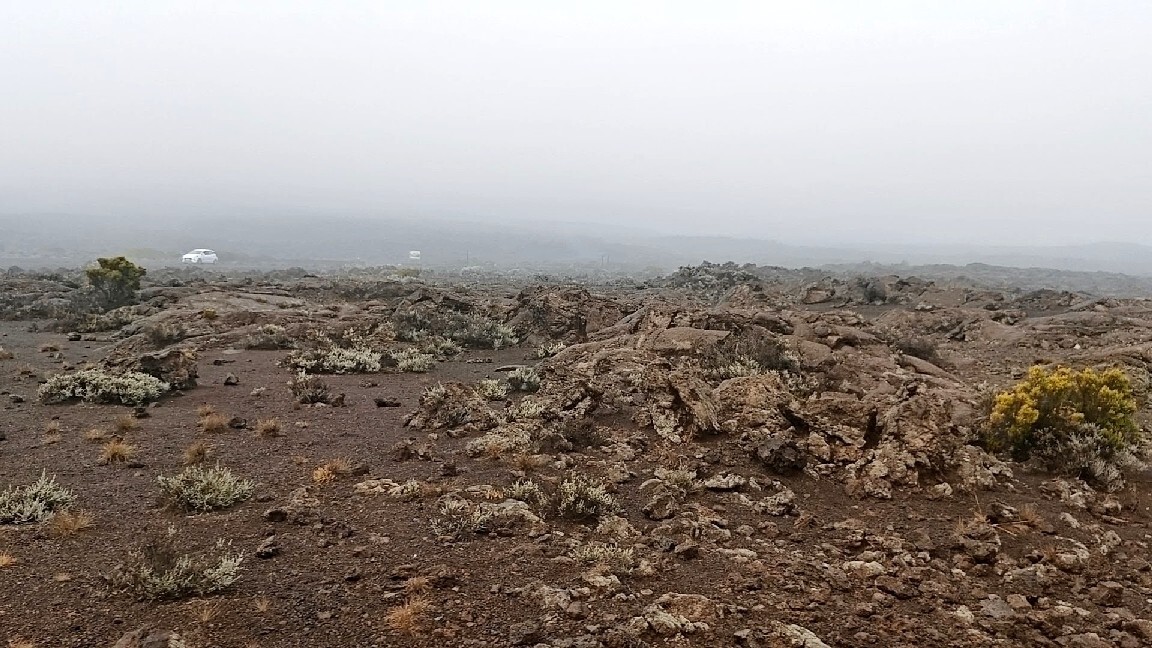
We didn’t even stop – the temperature now was about 9C / 49F and windy and wet. We climbed up some more and reached the Bellecombe viewpoint for views in the huge crater where one of the world’s most active volcanoes is located – Piton de la Fournaise – but it was not worth getting out as it was now raining hard and fully fogged in.
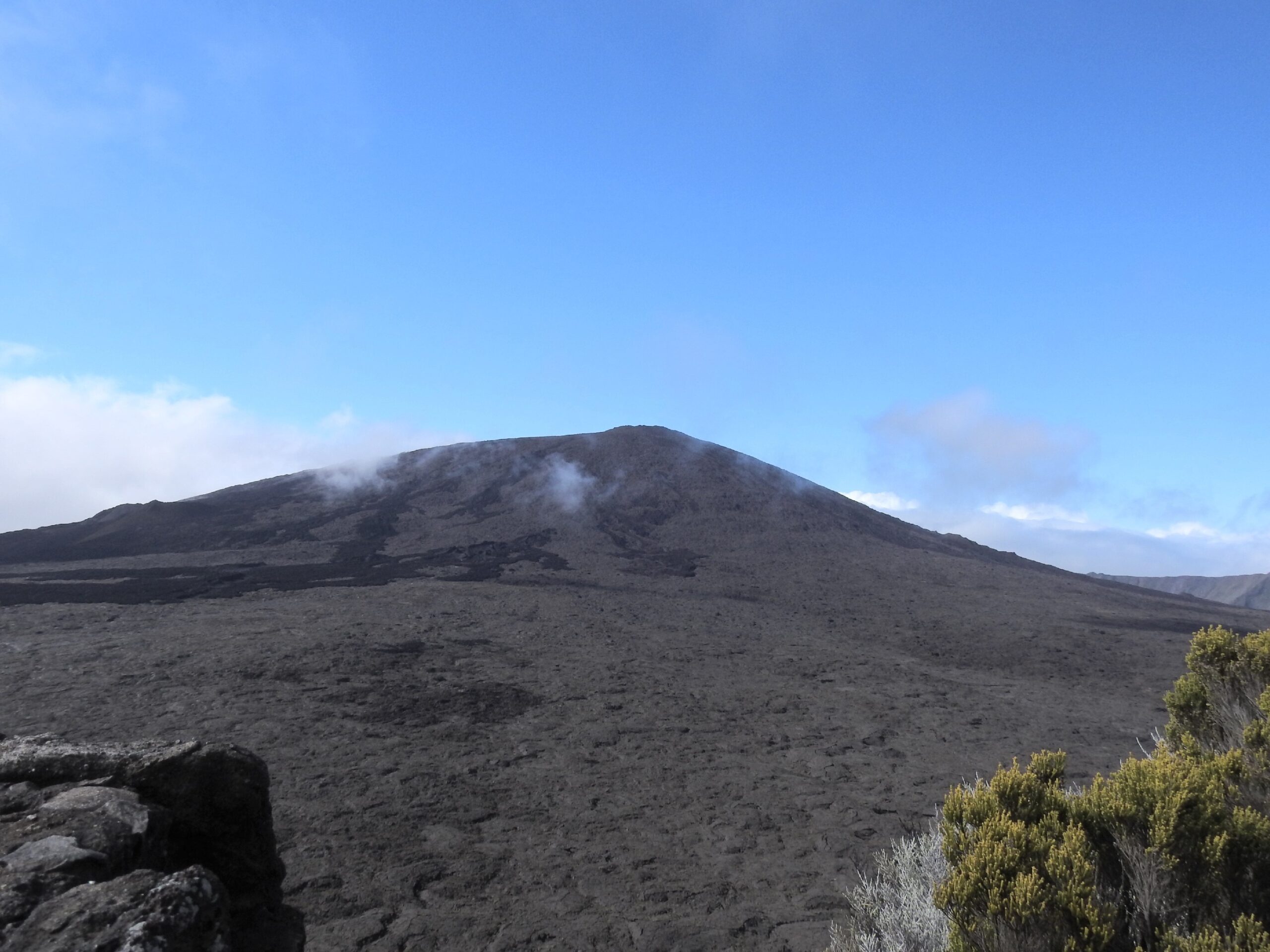
Piton de la Fournaise, reaching an altitude of 2,621 m / 8600’, is the active volcano of Réunion Island. It is a shield volcano that makes up 40 % of the island in its southeastern part.
Piton de la Fournaise is among the most active volcanoes on the planet; in terms of the frequency of new eruptions, (on average one every nine months over the last ten years), it probably ranks first in the world; in terms of the average volume of lava emitted, it is about ten times less productive than Kilauea in Hawaii, but comparable to Etna in Sicily. Since the installation of the volcanological observatory in 1979, Piton de la Fournaise has been one of the most closely monitored volcanoes in the world. Access is relatively easy, particularly via the Lava Road/Route of the Volcano and sometimes allows the public to witness the spectacle of the lava fountains and flows, characteristic of the effusive eruptions of this red volcano. Like those of Hawaii, Piton de la Fournaise is a hot-spot volcano. It is thought to be fed by a mantle plume that has been active for over 65 million years.
We turned back a couple of klicks and arrived at tonight’s accommodation in the middle of nowhere: Gite du Volcan. Réunion is a hikers haven and there are a series of “gites” (cabins) that accommodate long treks. This was one of the them and it’s complete with a restaurant and in NO way would you call this a cabin. It’s more like an upscale dormitory. Photo below is from their website – but not what we saw on this dismal day – you can see the Piton de la Fournaise in the background.

It was lightly raining here as well and check in was not until 3 (it was about half past one) so we went into the restaurant to have a drink and stay dry. We chatted with a nice French family (she spoke perfect English) and they had just done the hike to the volcano edge and back.
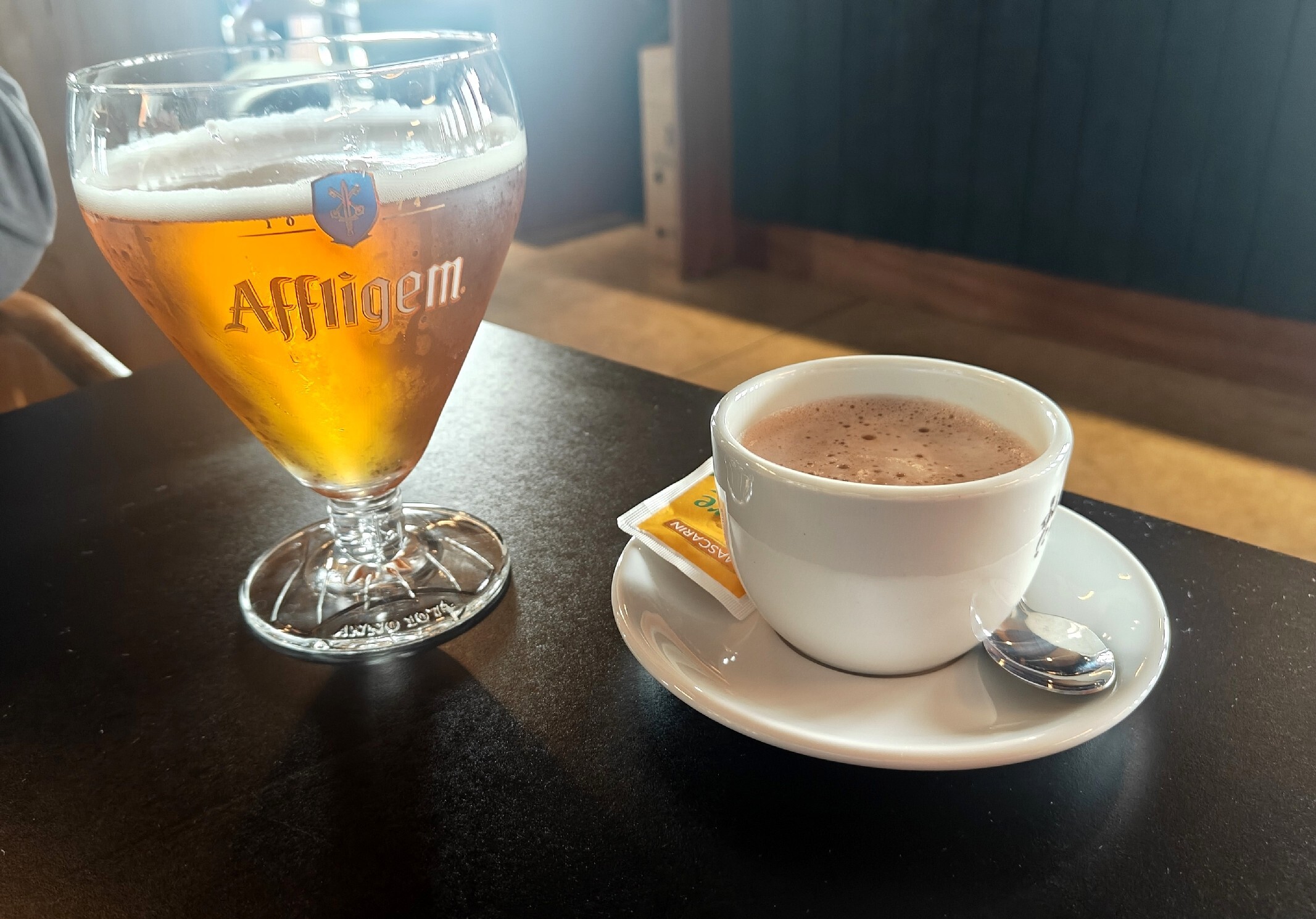
Just after three, we were able to check in, grab our bags and go to our room. We have a room with twin beds, a view of the fog:

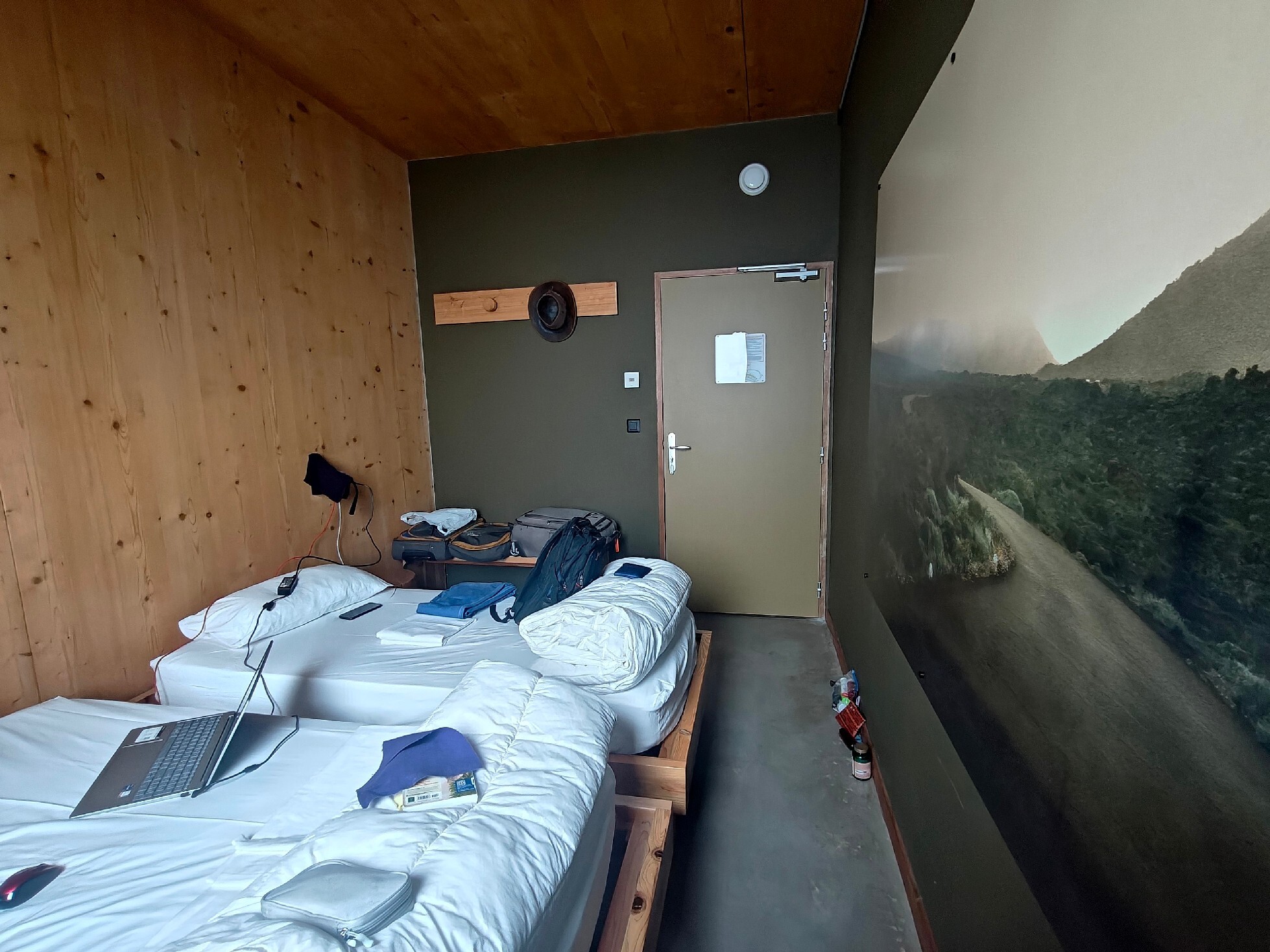 There is one surface to put luggage on and two small night stands and little else. There is Wifi in the restaurant only and an intermittent weak cell signal. There is a shared bathroom down the hall along with showers – but no towels. You cannot cook your own meals here so we booked dinner and breakfast.
After chilling in the room and getting online in the bar, we went for the dinner at 7pm. We were not super impressed; there was a soup and salad course which was not bad. Then a main course which consisted of rice with three different types of stews to eat with it – none of which we really liked. The dessert options were not much at all and we skipped that course. We returned to our room to stay warm and went to bed around ten.
Neither of us slept well; both of us were awake for hours in the middle of the night; could have been the late afternoon coke; or for Fran the too warm blankets and the alcoholic drink at dinner – some sort of guava and vodka drink they had sitting on the tables.
Doug woke up at 8 and we had to get up as breakfast was only until 9. This was a disappointment too – nothing hot, just granola, French bread and a really thick yoghurt.
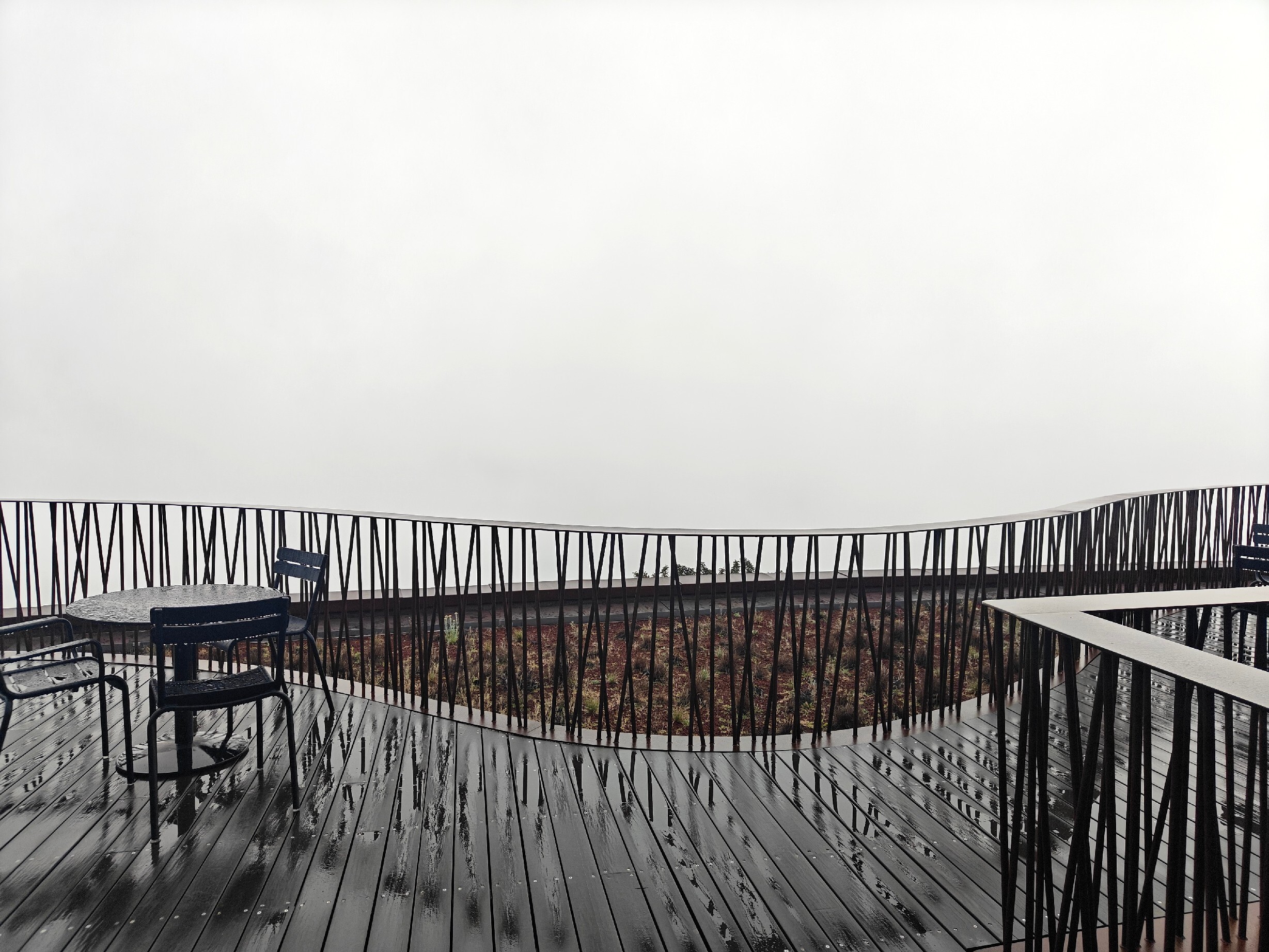
All in all with the bad weather, this was not what we had expected or hope for and we found it pricey for what we got. We paid €145 ($165 USD / $234 CDN) including dinner and breakfast which, as mentioned above, we were not impressed with. We checked out around 9 as the chance of rain was supposed to be 10% (which seemed low considering it looked like this at the balcony of the Gite:
We drove the 2km to the Bellecombe viewpoint, which was totally fogged in.
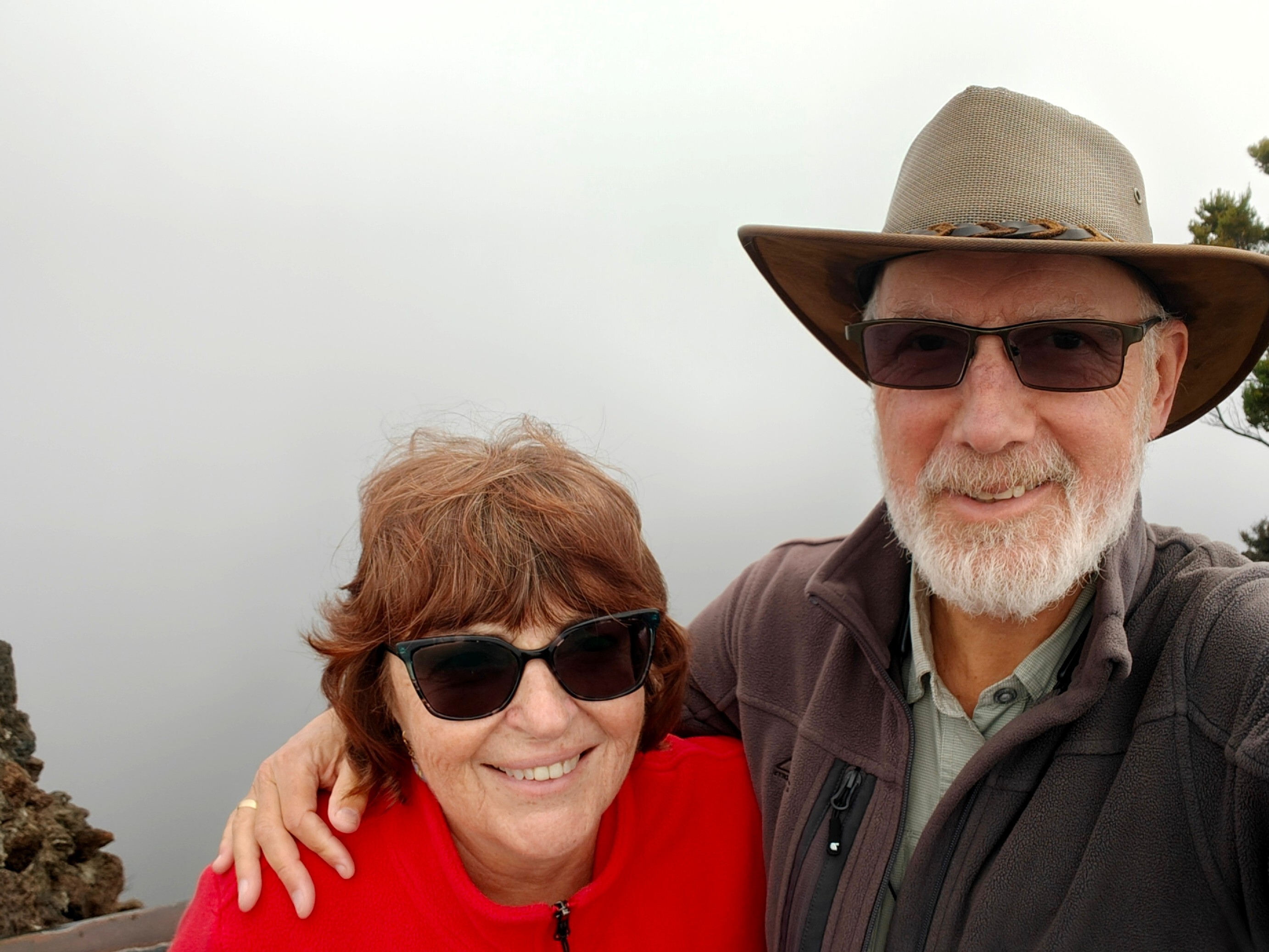
We decided to wait ten minutes in the car (it was quite chilly outside with the wind) and then suddenly Fran saw the edge of the Piton de la Fournaise! We grabbed our phones/camera and walked back over to the viewing area where the sky slowly cleared:
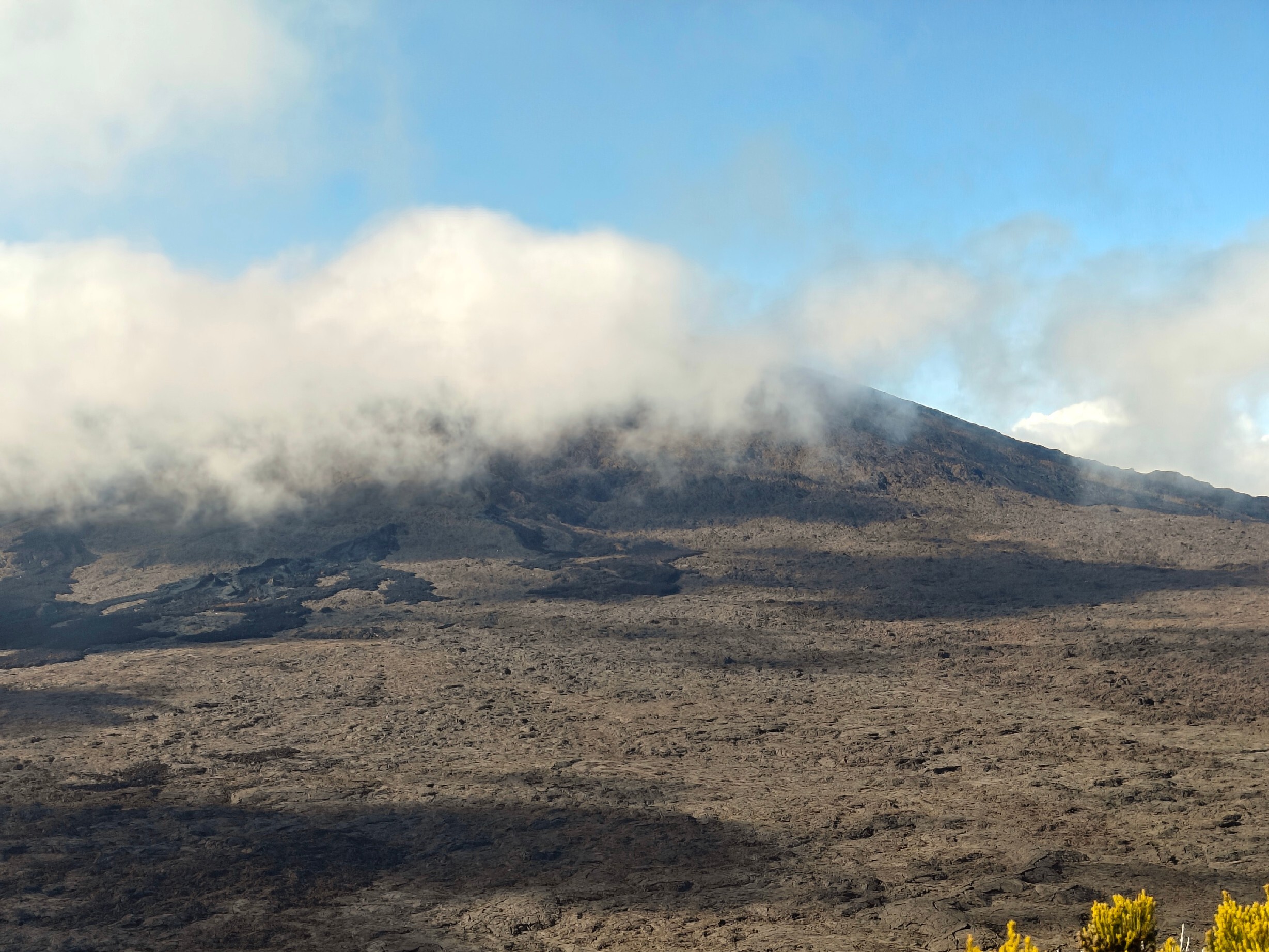
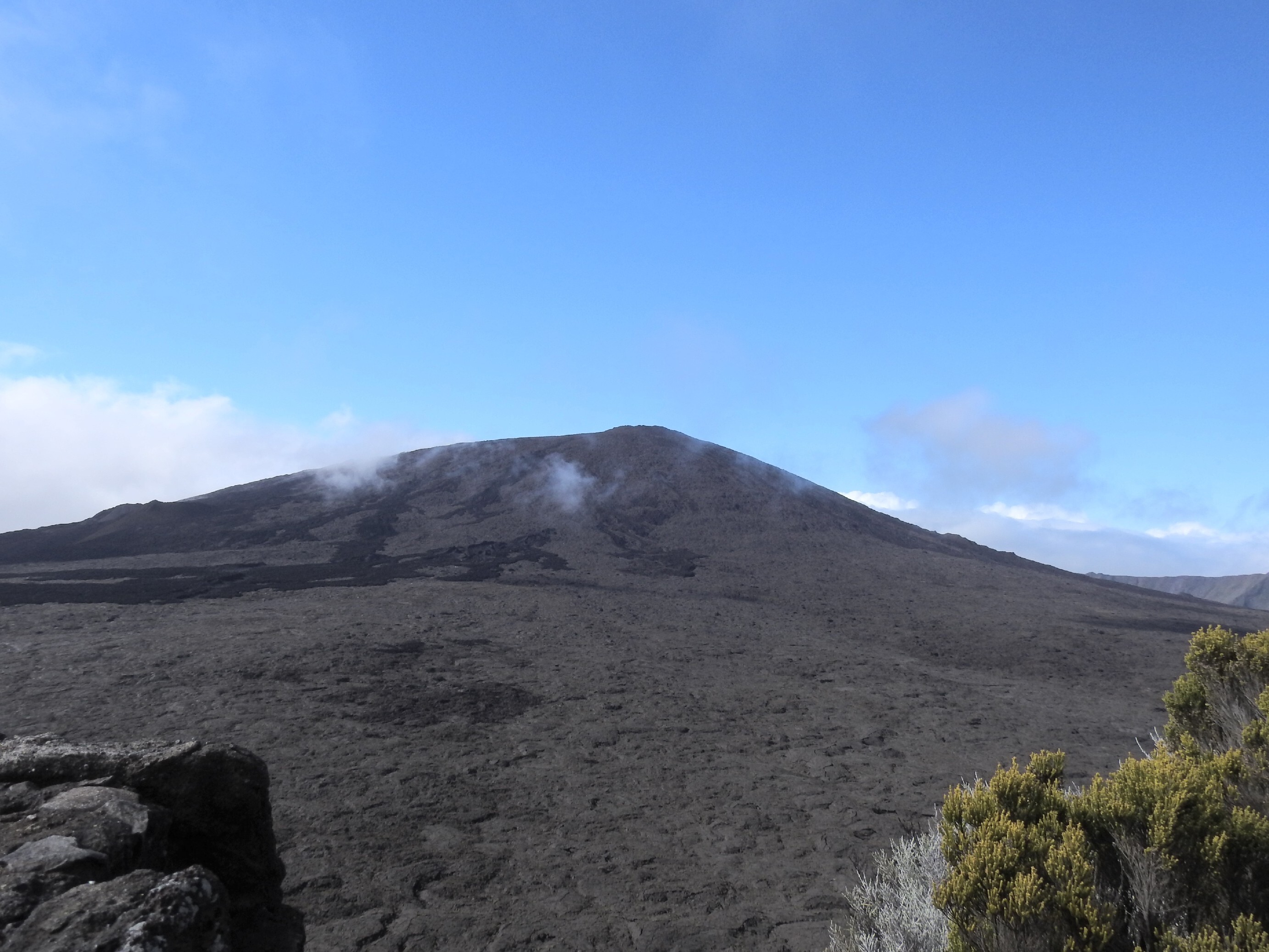
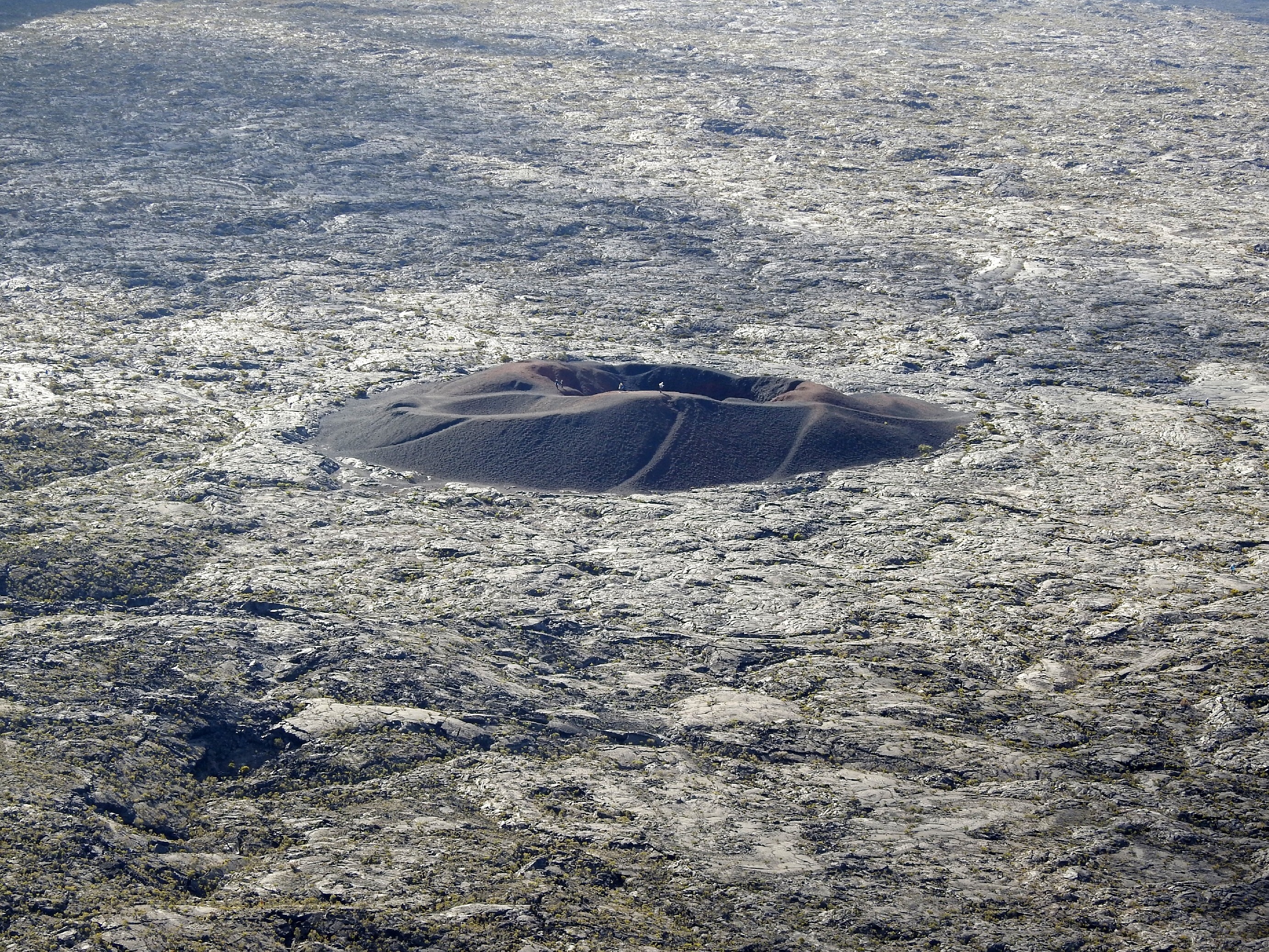


This lasted no more than ten minutes BUT we were SO pleased! This made the trip worthwhile!
Although the crater filled with fog, much of the drive back through the park was mostly in sunshine and it was a much more beautiful drive today:
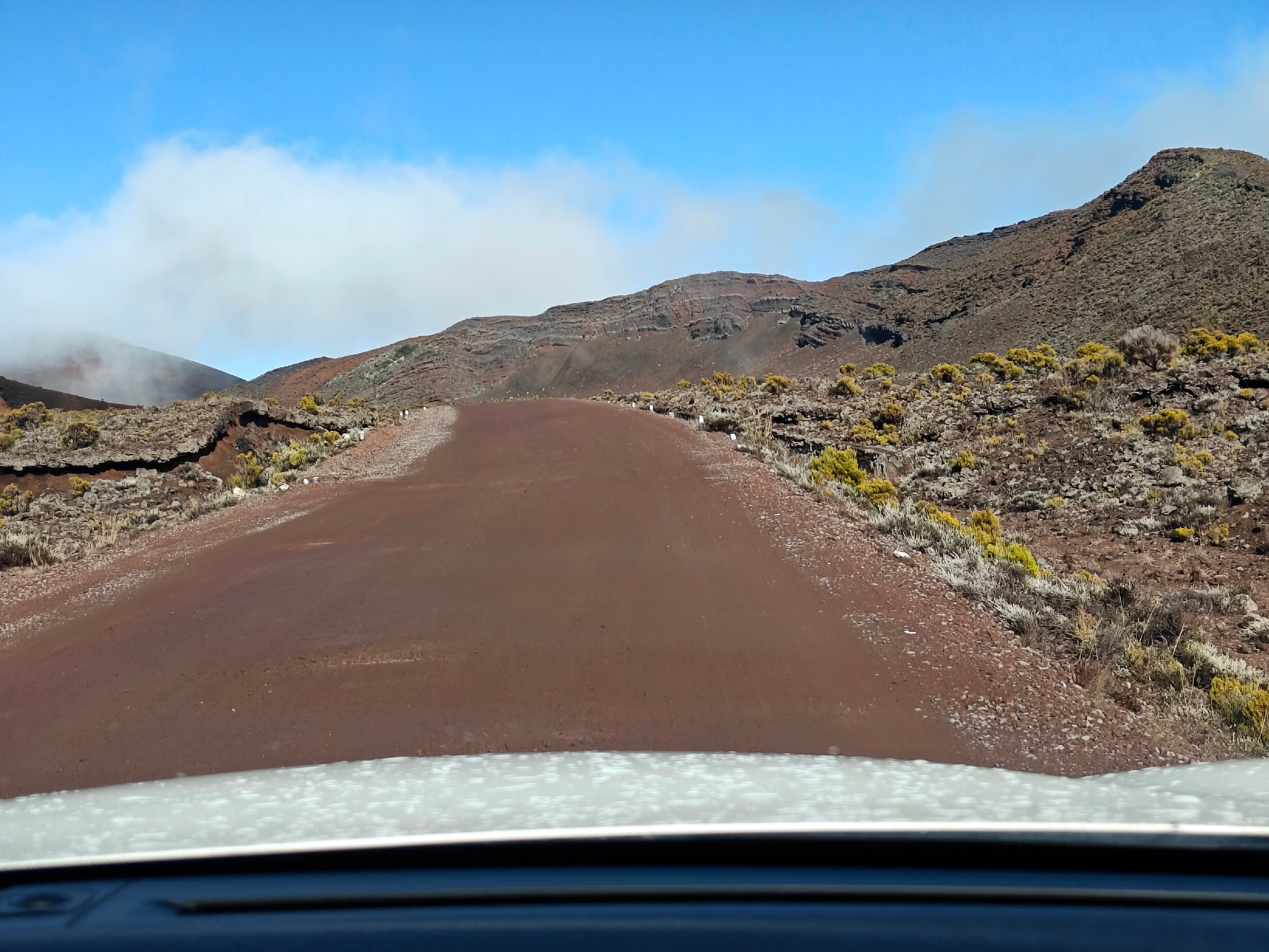
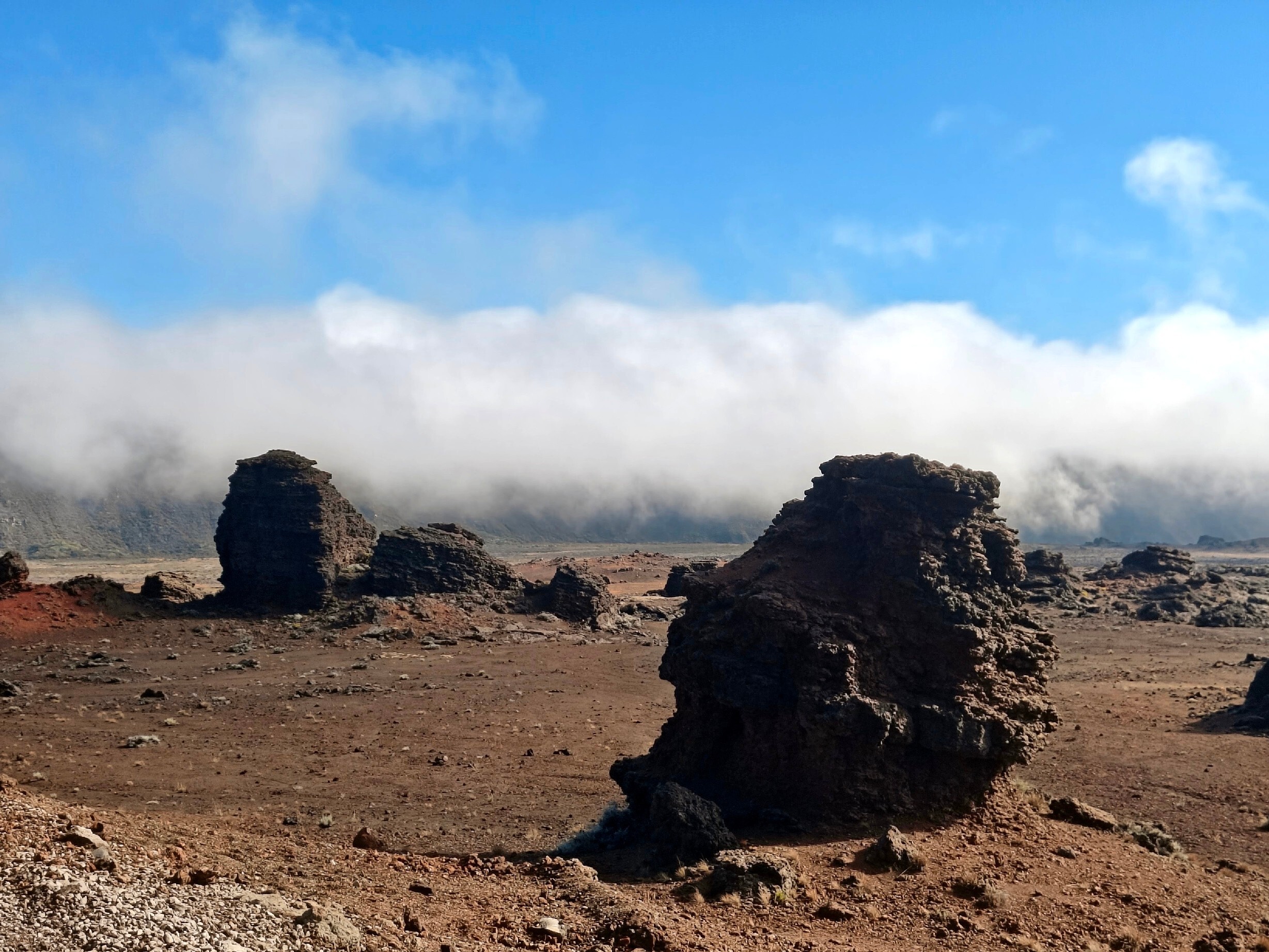
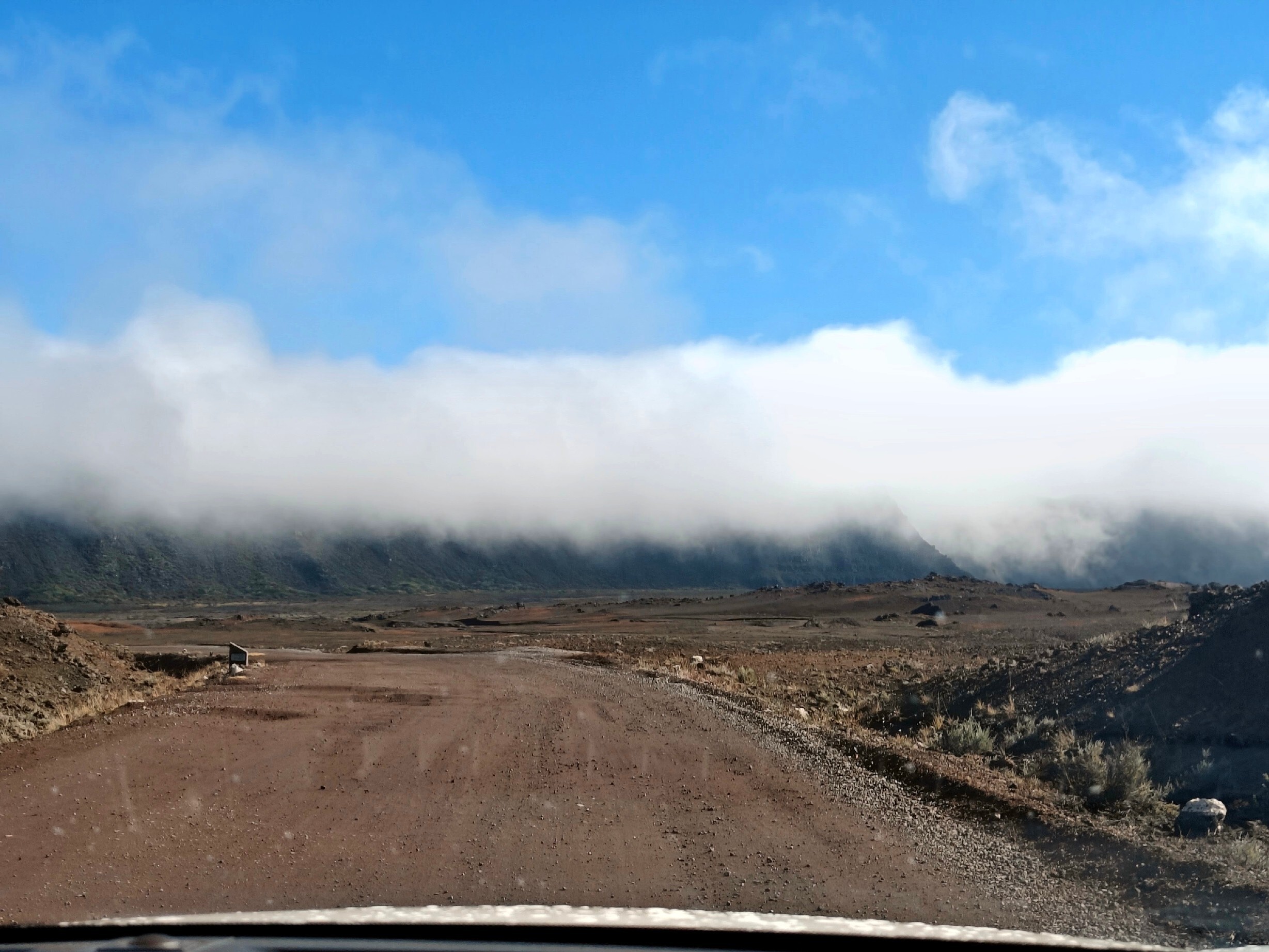
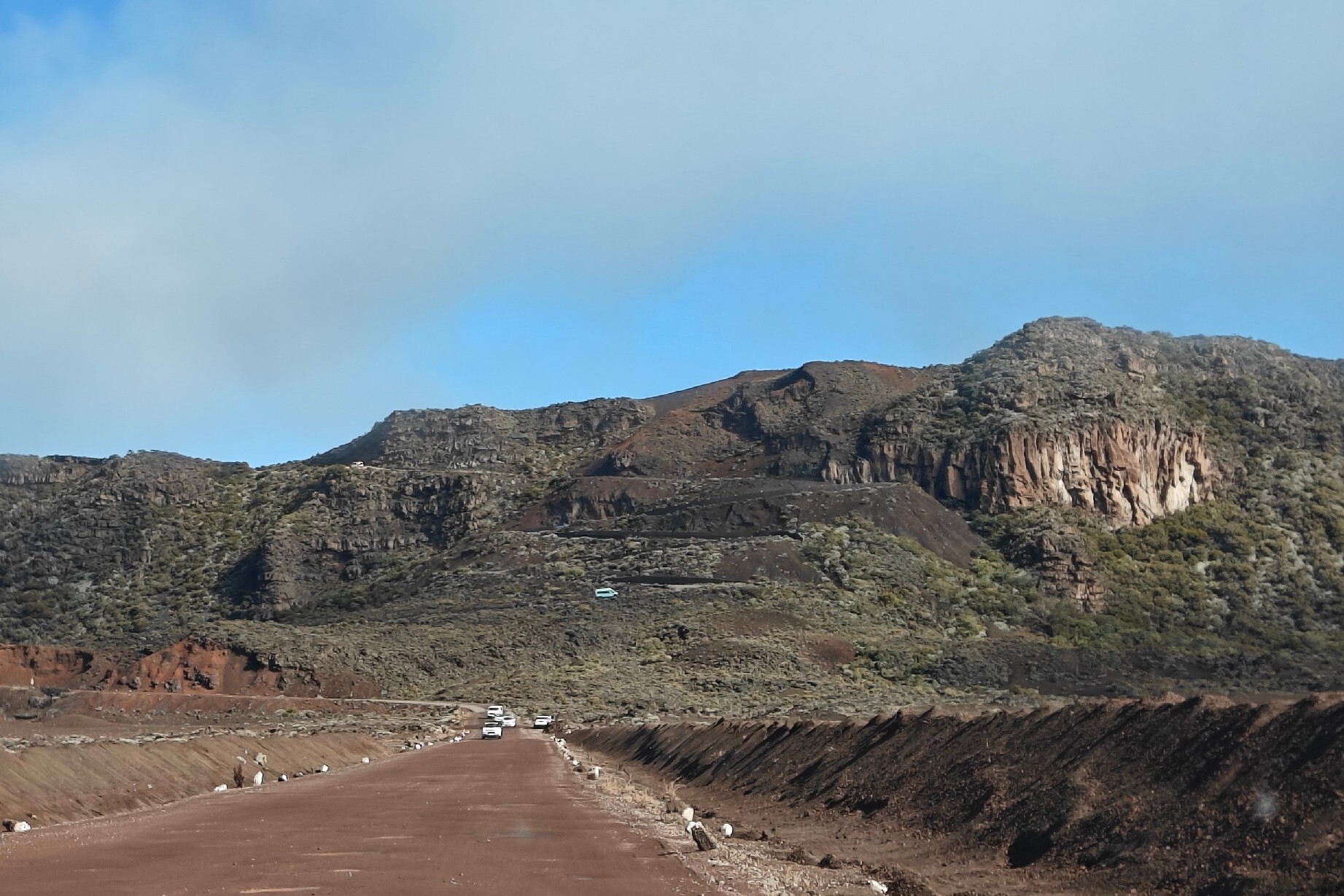
We stopped again today at the lookout over the plains:
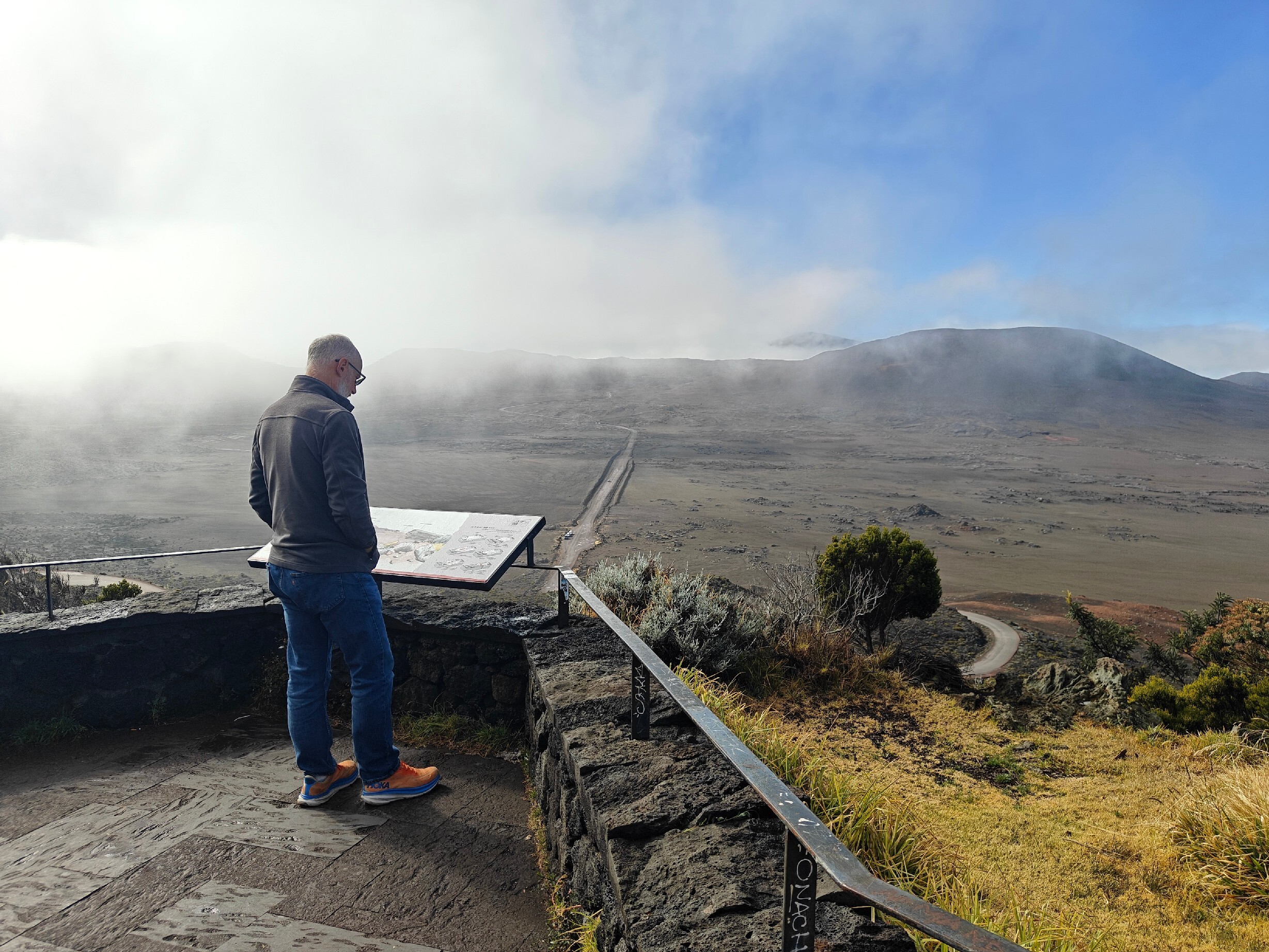
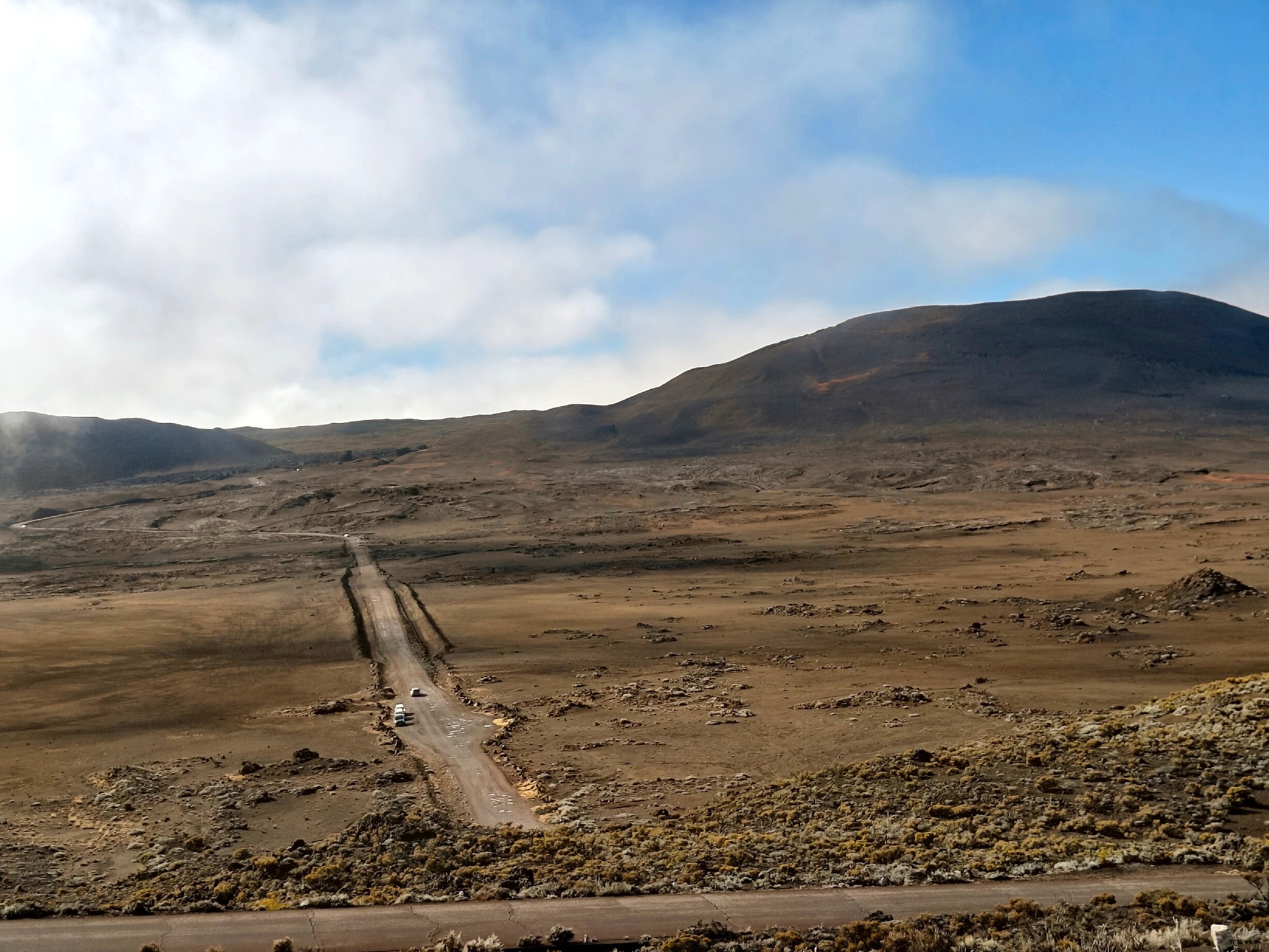
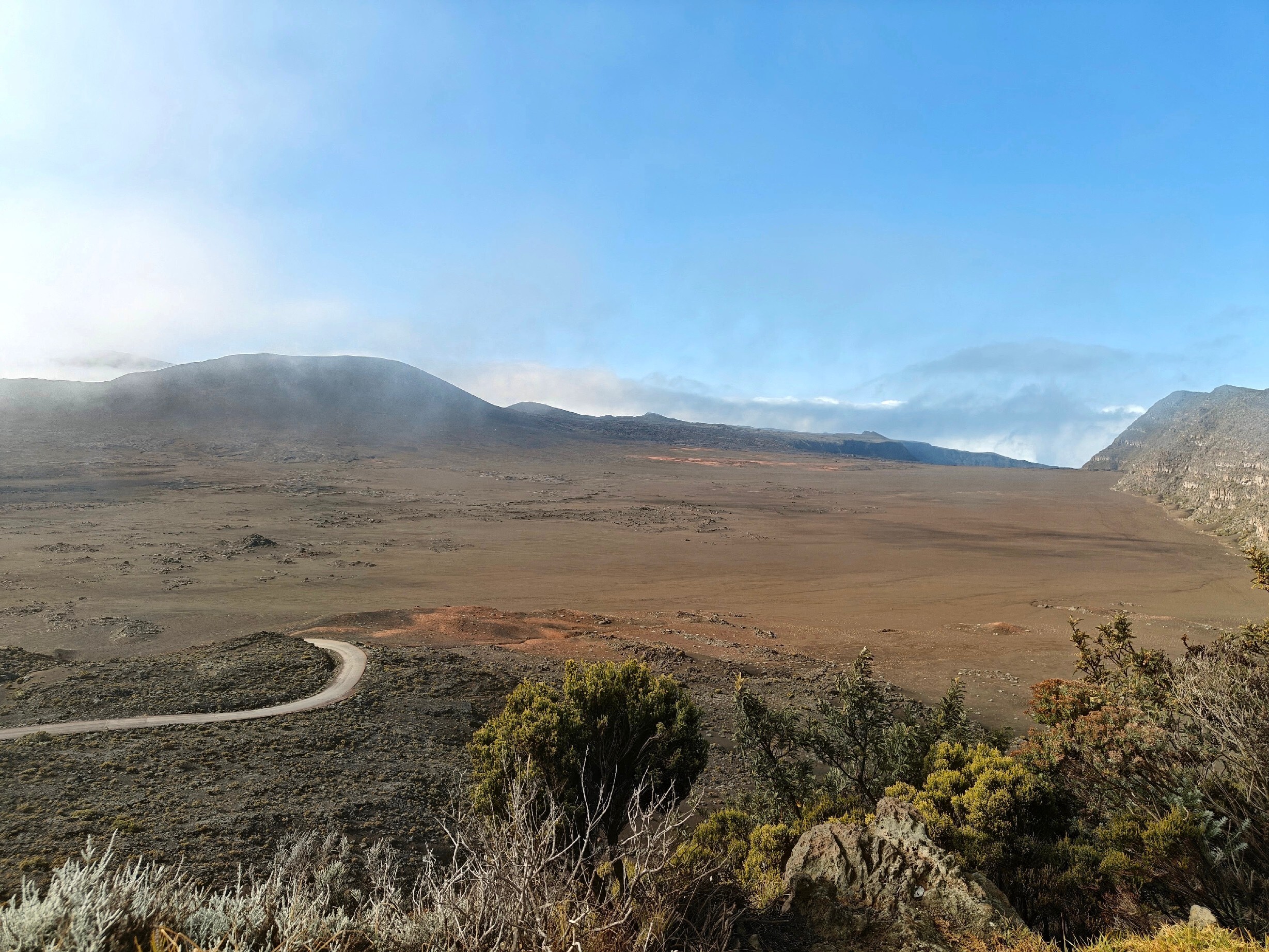
Note: You can take a hike up the Piton – it’s about a 5-6 hour trek on the lava surface starting with 527 steps down into the main crater ending with a climb up to the rim of Fournaise. Everyone we talked to yesterday said it rained the entire hike and they pretty much saw no views! This was not our plan especially since Fran’s left knee has not fully recovered from her change of gait. Besides, hiking on lava is no easy walk. We hoped to be able to see the crater when and if, we get the helicopter ride we’ve rebooked.