

February 28th, 2025
Note: we were in Malaysia back in 2014 so there will be no “country blurb” this time – just a bit of info on the island of Borneo.
Borneo is the third largest island in the world surpassed only by Greenland and New Guinea. Situated at the geographic centre of Maritime Southeast Asia, the island is divided by the equator, roughly in half between the Northern and Southern hemispheres. Borneo is so large that it could fit most European countries inside it multiple times and it’s slightly larger than the state of Texas!
The island is divided amount 3 countries. The monarchic dictatorship of Brunei in the north, makes up 1% of the territory while in the centre and south, approximately 73% of Borneo is Indonesian territory. In the north and to the west, the East Malaysian states of Sabah and Sarawak make up about 26% of the island.
The Borneo rain forest is estimated to be around 140 million years old, making it one of the oldest rain forests in the world. It is the centre of the evolution and distribution of many endemic species of plants and animals, and the rain forest is one of the few remaining natural habitats for the endangered Bornean orangutan. It is an important refuge for many endemic forest species, including the Borneo elephant, the eastern Sumatran rhinoceros, the Bornean clouded leopard, the Bornean rock frog, the hose’s palm civet and the dayak fruit bat.
CURRENCY (Malaysian): Ringgit – 1 MYR = $0.23 USD / $0.32 CDN
PETROL: 2.05 MYR per litre – $1.73 USD gallon
MOST POPULAR BEERS: Anchor, Tiger, Carlsberg
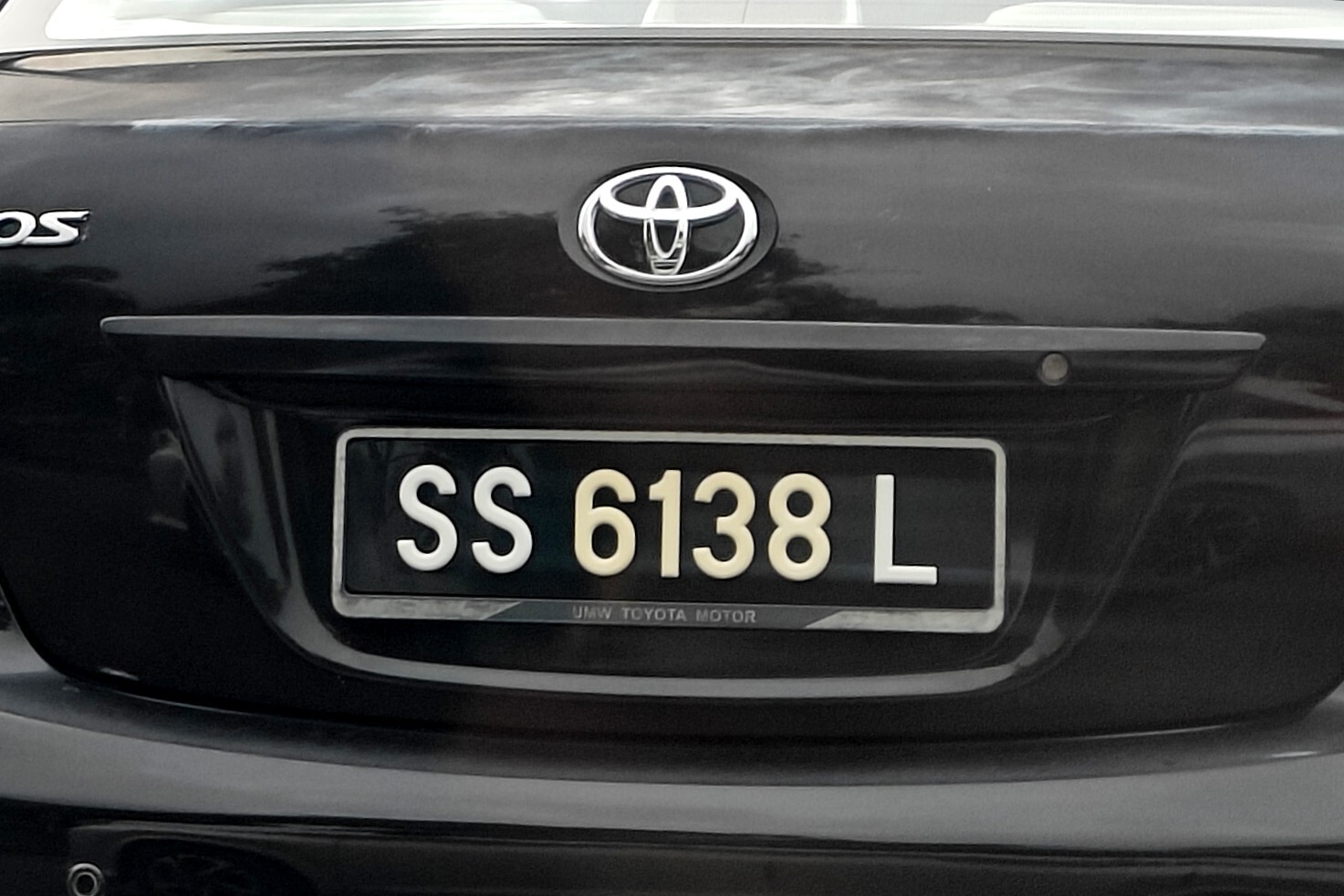
LICENSE PLATE:
We arrived in Singapore via Jakarta more or less on time and caught a Grab to our hotel which was on the east side of the city about half the distance from the airport from where we’d stayed a week ago. The airport hotel choices are minimal and very expensive. We watched one show and hit the hay.

Stories Joo Chiat is in a more commercial area than we stayed in before but we’ve not got time to explore today. We have booked this hotel again after this trip and will have two nights here. We have a deluxe queen room that is very modern but “cozy” with not much space. It’s got a desk, kettle, fridge and decent sized bathroom – there’s just not much room to put things or walk around.
Friday morning we left the hotel via Grab and returned to the international airport to catch our flight to Sandakan on the island of Borneo in the Malaysian part. This airport here is amazing; you could easily spend all day wandering the terminals and being entertained.
Today we are in Terminal 2 and saw this Wonderfall:
Then further on in the terminal, we came across this little “forest oasis” with a glass floor over a stream

and changing scenery on the ceiling complete with forest sounds and bird calls etc. So calming and peaceful!

We flew through Kuala Lumpur with a five hour layover arriving in the city of Sandakan, Malaysia in the northeast part of the island around 5. Despite still being in the same country, we had to go through immigration – this was weird. Here they actually had border agents and stamped our passports – first time on this trip.
We tried to get a Grab but it seemed it would take a while to arrive so after negotiating with a cabbie, he took us to the condo Fran had booked for the equivalent of $100 for two nights and we have room to spread out as it has three bedrooms, two bathrooms, and a washing machine! We have great Wi-Fi and an outdoor pool.
First order of business upon arriving was getting laundry going – the machine barely took all our clothes and doing it tonight meant it had all day tomorrow to dry. There was a drying rack on the balcony but it was not enough so Fran also strung her handy-dandy clothes line that she carries when we travel and then we had enough space.
For dinner we tried to get a Grab delivery of food with no luck, but did manage to get beer! We had eaten a lot of small things throughout the day in the airports and on the planes so we weren’t super hungry so we just had beer and peanuts for dinner!
Prior to leaving Darwin, Doug had researched and find us a private driver to take us to the three places we wanted to visit on Saturday. Christopher spoke excellent English and was knowledgeable and kind. He picked us up just after 8am the next day, Saturday, and our long day began.
First stop was the Sepilok Orangutan Sanctuary – all of the creatures we’ll see today, we’ve never seen outside a zoo and in order see them in the wild, it means a trek or multi-day jungle boat cruise (either here on Borneo or on the island of Sumatra). In this heat and humidity, Fran (nor Doug) fancied doing that and this place has rescued orangutans and has a huge jungle area fir them to roam complete with a feeding platform and a nursery.
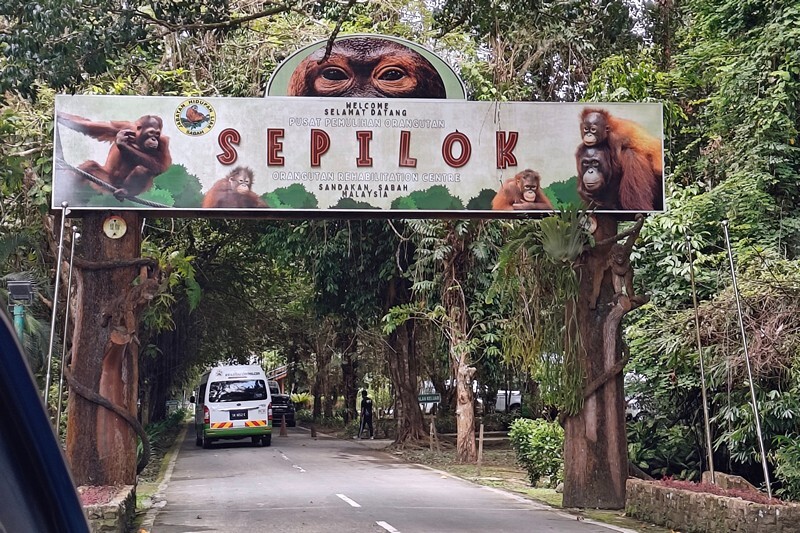
The entrance fee is 30 MYR pp ($7 USD).
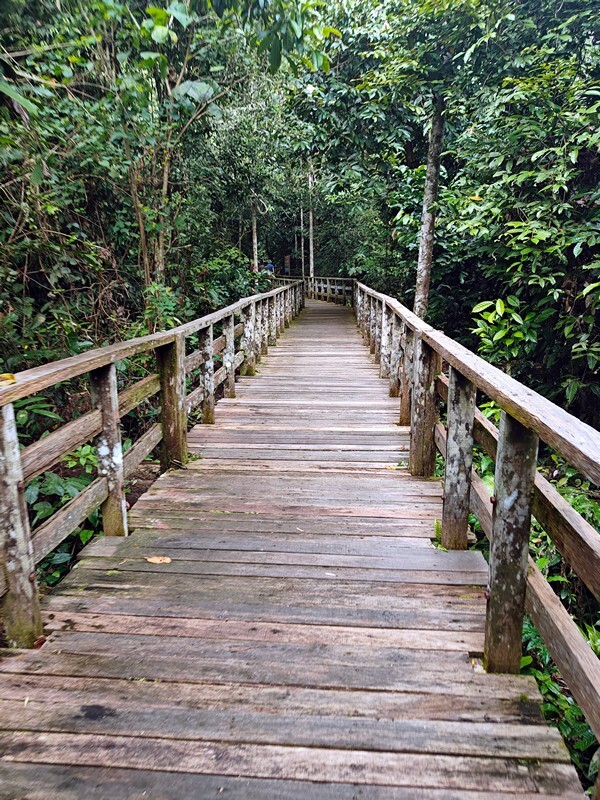
We arrived by opening at 9 and saw several mini van tour buses so we weren’t going to be alone but it could have been much more crowded. Christopher recommended that we walk along a raised boardwalk through the forest past the feeding platform to the nursery first and make it to the feeding platform 15 minutes before it starts.
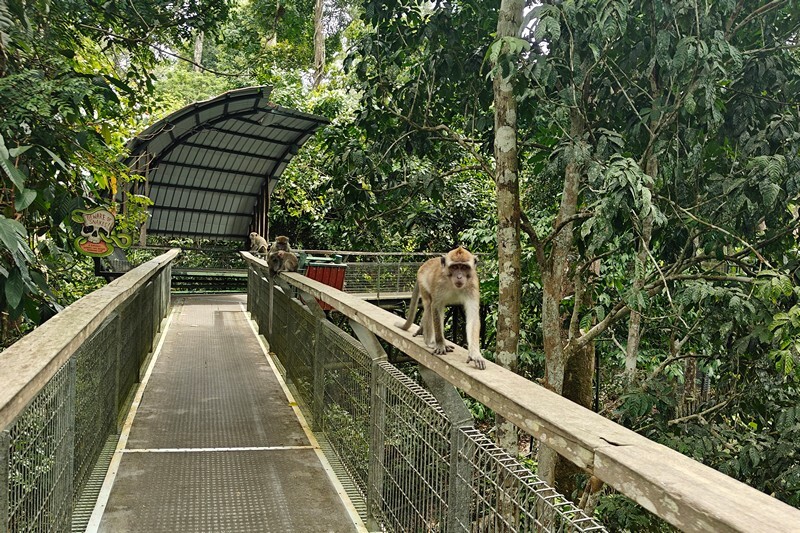
So we set out on the boardwalk to Nursery stopping for a few minutes at the feeding platforms where we saw several macaques.
 The Nursery is a building with a large play area outside with platforms and ropes that you view through large glass windows so as not to disturb the young animals who can come and go as they please. In attendance today was a quite large orangutan, several juniors and a couple of moms with little ones.
There are two viewing rooms: one with seating and ceiling fans and one with seating and air con (which didn’t seem to make a big difference). We went to both and the sad part was you were viewing through large glass windows which were not very clean. Fran took photos but some are not great for that reason. We watched for a while and were quite amused by the antics of the little ones. At 9:30 food was brought out and it was interesting to see that almost all the time they were eating, they had one hand on a rope or rail – like they were in position to take off if needed!


The Bornean orangutan is an orangutan species endemic to the island of Borneo. It belongs to the only genus of great apes native to Asia and is the largest species. It has a coarse, reddish coat and up to 1.5m / 4’11” long arms. Females range in body length from 1-1.2m / 3’3”-3’11” and males from 1.2-1.7m / 3’11”-5’7”. The Bornean orangutan is the third-largest ape in the world after the western gorilla. Body weights broadly overlap with the considerably taller Homo sapiens, but the latter is considerably more variable in size. By comparison, the Sumatran orangutan is similar in size but, on average, is marginally lighter in weight.
It has grey skin, a coarse, shaggy, reddish coat and prehensile, grasping hands and feet. Its coat does not cover its face unlike most mammals, although Bornean orangutans do have some hair on their faces including a beard and mustache. It also has large, fatty cheek pads known as flanges as well as a pendulous throat sac.
The Bornean orangutan inhabits Borneo lowland rain forests and Borneo mountain rainforests up to an elevation of 1,500m / 4,900’. Its diet includes fruits, seeds, flowers, birds’ eggs, sap and vines. It is highly intelligent, displaying tool use and distinct cultural patterns. It is critically endangered, with deforestation, palm oil plantations, and hunting posing serious threats to its survival.
The Bornean orangutan exhibits nest building behaviour. Nests are built for use at night or during the day. Young orangutans learn by observing their mother’s nest-building behaviour. This skill is practiced by juvenile orangutans. Nests may be elaborate and involve a foundation and mattress made by intertwining leaves and branches and adding broken leafy branches. Additional features such as shade, waterproof roof, “pillow”, and “blanket”, all of which are made from branches, twigs and leaves, may also be added. Nest-building in primates is considered as an example of tool use and not animal architecture.
At 9:40 we walked back to the feeding platform viewing area in the hopes of sussing out a good spot and there on the platform, partially hidden by the main post, was a large orangutan. We watched him (and many macaques) lounge around until the ranger came by with the large basket of food.


The ranger brought the basket directly to the orangutan (he sat up and watched him come) and he ate from it alone for quite awhile before the ranger dumped it out on the platform so all could share.


The macaques waited patiently on the sidelines:


Once he’d had enough, he made his way hanging from the ropes over to the forest and Fran thought we should head in that direction. Just before he came out of the forest onto the boardwalk, we could see his arm and another ranger closed off the gate so he wouldn’t be disturbed by us “gawkers” as he made his way further down.

 As much as we would have liked to follow him, we appreciated the care the rangers were giving to these creatures and how they understood that this would stress him out. After about 5 minutes they reopened the gate and he must have been off into the forest somewhere.
This was a great experience (except for the glass!) and we are very happy we came.
For lots more shots of this experience, click here.
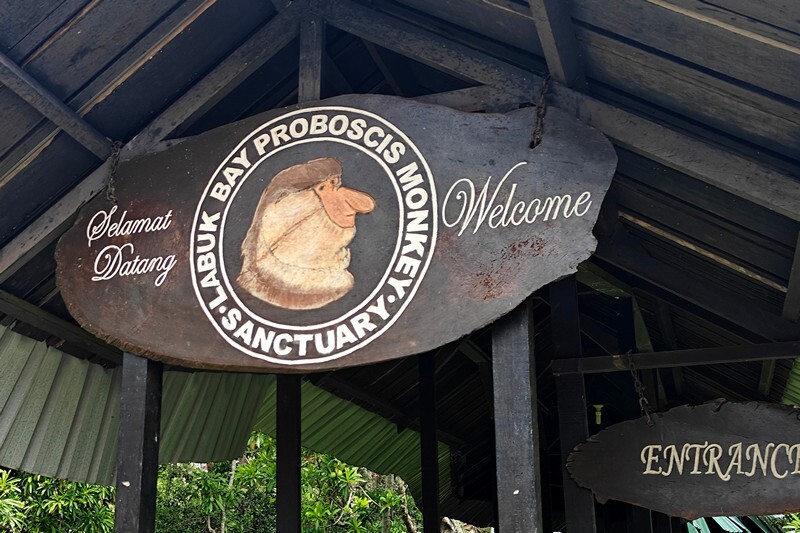
Then it was a bit of a drive to the Labuk Bay Proboscis Monkey Sanctuary. This sanctuary sits on a palm oil plantation in a mangrove swamp area and was created in the mid 1900’s when the plantation staff and workers were surprised to discover their food supplies being raided. An area was set aside with access to mangrove swamps and the trees the monkeys like. This raiding is when the monkeys developed a taste for coffee and pancakes.
The owners decided to create a tourist attraction by building two large feeding platforms over a kilometre apart and offering morning and afternoon viewing sessions. They feed them a modified reeipe of pancakes (flour and water) and cucumbers and it’s not so much they do not have to forage for themselves. The entrance fee here is 60 MYR ($14 USD). You don’t walk around in this place but must drive to the platforms after purchasing your entrance tickets. Christopher took us to Platform B for the 11:30 feeding.
The proboscis monkey or long-nosed monkey is an arboreal monkey with an unusually large nose (or proboscis, a reddish-brown skin color and a long tail. It is endemic to the island of Borneo and can be found in all three countries mostly in mangrove forests on the coastal areas of the island. This species is restricted to lowland habitats that may experience tides. It co-exists with the Bornean orangutan.
Males have a head-body length of 66-76cm / 26-30” and typically weigh 16-22 kg / 35-50 lb. Females measure 53-62cm / 21-24” in head-and-body length and weigh 7-12 kg / 15-26 lb. The male has a red penis with a black scrotum.
The proboscis monkey has a long coat; the fur on the back is bright orange, reddish brown, yellowish brown or brick-red. The underfur is light-grey, yellowish, or greyish to light-orange. Infants are born with a blue coloured face that at 2.5 months darkens to grey. By 8.5 months of age, the face has become cream coloured like the adults. Both sexes have bulging stomachs that give the monkeys what resembles a pot belly. Many of the monkeys’ toes are webbed.
Further adding to the dimorphism between the sexes, is the large nose (or proboscis) of the male, which can exceed 10cm / 4” in length, and hangs lower than the mouth. Theories for the extensive length of their nose suggest it may be sexual selection by the females, who prefer louder vocalizations, with the size of the nose increasing the volume of the call. The nose is smaller in the female and is upturned in the young. Nevertheless, the nose of the female is still fairly large for a primate. The skull of the proboscis monkey has specialized nasal cartilages that support the large nose.
We entered Platform B via the raised walkways and there were already a few monkeys waiting around – they know, it’s almost lunch time. We could see that several monkeys had already arrived and were just hanging around.


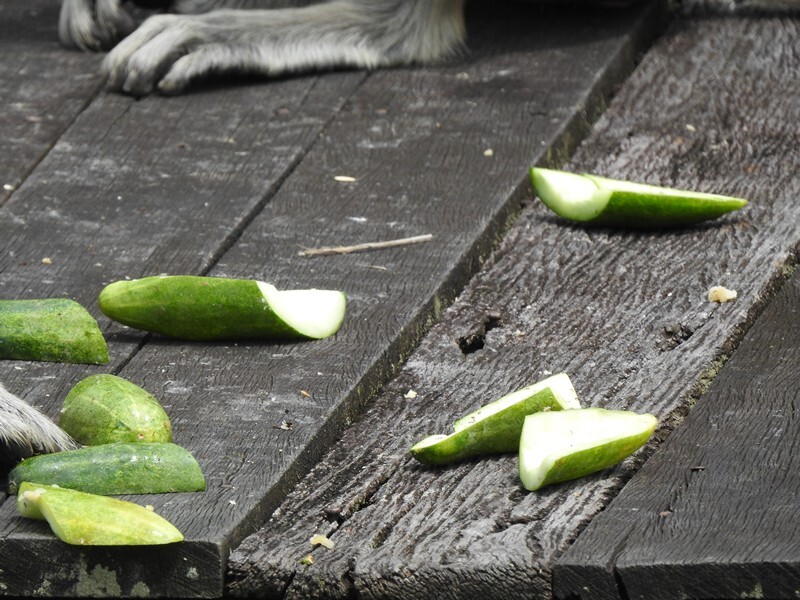


There are apparently around 300 monkeys in this sanctuary in about five difference groups and today we saw a couple of dozen visit to get food – different groups go to different platforms and daily numbers vary.


After lunch they take off and spread out; some into the play areas, some into the jungle and some went into the mangroves.


This was most enjoyable due to the numbers, the antics and seeing them come in from the forest, eat, play for a while and head back into the forest. Highly recommend this visit too!
Check this out for more photos of these unusual looking but cute, monkeys!
Driving back out of the palm plantation and towards the restaurant for lunch we passed lots of colourful palms that we thought were bamboo but Christopher called them red lipstick palms.
It was now lunch time for us humans and Christopher took us back towards Sepilok to a Chinese restaurant he knew would have vegetarian options and we had a decent lunch before visiting the Bornean Sun Bear Sanctuary (which is right across the road from the orangutans as a matter of fact but there are no set feeding times) so you can go anytime.
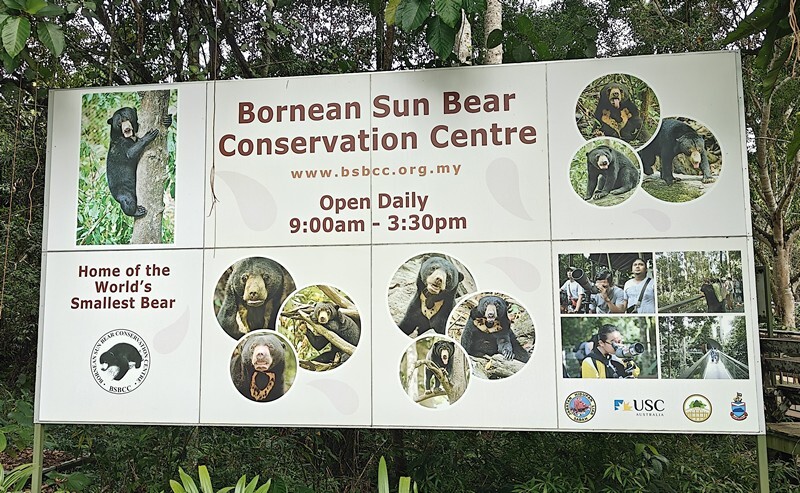
The sun bear is a bear species found in the tropical forests of Southeast Asia. It is the smallest bear species, standing nearly 70cm / 28” at the shoulder and weighing 25–65 kg / 55–143 lb. It is stockily built, with large paws, strongly curved claws, small, rounded ears and a short snout. Its fur is generally short and jet black, but can vary from grey to red. The sun bear gets its name from its characteristic orange to cream-coloured chest patch. Its unique biology – inward-turned front feet, flattened chest, powerful forelimbs with large claw – suggests adaptations for climbing.
The most tree-living of all bears, the sun bear is an excellent climber and sunbathes or sleeps in trees 2-7 m / 7-23 ft’ above the ground. It is mainly active during the day, though nocturnal behaviour might be more common in areas frequented by humans. Sun bears tend to remain solitary, but sometimes occur in twos (such as a mother and her cub).
They do not seem to hibernate, possibly because food resources are available the whole year throughout the range. Being omnivores, sun bears’ diet includes ants, bees, beetles, honey, termites, and plant material such as seeds and several kinds of fruits; vertebrates such as birds and deer are also eaten occasionally. They breed throughout the year and litters comprise one or two cubs that remain with their mother for around three years.
The global population is estimated to have declined by 35% since the 1990s due to deforestation, hunting and human infringement on their territory.
The Bornean sun bear occurs only in Borneo and it differs as it has a small skull than the Malayan sun bear.
The entrance fee here was again 30 MYR (oh and at all three places, Fran had to pay a 10 MYR camera fee). Here you again walk on raised boardwalks and there are also two viewing platforms. Number 1 had several people sitting there waiting for bears to show up so we after looking around for a couple of minutes we opted to move to the second one and that turned out to be a wise move.
There was a bear sleeping under a tree that you could just make out and/or spot through the rangers’ monocular that was set up and then one wandered by in the next “pen” but didn’t stay long. The sleeping fellow, woke up but only turned over and went back to sleep.

About 5 minutes later a different ranger came by throwing fruit into each of the three pens and out came the second one and a third one in yet another pen and then the first one woke up and we could observe them all. Macaque monkeys also appeared trying to steal their food.


It’s hard to get great photos when you’re looking down on them but at times, they cooperate and put their heads up!


There were chain link fences between the pens so at times it was hard to snap a photo but for the most part, we saw them eat and play. This was pretty special too!
Here’s the link to more bear shots.
Finding Christopher again waiting for us in the parking area, he offered to take us to the Rain Forest Discovery Centre but we’d read reviews on it and we’ve seen many rainforests in our travels so we passed on this. Also, being mid afternoon, whatever animals might be found, would be hiding from the heat this time of day. It’s about 30C / 86F now with a “feels like” temp of 38C. We too feel wiped.
So instead Doug asked about taking us to the Sandakan Death March Memorial in town and Christopher agreed and mentioned he could take us up to a Chinese temple with views over the city and the sea. We have not actually been in the city at all, as our accommodation is closer to the airport.
Traffic was slow especially for a Saturday afternoon but we made it to the Memorial Park.

The Sandakan Death Marches were a series of forced marches in Borneo from Sandakan to Ranua (well over 200 km) which resulted in the deaths of 2,434 Allied prisoners of war held captive by the Japan during WWII. By the end of the war, of all the prisoners who had been incarcerated at Sandakan and Ranau, only six Australians survived, all of whom had escaped. It is widely considered to be the single worst atrocity suffered by Australian servicemen during the Second World War.
The first phase of marches across wide marshland, dense jungle, and then up the eastern slope of Mount Kinabalu occurred between January and March 1945. The Japanese had selected 470 prisoners who were thought to be fit enough to carry baggage and supplies for the accompanying Japanese battalions relocating to the western coast. In several groups the POWs, all of whom were either malnourished or suffering serious illness, started the journey originally under the intention of reaching Jesselton (what is now known as Kota Kinabalu). Although the route took nine days, they were only given enough rations for four days.
A second series of marches began on 29 May 1945 with approximately 536 prisoners. The new Sandakan camp commander, ordered the prisoners towards Ranau in groups of about fifty with accompanying Japanese guards. The march lasted for twenty-six days, with prisoners even less fit than those in the first marches had been, provided with fewer rations and often forced to forage for food. Compound No. 1 of the Sandakan camp was destroyed in an attempt to erase any evidence of its existence. Only 183 prisoners managed to reach Ranau. Upon their arrival on 24 June 1945, participants of the second marches discovered that only six prisoners from the first series of marches during January were still alive.
Approximately 250 people were left at Sandakan after the second march departed. Most prisoners were so ill that the Japanese initially intended to let them starve to death, forcing many to scavenge in the surrounding forest for food. However, on 9 June 1945 it was decided to send another group of 75 men on a final march. The remaining men were so weak that none survived beyond 50 km / 30 mi. As each man collapsed from exhaustion, he was shot by a Japanese guard. All remaining prisoners left at Sandakan who could not walk either were killed or died from a combination of starvation and sickness before the Japanese surrender on 15 August 1945. Many Japanese soldiers also died from starvation, with some even turning to cannibalism in order to preserve their fighting effectiveness.
Due to a combination of a lack of food and brutal treatment at the hands of the Japanese, only 38 prisoners were left alive at Ranau by the end of July. All were too unwell and weak to do any work, and it was ordered that any remaining survivors should be shot. They were killed by the guards during August, possibly up to 12 days after the end of the war on 14 August. It has been estimated that in total, approximately 16% of the population of North Borneo were killed during the three years of Japanese occupation.
We felt this memorial park on the grounds of the former POW camps was very well done. A museum sits on the site as well but it was in the process of being rebuilt and we could not visit. There were information plaques around the walkways and evidence like concrete water tanks still exist.


 Christopher then drove us up to an altitude of a whopping 95m to the Puu Jih Shi Buddhist Temple which had just closed (we have seen many such temples before) and took us out to the large patio that surrounds it with views to the sea. Here we could see islands, freighters, fish farms and part of the city including a Sheraton Hotel that been abandoned due to COVID.


It was now around 4pm and Christopher took us “home” after stopping to show us a good place to eat dinner tonight and picking up a couple more beer. We paid $300 MYR ($67 USD) for his services today and it was money well spent; no driving, no navigating, lots of information and air conditioning! Thank you, Christopher!
We also saw lots of kingfishers, a monitor lizard and TOO many palm oil plantations.
By the time we got back, we were quite wiped and the thought of walking in the heat a kilometre to fetch dinner was not appealing. We decided to try and order with Grab and tonight were successful getting a couple of pasta dishes with our beer.
We both crashed on the early side and neither of us slept well; not sure if it was the beer, the bed/pillows or what but Doug had no mojo to run today and we just hung around the apartment before catching a Grab back to the Sandakan airport at 11 for our 2pm flight back to Singapore via Kuala Lumpur again.
The Sandakan airport is NOT an international airport and again, like when we arrived, we went through immigration. One of the security clearance people told us it’s because we are on an island with two other countries on it and they want to be sure, no one has entered Malaysia illegally. Okay……
There was little in the way of food options at this airport (but we did buy some chocolate at the shop as it was cheaper than in Oz!). On board we were given a meal but, as is often the case, not a very good one. We looked in Kuala Lumpur during our layover and choices were slim there too; it’s mostly high end shopping but we did find a place for some lunch/dinner before boarding the short flight back to Singapore.
SINGAPORE – part deux
As we are only here for two nights, one day, it wasn’t worth creating a separate post for it, so we’re tagging it on here to this one.
We actually arrived early in Singapore, got thru the speedy immigration, waited a bit for our bags and caught a Grab back to the same hotel we stayed at then night before flying to Borneo but this time got a slightly bigger room – the other one had NO walking space and felt quite cramped. We watched one show and hit the hay. We both slept well and long. Doug tried for a better run and was successful. After Fran did yoga and showered, he was back and we had a video chat with Serena.
Doug had a few errands to run so Fran stayed behind for a bit to do some website work and then she joined him down at East Coast park to check out the beach:

then we went to Tim Horton’s for lunch! It was yummy! They have a different menu than back in Canada but this location actually had Maple Dip donuts which are Fran’s faves and pretty much the only donut she ever eats.

 Views along our stroll of Joo Chiat Road:


On our hot walk (it’s quite sunny today with highs of 34C / 93F without the humidex and 39C/102F with it) back towards the hotel we stopped at Koon Seng Road to check out the Peranakan Terrace houses.
These pretty, quaint shop houses are home to the Peranakan, Chinese descendants who moved to Singapore in about the 15th century. The Joo Chait and the Katong Districdt was once known for its coconut plantations but in the early 20th century the area became more developed into a residential suburb which lead to the Peranakans building these stunning colourful shop houses that you see today. The unique architectural style of Peranakan houses, formally known as “Straits Eclectic”, combines Chinese and European influences. Carved timber doors, gable ends, air vents, and air-wells reflect the Chinese influence, while the “goh kha kee” or five-foot way in front of the houses provided shade and a communal space. The front of these houses are so decorative, it is like a heady visual perfume: brightly coloured tiles, elaborate doors, wood shutters and large gold Chinese characters. It is distinctly oriental, but the floral plaster motifs look Western and looks unified.


 We stopped for a couple of cold drinks and other small items and then Fran went back to the hotel while Doug went in search of a pedicure. We walked around the corner for dinner that night and then back past the hotel for some gelato before going to bed a bit early as we had to get up at 5:30 am. Fran is feeling a bit under the weather; seems she has a sore throat which could mean a cold is on the way. Dang.
We were out of the hotel at 5:45 and caught a Grab to Terminal 3 of the Singapore airport. We hardly slept because Fran’s sore throat turned into a cough and she couldn’t settle well. At the airport we found some cough syrup in a 7-11 and hopefully she will fly well. We hit the duty free for a bottle of Bailey’s and our flight departed more or less on time.