

May 7th, 2025
Samoa, officially the Independent State of Samoa and known until 1997 as Western Samoa, is an island country in Polynesia, consisting of two main islands: Savai’i and Upolu, and other smaller islands, both inhabited and uninhabited. Samoa is located east northeast of Tonga, west of American Samoa and northeast of Fiji. The capital and largest city is Apia. It is smaller than the state of Rhode Island and slightly larger than Luxembourg.
The Lapita people discovered and settled these islands around 3,500 years ago. They developed their own language and cultural identity.
Today, all of Samoa is united under its two principal royal families: the Sā Malietoa of the ancient Malietoa lineage that defeated the Tongans in the 13th century; and the Sā Tupua, Queen Salamasina’s descendants and heirs who ruled Samoa in the centuries that followed her reign.
Because of the Samoans’ seafaring skills, pre-20th-century European explorers referred to the entire island group, including American Samoa, as the “Navigator Islands”. The country became a colony of the German Empire in 1899 but that ended in 1914 after New Zealand troops bloodlessly occupied the colony at the start of WWI. New Zealand officially gained control of the region as a League of Nations mandated in 1920. After being converted into a United Nations Trust Territory in 1946, Samoa gained independence on 1 January 1962, the first small-island country in the Pacific to become independent. The 1960 constitution, which formally came into force with independence, builds on the British pattern of parliamentary democracy, modified to take account of Samoan customs. It has been a sovereign state and a member of the commonwealth since 1970.
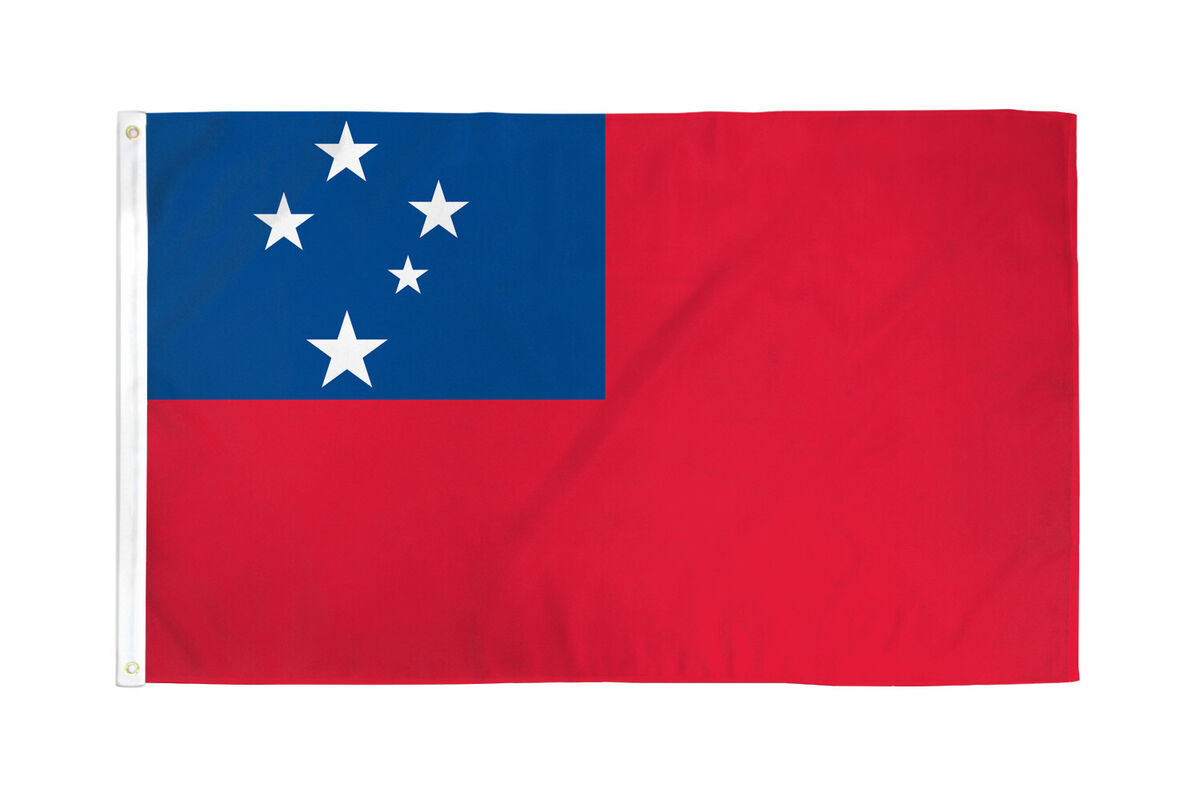
The Samoa flag, features a red field with a blue canton in the upper left corner, representing courage and the struggle for independence, and freedom, respectively. The five white stars in the canton represent the Southern Cross constellation, signifying Samoa’s location in the South Pacific. The flag also symbolizes loyalty, purity, and patriotism.
Currency: The Samoan Tala WST$ – 1 WST is $0.36 USD and $0.50 CAD
Petrol/Diesel price: 3.021 WST per litre which is about $4.10 USD a gallon
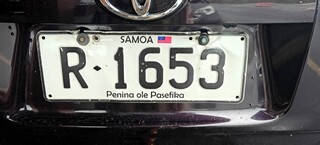
License plate:
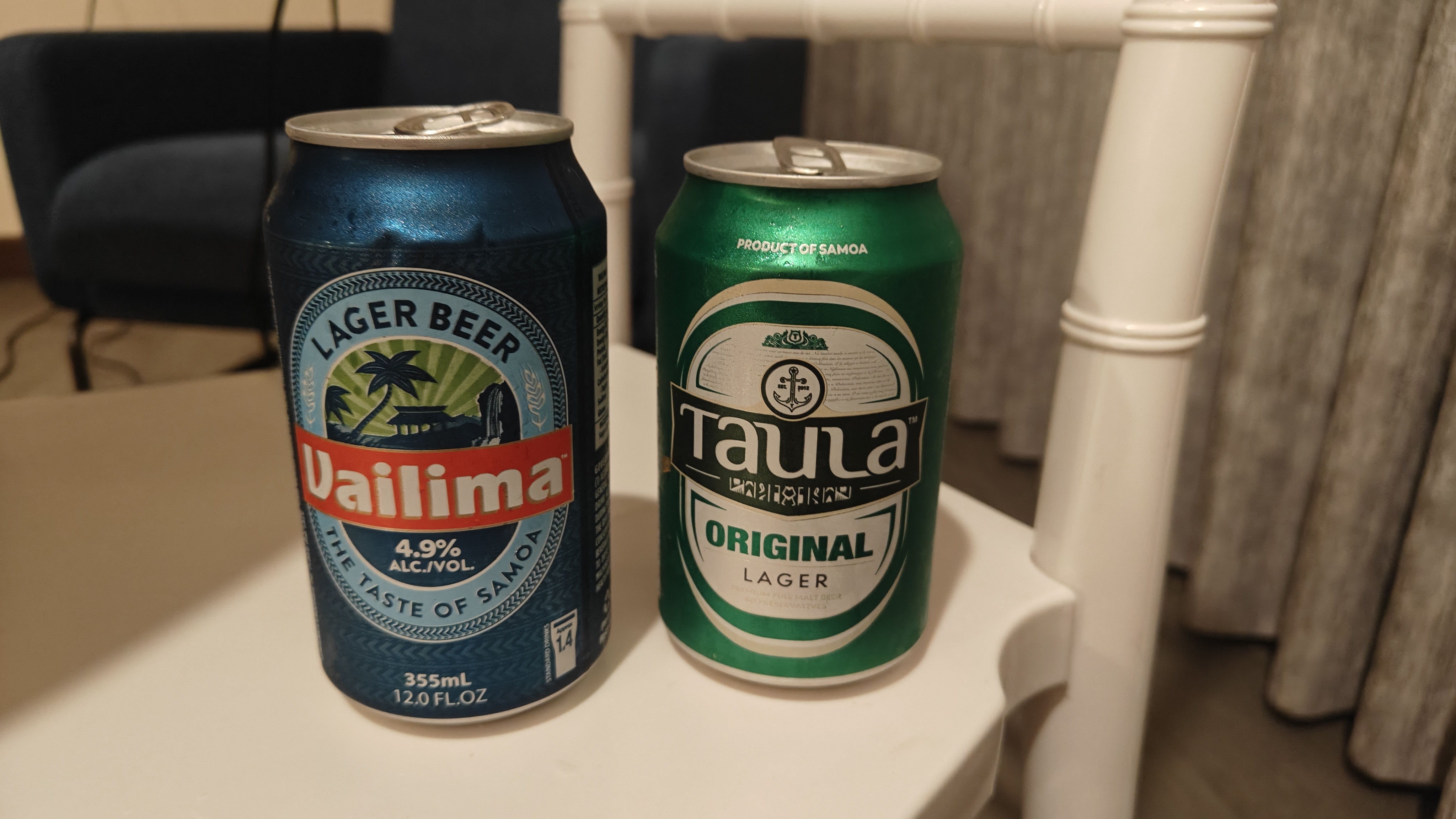
Beer: Taula and Vailima
After a flight of less than two hours and a one hour advancement in time, we landed in Samoa at the Faleolo Airport about 30km / 20 mi west of the capital city, Apia. ATM’s were available at the baggage claim, bags came out fairly quickly, we got a Vodafone SIM cards quickly 55 Tala for us both with 16GB and 29G (just under $20USD). Our car rental office was right there at the airport.
Our arrival was in a heavy downpour and the weather forecast looks quite wet for our week here. We have a few things we want to get done while we’re here (teeth cleaning and such before going back to the US) so we can work around good “spells” of weather for sight seeing.
Like in Fiji, cash is king, and instead of pay the extra 4.5% they charge for credit card use, we paid cash and then had to leave a “bond” (deposit”) for the rental. This we did not want to leave in local currency because what would we do with that when we returned the car and boarded the plane? So Doug had previously had them agree to a mix of USD and CAD in an equivalent amount to hold and return upon return of the car.
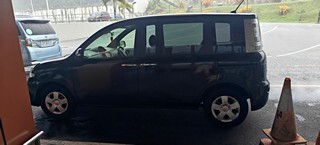
The car we got was a Toyota Sienta which was automatic and the rear doors slid open like a van:
The lady at the office then asked us for a ride into Apia as she was going just a couple of hundred metres past our booked accommodation anyway so we did that before arriving at Olivia’s Accommodations. Here for $56 USD we got a room with a queen bed, private bath, fridge, AC and a desk and the rate included breakfast.
As it rained hard the entire drive, we didn’t take photos but much of the drive was right along the north coast with lots of views of the ocean.

We put our bags in the room after checking in and went out for dinner to a really nice place called Paddles. It’s run by a Samoan/Italian couple and their family. The food was amazing and here is how they present their wine list:

After dinner we stopped at the grocery store next door for some drinks, water and snacks before returning to our room for the night. It’s not fancy but it was clean and does the job.
We have been trying to sort out a ferry to get us to Samoa’s other big island and that seems complicated. Despite the ferry company’s website having a “Book Now” button, nothing happens. Fran emailed last week and got no replay so she called from Fiji and was told you have to come into the office in Apia! Then we had learned that rental car companies can arrange this for you but our company had no luck with a range of dates. Thursday morning, Doug went for a walk before breakfast and passed by the ferry office (it was right next door to where we had dinner) and was told to come back at 8:30 – seems the ferries are busy this week – we think for Mother’s Day – and we’ll see what we can sort out. That didn’t pan out either – totally booked but we could try stand by. We don’t fly out till the 14th so we have time.
So the plan for Wednesday was to try and get onboard the 4pm ferry. So we were taking the scenic route (the ring road) and made several stops. The weather threatened rain a lot, did rain on and off but the sun gods were on our side as every time we stopped to see something, the rain stopped! The sun didn’t always come out but many times it did.
First was the Falefa Waterfalls where we had to pay 5 tala each even though it’s just a roadside pullout at best.
 Then it was to see the Le Mafa Road viewpoint – free:

We passed by the Lake reservoir:

and then hit the east end of the island to go south to check out Lalomona beach – said to be the best on the island.
Shots enroute of the east end of the island:


While it was very nice there were no public section, you had to pay to get on the beach or sit in a fale. We did snap these shots from the car:


A fale is covered platform with often only one wall. You can rent these for picnics or to sleep on. We didn’t see any mattresses in any but perhaps due to the weather, they had taken them inside somewhere – ?


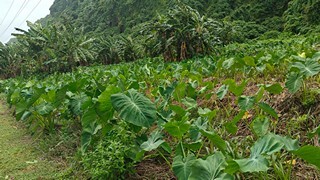
We passed a lot of agricultural land with fields of taro.
Next stop was not one we planned but Fran saw a ping for it on our Organic Maps app: the Sua Ocean Trench. This was like the cenotes you find in Mexico. We had to pay to enter (10 tala each) but it was worth it just for the views in the surrounding park. Unfortunately, the trench itself was closed due to “strong currents and bacteria in the water” but we did get to see it:

And yes, the water looked yucky. But we walked around the park and the waves, rocks and views were great.

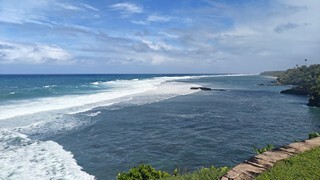


There was even a rock swimming pool at the water’s edge but it was closed today too. There are LOTS of these on the island; makes for safer swimming for families although later in the trip, we did see a lot of them where women were doing their laundry.

On the next piece of the drive:
Then went to check out Sopo’aga Waterfalls which was tall and lovely – photo at the top of this post after which we stopped in Pupa Pue National Park to see Togitogiga Waterfalls:
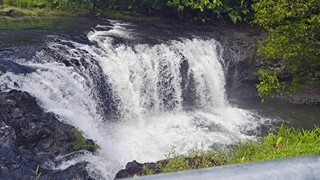
All the falls were running well with all the rain they’ve been having.
We then tried to get to the “Return to Paradise” beach from the Gary Cooper movie of the same name only to be stopped at a gate; some resort has taken over the land and beach and now there is no free access.
We have now almost done the complete ring road around the island and have arrived at the ferry terminal at 1:15. There actually was a 2pm ferry which no stand by cars seemed to make and there were enough ahead of us that we felt we wouldn’t get on the 4pm either. Fran had counted the cars that came off the ferry and there were only 28 so it’s not a large ferry.
The staff told us that there will be a 6pm special ferry today to take the overflow but we decided it was not worth the risk of not being able to come back by Sunday/Monday with all the people over there for Mother’s Day. There is only one ferry sailing for each of the two companies on Sunday so we sadly opted to skip heading over to Savi’i. The main thing we wanted to see over there was a white sand beach and it’s not like we haven’t see any of those in the past few weeks!
So as we were driving back to Apia, completing the ring road as we passed the international airport, Fran began to look for a hotel for a week hopefully with a beach in Apia. There was nothing but a nearby Sheraton came up at what seemed like a decent price so we looked on the Marriott app as well and could get a slightly better price than Booking.com and decided to turn around (it was 3km from the ferry) and go there to see what a walk-in price would be. Their price was similar to Booking.com but we booked through the app and paid a bit less. We had to wait till the room was ready due to a late check out so we went to the bar for a beer.

We got a king room with a sea view, private bathroom, decent Wi-Fi, fridge, kettle and buffet breakfast included for $94 USD per night. There’s a small beach, a large pool, two restaurants, a gym, a spa and a shuttle to town (not free so we’ll just drive). The weather stayed dry all afternoon and we can only hope for the best for the next 6 nights!

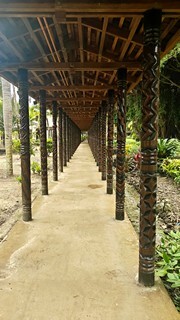


After getting settled in our room, we went for dinner at the bar where we meet a couple of New Zealand whom we chatted with for a while. They too had only arrived yesterday but were only staying here for 3 nights then on to another resort for 3 more.
We had a quiet night in super comfy beds but Fran was beginning to feel a little “off”. Next morning she felt worse but couldn’t quite say what it was; her head hurt, she was tired, a bit of a scratchy throat and upset tummy.
We went for breakfast around 9 (since it’s a buffet we’ll take advantage of a big early included brunch) and then went into town looking for a dentist for teeth cleaning and a laundry place. We found the first quite quickly and they texted about 2 hours later to say it was all done; washed, dried and folded for less than $12USD. We struck out at the first potential dentist – it was closed and seemed to run by the LDS church with super strange hours and after a bit of confusion Fran found the second one and made appointments for Tuesday morning.
Since we’re in town and it’s 35 km from our hotel, we thought we see a few sites. First was the Robert Louis Stephenson Home and Museum.


Robert Louis Stevenson (1850 – 1894) was a Scottish novelist, essayist, poet and travel writer. He is best known for works such as Treasure Island, Strange case of Dr. Jekyll and Mr. Hyde, Kidnapped and A Child’s Garden of Verses.

Born and educated as a Christian in Edinburgh, Stevenson suffered from serious bronchial trouble for much of his life but continued to write prolifically and travel widely in defiance of his poor health. In 1890, he settled in Samoa where, alarmed at increasing European and American influence in the South Sea Islands, his writing turned from romance and adventure fiction toward a darker realism.
In many respects, as he grew older, Stevenson moved away from his upbringing. His dress became more Bohemian; he wore his hair long, he took to wearing a velveteen jacket and rarely attended parties in conventional evening dress. Within the limits of a strict allowance, he visited cheap pubs and brothels. More significantly, he had come to reject Christianity and declared himself an atheist.
In January 1873, when he was 22, his father came across the constitution of the LJR (Liberty, Justice, Reverence) Club, of which Stevenson and his cousin Bob were members, which began: “Disregard everything our parents have taught us”. Questioning his son about his beliefs, he discovered the truth: Stevenson no longer believed in God and had grown tired of pretending to be something he was not asking “am I to live my whole life as one falsehood?” His father professed himself devastated: “You have rendered my whole life a failure.” His mother accounted the revelation “the heaviest affliction” to befall her. Stevenson’s rejection of the Presbyterian Church and Christian dogma, however, did not turn into lifelong atheism or agnosticism. On 15 February 1878, the 27-year-old wrote to his father and stated:
“Christianity is among other things, a very wise, noble and strange doctrine of life. You see, I speak of it as a doctrine of life, and as a wisdom for this world. I have a good heart, and believe in myself and my fellow-men and the God who made us all. There is a fine text in the Bible, I don’t know where, to the effect that all things work together for good for those who love the Lord. Strange as it may seem to you, everything has been, in one way or the other, bringing me nearer to what I think you would like me to be. ‘Tis a strange world, indeed, but there is a manifest God for those who care to look for him.”
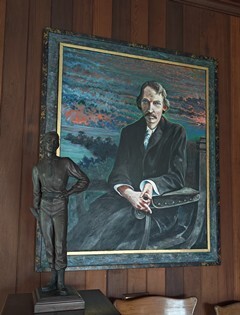
Stevenson did not resume attending church in Scotland. However, he did teach Sunday School lessons in Samoa, and prayers he wrote in his final years were published posthumously.
He died of a stroke in his island home in 1894 at age 44.
A celebrity in his lifetime, Stevenson’s critical reputation has fluctuated since his death, though today his works are held in general acclaim. In 2018, he was ranked just behind Charles Dickens as the 26th-most-translated author in the world.
This cost 20 tala each and the house is quite nice. We were in between their offered tours but they lent us a book to use to see info on each room on our own. The grounds are huge and used to be a plantation.
Main Salon:

RLS’s room:

The Great Room including a music corner and the grand staircase:


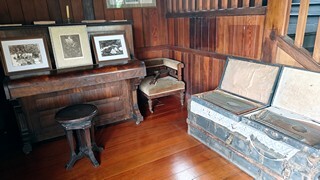

Then it was on to Piula Cave Pool outside the city on the east side about 20 km. As the weather is still on and off sprinkling, we weren’t planning on swimming (and Fran was not feeling well) but we wanted to see this attraction.
It cost of 10 tala to get in and we drove down and found this:

The water is quite clear and it’s nice looking but no regrets about not going in on this mostly rainy day.
By now it’s 2:30 and Fran just wants to lie down. We head back towards the city stopping for a few groceries and we decided to postpone the city tour till Tuesday when we come back for the dentist.
Traffic was not good and it took us till 4:30 to get back to the hotel.
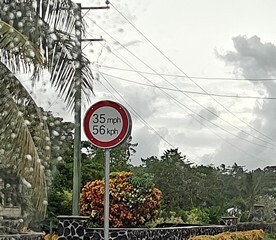
The roads here are narrow, in decent shape for the most part if you stick to the ring road but can be so slow! The most common speed limit signs say “35mph / 56 kmph” and most people drive slower, sometimes excruciatingly slower. The rain doesn’t help as they slow down even more!
We ate dinner in our room tonight and watched the movie “Cast Away” recognizing much of the island Chuck was stuck on for four years. It rained hard and must have been a lot overnight as the grass between us and the beach was flooded in some spots but the sky was “lighter” by morning and the sun tried to come out on Saturday.
For more pics of these first few days in Samoa click here .
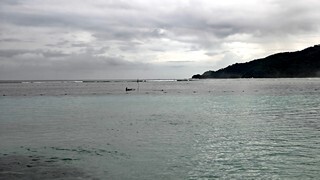
Fran got some website “work” done in the morning around our late breakfast buffet and at 2pm we went out for a bit. We drove back to the south side of the island (on the cross island road this time) to the Giant Clam Sanctuary. Now we’ve seen plenty of clams in our snorkeling trips but never giant ones.
Enroute, we decided we should try again to head over to the other big island of Samoa, Savi’i and thought we should be walk on passengers and try and get a one day rental on the other side. Doug had found a company so Fran called while we drove and arranged it. They will meet us when we get off the very first ferry and we should have enough time to see the two main areas we want to see before returning on either the 2nd last or last ferry.
Here at the beach where the sanctuary is located, there is a rudimentary change room (with a fresh water shower) and they give you snorkel gear including fins (seems you have to ask for those though) all for 20 tala a person. You walk down a short set of stairs and swim out (or take a kayak) to the cordoned off section about 25m away.

Unfortunately, we forgot to bring the underwater camera so we didn’t take any photos but we’ve added a few shots from Google below.
Giant clams are the largest living bivalve mollusks. These clams were known to indigenous peoples for thousands of years and Europeans first documented them in 1521. They may weigh more than 200 kg / 440 lbs, measure as much as 120 cm / 47” across, and have an average lifespan in the wild of more than 100 years.
The giant clam lives in flat coral sand or broken coral and may be found at depths of as great as 20 m / 66’. Its range covers the Indo-Pacific, but populations are diminishing quickly and the giant clam has become extinct in many areas where it was once common. The creature’s mantle tissues act as a habitat for the symbiotic single-celled algae from which the adult clams get most of their nutrition. By day, the clam opens its shell and extends its mantle tissue so that the algae receive the sunlight they need to photosynthesis. This method of algal farming is under study as a model for highly efficient bioreactors.
The mantle border itself is covered in several hundred to several thousand pinhole eye-spots approximately 0.5 mm /.020” in diameter. Each one consists of a small cavity containing a pupil-like aperture and a base of 100 or more receptors sensitive to three different ranges of light, including UV. These receptors allow the clams to partially close their shells in response to dimming of light, change in the direction of light, or the movement of an object. The optical system forms an image by sequential, local dimming of some eyes using pigment from the aperture.
The largest known specimen discovered in 1817 measured 137 cm / 4’6”, and was estimated to be 250 kg / 550 lbs alive. A heavier giant clam was found in 1956 in Japan weighing an estimated 340 kg / 750 lbs alive.
Giant clams are filter-feeders, yet 65-70 percent of their nutritional needs are supplied by zooxanthellae. This enables giant clams to grow as large as one meter in length even in nutrient-poor coral-reef waters.
These clams reproduce sexually and are hermaphrodites. While self-fertilization is not possible, having both characteristics does allow them to reproduce with any other member of the species as well as hermaphrodically.
Once you reach that area, you begin to see small clams right away and there are LOTS of them and when you reach the flag, you see the really, really big ones like a metre or more across!
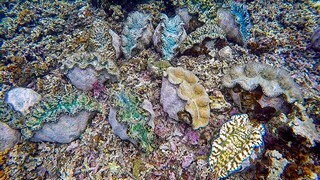

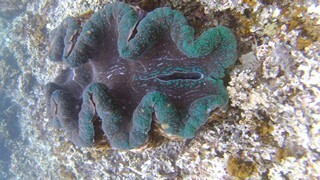

This was very cool and we are so glad we came over (sad about not getting our own photos….). There are turtles here at times as well but we did not see any but then we stuck around the giant clams area and didn’t venture too far east. There was some coral in poor shape, some fish but not many and we saw several blue star fish as well.

We didn’t stay that long as the area is small but really enjoyed it. After a quick shower and change we returned to the resort. We had dinner at the resort with a view of the ocean.
Sunday, Mother’s Day – as mentioned above, this is a big holiday here with Monday being a stat holiday tomorrow. Josh reached out to Fran in the morning. It was a partly cloudy sky and the day stayed dry. We took a “day off” sightseeing and spent the day at the beach and pool including the swim up bar. It rained for a few minutes about 3 times but only hard once the first bout and we hung out in the bar area for a bit while Fran took a call from Serena for Mother’s Day.
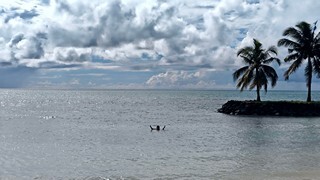
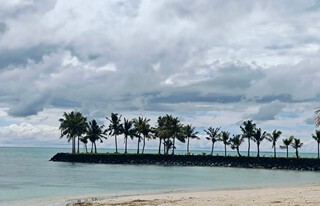
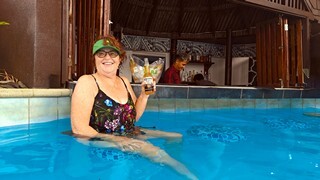
That evening our time, we had our monthly KEGS meeting in the room.
Monday, the public holiday for Mother’s Day here, we were up early – before the sun! – to catch the 6am ferry. The ferry terminal is very close by and we were parked, had tickets and began boarding at 5:40. The crossing is supposed to take 60-90 minutes and in this direction it took the full 90. We called the rental car guy from Jetz Rentals and he came and picked us up, we did the paperwork, left the “bond” and were on our way. For this day trip, we had a Mazda.
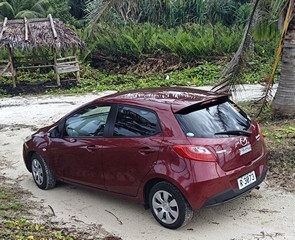
We had a few places we wanted to see but naturally, there were not near each other so first we went to the Alofaaga Blowholes – supposed to be some of the most spectacular in the world at high tide. Well high tide was about two hours before we got there but boy, they did not disappoint!
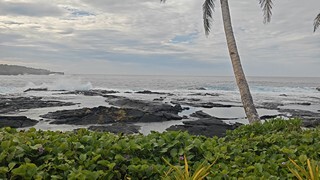
The Alofaaga Blowholes, also known as the Taga Blowholes, are a natural feature located on the island of Savai’i in Samoa. he entrance to the blowholes is in the village of Taga.
In this area, lava flows have created a series of tubes connecting a flat clifftop of lava rock with the ocean below. Waves breaking against the lower end of the lava tubes send water at high pressure up through the tubes, creating fountains that spray every few seconds. The village charges a small admission for entry to view the blowholes. The area is unfenced and surrounded by wet, slippery rocks which can be dangerous.
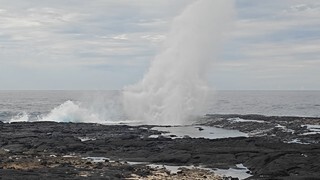
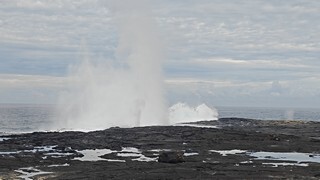
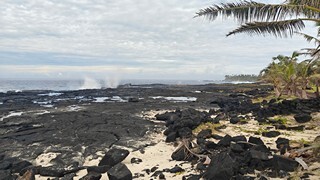
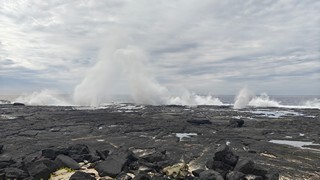
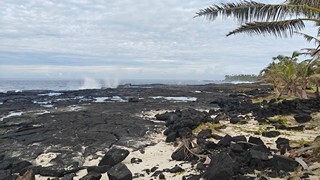

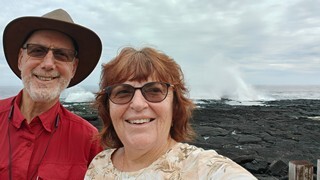
The dirt road went beyond the lookout so of course we had to check it out but we did hit a dead end before we expected to based on the map on our phone.
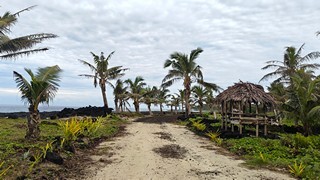
When we turned around the leave, we stopped near the beginning of the lava outcroppings to watch the waves:

We had planned to return the way we came to get to Manase on the northeast coast but measuring the distance the other way, we figured we could do that no problem so we ended up circumnavigating the entire ring road.
We passed lots of little villages, lots of churches (as each village likes to have its own), lots of LDS halls and lots of coastline, farmland (lots of loose pigs and chickens!) and forest.
Upon reaching the north side of the island, we looked for a place to have lunch as it was nearing 11 and we’d been up since 5 which was too early to get breakfast at the Sheraton. We hoped to find something with a sea view.
We stopped at a a couple of beaches looking with no luck.
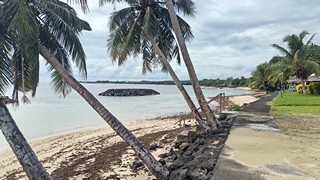
It took a while but we ended up at the perfect place: Barefoot Bar & Restaurant and they were open for lunch. We were the only ones there and had a lovely lunch view.
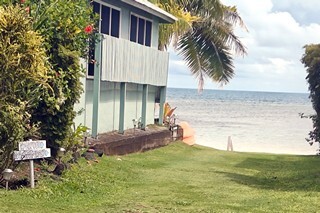
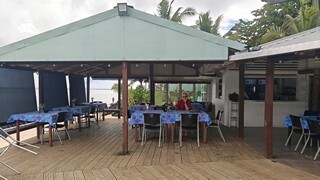

We started with a mocktail called a Snowman which we both enjoyed (pineapple, ice cream and coconut cream) and then had a good lunch.
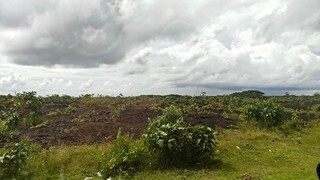
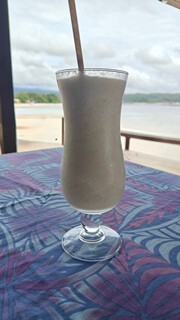 We next wanted to check out the lava fields but as we began passing them they did not look any different from those we’d seen in many countries and in fact had a fair amount of vegetation on them.
 More sea views on the way back to the ferry:
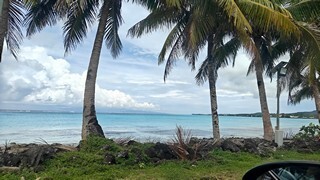
So we continued southeast, topped up the tank and returned the rental car. The day rental cost 120 tala once we got out 300 WST bond back and if we’d brought our car over it would have been 200 tala return so it was a smart way to visit Savai’i. We have now done the ring roads on both of Samoa’s largest islands.
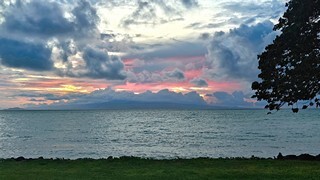
This 2pm ferry back only took an hour but upon docking the boat hit the dock so it had to back up and re park and we were back the hotel by 3:30. We had dinner at the hotel restaurant with a sea view and a really pink sunset.
 Tuesday, our last full day was a very wet day with rain most of the morning. Breakfast was super windy and most tables got wet a bit – there is a roof but no walls over this area.
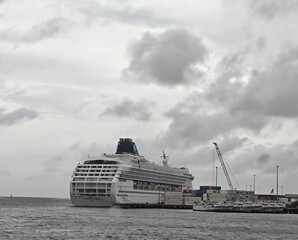
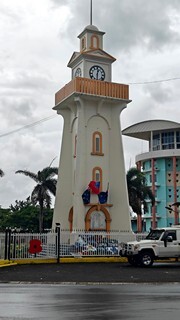
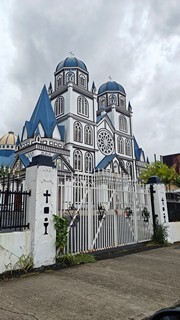
We went into the city (34 km away) giving a ride to an American woman, Sherry, that was also heading into the city. After dropping her off, we went for our teeth cleaning, found a market to buy a couple of gifts and our usual country souvenir and then took a short stroll and drive to see the few sites the city has to offer. There was a cruise ship in port so there were lots of people wandering around. We met two couples from New Brunswick!
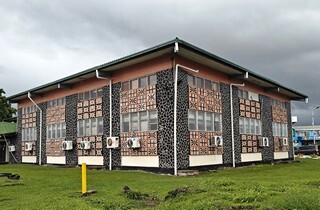

We then drove over to the Museum of Samoa to learn about the country’s history. It was no longer in the same building as our info said but had moved into the Cultural Centre and all we found was one small room of exhibits! This was mostly about archaeology and the founding of the Methodist Church in Samoa.
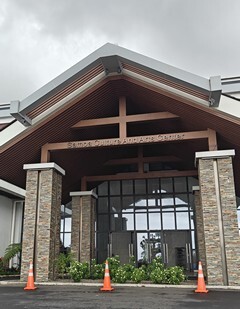
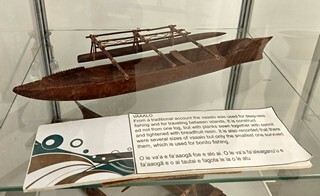
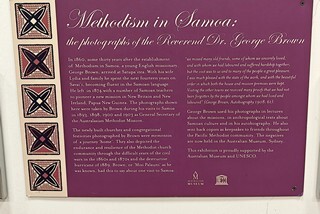

The entire time in the city, we kept looking for a place to both get pedi’s. The first place which we had found last week was open but there was no customers and the two women that were there were Asian (unlike when we were there on Thursday) and they didn’t seem to speak English. They had us put our feet on a shelf and were about to begin just taking the polish off Fran’s nails when we asked “don’t you soak the feet first?” as Doug wanted his feet scraped. They did not understand so we left. We tried Mr. Google for another place but it either ended up being a hair salon or did not exist. We have been finding that Mr. Google is more wrong than right these days.
It’s now almost 2 and we’ve had enough so we returned to the hotel. The wind was still present and the sky was pretty dark the rest of the day. It was not a good day to sit on the beach unfortunately. We went for appies and a drink at the bar before dinner time and then finished up the remainder of our groceries for dinner.
Wednesday, the 14th of May, after breakfast we checked out of the Sheraton and drove to the other airport in Apia on the other side of the city to catch our Samoa Airways flight to American Samoa. The confirmation advised getting to the airport only two hours ahead and Doug had arranged with the rental car company to meet us at this airport.
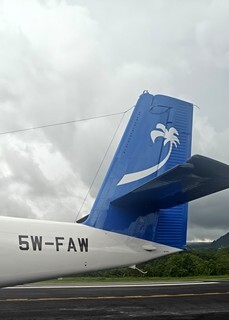
Well, we arrived at 9:45 instead of 10:35 (traffic was not as bad as yesterday) and we met the lady to hand the car back to. She had our “bond” to give back to us and we went to check in.
It seems there was a 10:15 am flight to Pago Pago and without actually telling us so, they put us on that flight and made us hurry up as we “were delaying the departure”. So we rushed through immigration, Fran didn’t even finish filling in the form, the woman just said “sign the bottom and go” and we hurried on to the plane. It took off and about 15 minutes later we landed back in Apia! They made no announcement until we landed which was hard to make out but it appears something was wrong with the plane and they needed an engineer to look at.
We all disembarked and we put in the departure lounge where there’s no food or bathroom. About 12:20 a plane arrived, our luggage was transferred and we were put on that plane which was probably our original 12:35 flight anyway.
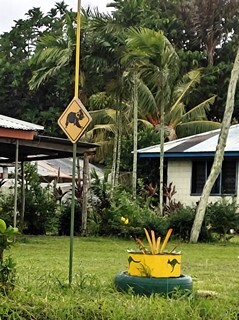
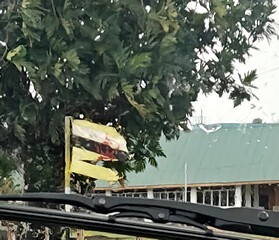
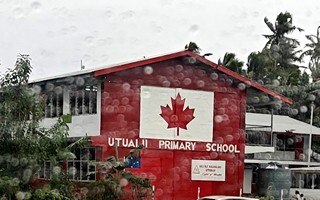
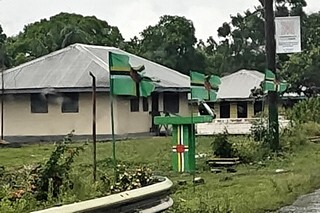
Now something we didn’t mention that we noticed around much of the island of Upolo, is that the villages have decorated their main road with country flags. When you leave the main airport and head into Apia (remember that’s 34 km) you first see Australia:
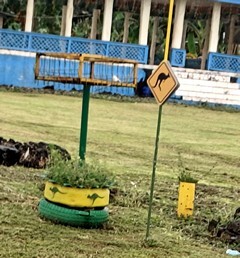
then Bahamas,
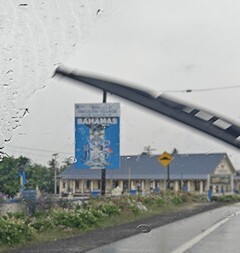
Botswana:
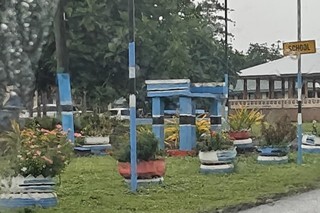
Brunei
Canada
Dominica
and so on. When we were inland a few days ago we passed Rwanda.
We drove a total of 565 km / xx mi on both islands in Samoa.
This link will take you to the rest of our Samoan photos.
Our thoughts on Samoa:
-
a very religious country with SO many churches
-
very clean – less garbage around then Fiji
-
friendly people with so many of them sadly quite overweight
-
lots of tattoos
-
decent infrastructure – slow speed limits (35 mph / 56 kmph) and people drive well under the speed limit
-
inexpensive country to travel to with lots of beaches
In Samoa we were at around 13 degrees south of the equator – still not as far north as the northernmost point we visited in Australia!
Fun facts about Samoa:
-
Samoa moved to its current time zone in 2011 which resulted in the country losing a day! By the end of Thursday 29 December 2011, Samoa shifted time zones from east of the International Date Line to west, skipping Friday 30 December completely! The country went from being one of the last countries to celebrate the New Year to one of the first. The time zone was changed to bring it in line with its closest trading partners, New Zealand and Australia.
-
42% of the population is Mormon! There are SO many Mormon halls and they even have a temple in Apia and a large area of grounds with schools etc.
-
The Police Force has a marching band that parades through the capital every morning.
-
It is considered rude in Samoa to sit pointing your toes at someone.
-
According to legend, a giant named Moso stepped his right foot onto Savai’i, extending his left foot across the Pacific onto Suva in Fiji. The 2 m/ 6.6’long foot-shaped depression known as “Moso’s Footprint” can be found near Falealupo Beach.
-
Actor, The Rock Johnson is part Samoan.
-
The country has no poisonous snakes or spiders.
-
The Samoan alphabet only has 14 letters: a, e, i, f, g, l, m, n, o, p, s, t, u and v.
-
Samoa’s main exports are refined petroleum, coconut oil and cream, copra, fish and beer.
-
Rugby is the most popular sport.
-
On 7 September 2009, the government changed the rule of the road from right to left, in common with most other Commonwealth countries. This made Samoa the first country in the 21st century to switch to driving on the left.