
May 13th, 2025
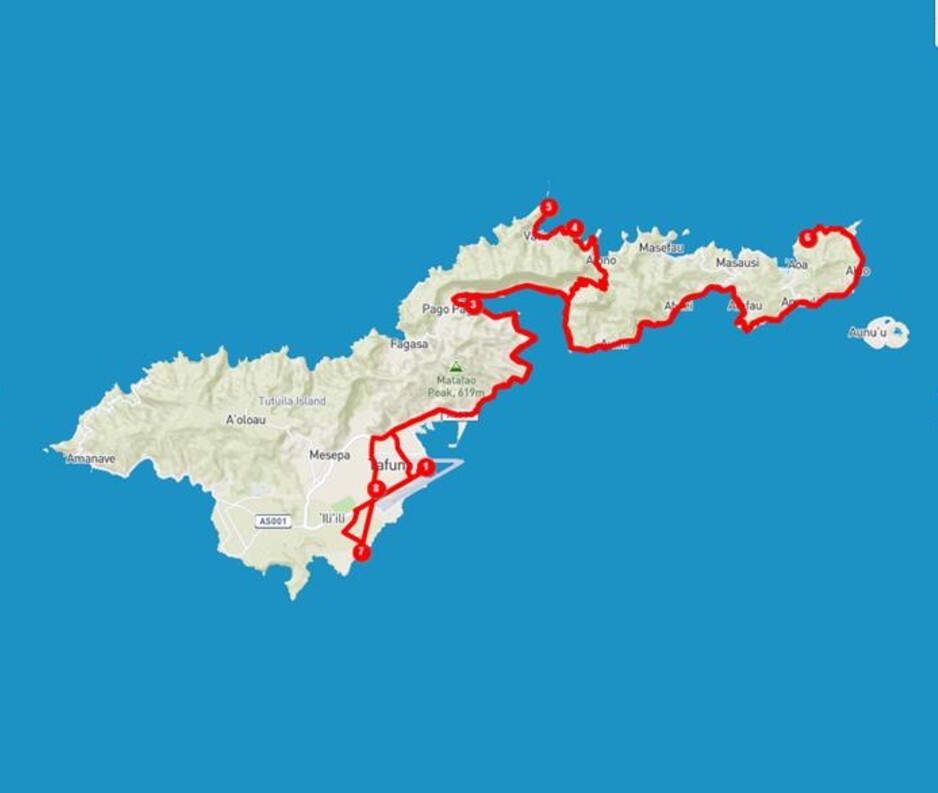
American Samoa is a territory of the United States located in the Polynesia region of the South Pacific Ocean. It is 64 km / 40 mi southeast of Samoa, east of the International Date Line, west of the Cook Islands and north of Tonga. It is the southernmost territory of the United States, situated 3500 km / 2,200 mi southwest of Hawaii. American Samoa consists of the eastern part of the Samoan archipelago – four inhabited volcanic islands and the uninhabited Rose Atoll . It is slightly larger than Washington DC but including its territorial waters, it is about the size of New Zealand.
American Samoa has a tropical climate, with 90 percent of its land covered by rainforests. Much of its population is concentrated on the largest island of Tutuila, which hosts the capital and largest settlement, Pago Pago. The vast majority of residents are indigenous ethnic Samoans, most of whom are fluent in the official languages of Samoan and English.
Inhabited by Polynesians since prehistory, contact with Europeans began in the early 18th century. Dutchman Jacob Roggeveen was the first known European to sight the islands in 1722, calling them the “Baumann Islands” after one of his captains. The islands attracted missionaries, explorers, and mariners, particularly to the highly protected natural harbor of Pago Pago. The United States took possession of American Samoa in the late 19th century, developing it into a major naval outpost; the territory’s strategic value was reinforced by WWII and subsequent Cold War.
Some people were unhappy since they were left out of the name “Naval Station Tutuila”. In May 1911, Governor Wlliam Michael Crose authored a letter to the Secretary of the Navy conveying the sentiments of the Manuʻa people. The department responded that the people should choose a name for their new territory. The traditional leaders chose “American Samoa”, and, on July 7, 1911, the Navy authorized the governor to proclaim it as the name for the new territory.
In 1967, American Samoa became self-governing with the adoption of a constitution; its local government is republican in form, with separate executive, legislative, and judicial branches. It remains officially unorganized and is thus directly administered by the federal government. Due to the territory’s strategic location, the US military has a significant presence and plays a major role in its economy and society. The territory is noted for having the highest rate of military enlistment of any US state or territory.
Tuna products are the main exports, with the US proper serving as the largest trading partner. Tourism is a nascent but underdeveloped sector, owing in part to the territory’s relative geographic isolation, which also accounts for its high rate of poverty and emigration.
Residents of American Samoa are politically disenfranchised, with no voting representation in the Congress. American Samoa is the only permanently inhabited territory of the United States in which citizenship is not granted at birth, and people born there are considered “non-citizen nationals” with limited rights. Citizenship is a controversial topic locally, as the government of American Samoa fears that it would lead to the erosion of traditional customs. It is the only US territory with its own immigration system.
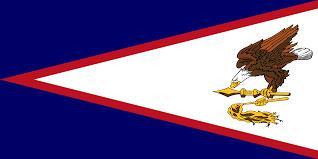
The flag of American Samoa features a blue background with a white triangle bordered in red, extending from the hoist to the fly. Inside the triangle, a bald eagle, clutching a war club and a fly-whisk, is placed. These symbols represent the US guardianship over the territory and Samoan traditions, respectively. The colors red, white, and blue also reflect the traditional colors of the United States and Samoa.
Currency: USD = $1.39 CAD
Petrol/Diesel price: $4.28 USD a gallon
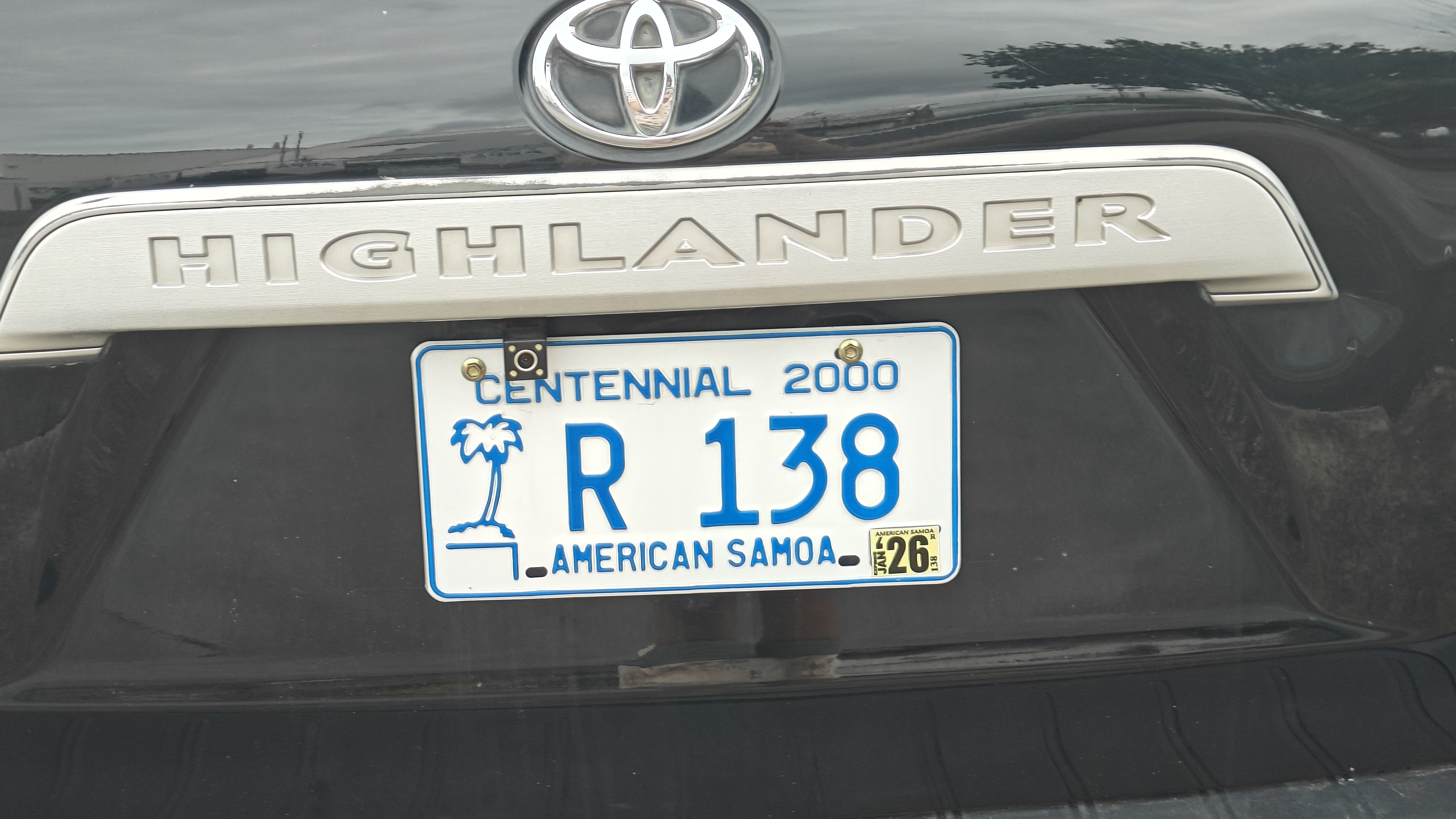
License plate:
Beer: Bud and Samoan Vailima seem to be most popular
The flight on Wednesday from Samoa to Pago Pago was about 40 minutes and we crossed the International Date Line so we actually gained a day and landed on Tuesday. Before Immigration we got checked in at a medical table where a woman asked if we were feeling well and recorded our hotel name. We could see the baggage right behind the Immigration Booth. They had one agent for the 19 passengers onboard. We looked for an ATM (we are low on USD) and a SIM card with no luck. We asked a couple of people and they confirmed there is neither is available at this “international airport”. We had pre-arranged yesterday with our hotel to pick us up at 1:10 but had advised this morning about the early arrival then the canceled flight and since we didn’t have a local SIM card, we could not all to have them pick us up. We went into a small shop and asked if they perhaps sold SIM’s and she said no but after telling her our predicament, she used her landline to dial the hotel and Fran spoke with them to arrange for their free shuttle.
The shuttle van arrived about 10-15 minutes later and then in five minutes we were at the Tradewinds Hotel. From what little information we had, there are really only two hotels on the island that you can book online – there are a few guesthouses you can get in person upon arrival as well. The other hotel is Sadie’s and it’s more in the city but it was all booked up.
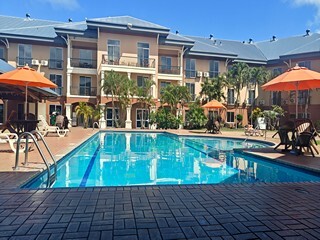
The Tradewinds Hotel gave us a Deluxe King Room for $149 a night. This came with a private bath, kitchenette with microwave, fridge and sink, a sitting room, AC, and a pool. The Wi-Fi cost an additional $5 a day. We opted to do this instead of get SIM cards. There’s not much to do here besides the national park so two nights here is more than enough. Unfortunately our flight out is at 11:10 pm on Thursday so since hotel check out is noon, we’ll have a loooooooong time to wait until we can check in. There is no airport lounge or services at the airport so you don’t want to be there too much before your flight. The hotel has a check out time of noon, which is later than we’ve encountered in a while but if we want to check out later, like say 6pm, they charge half the room rate so we won’t be doing that.
After settling in our room, we went for a walk hoping to get a fountain drink at the McDonald’s but like in Samoa, there is no Diet Coke on offer. On the walk back to the hotel, we stopped at a few small grocery stores and got some beverages and snacks.
It’s similar weather here to Samoa – after all we are not that far away! Mostly cloudy, humid, a few tiny sprinkles and about 32C / 90F. There are plenty of stray dogs and lots of banana, papaya and coconut trees.


The next day, on our second Wednesday (like ground hog day!) we mostly hung around the hotel other than going for walks and we went out for dinner across the road to a Vietnamese restaurant for dinner. It was a gorgeous sunny day too but of course still humid. In the afternoon we sat by the pool for a while reading.
 When we checked in we had seen an ad for motorbike rentals and Doug called there today and arranged for a day rental for tomorrow to check out around the island and, of course, visit the National Park. For $30 we can rent a 50 cc motorbike that seats two from 9-5. What a deal when a rental car is well over $120 a day!
So Thursday morning after breakfast, we checked out and put our luggage in their storage room and Doug went to get our rental. We got a little “red rocket”:
 and set off to go into the city of Pago Pago to the National Park Visitor’s Centre. Enroute we saw the Flower Pots.
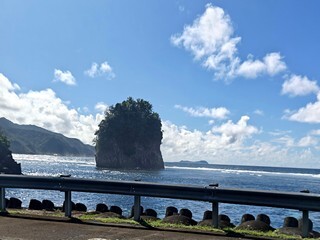
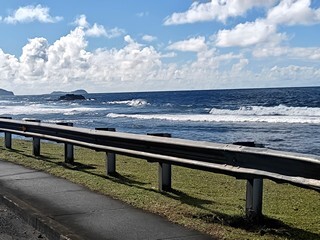
as well as lots of lovely sea views:
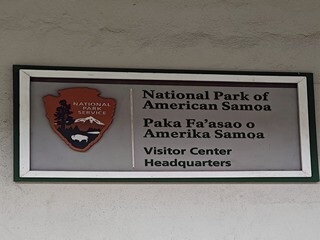
This was quite a good visitor’s centre and we looked into trails (snorkeling is possible here but it’s on another island or in the marine sanctuary which is hard to get to and you need your own gear). This national park is free. Fran picked up the usual NP brochure for her collection and we spent about 20 minutes reading all the info:

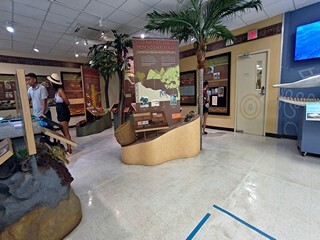
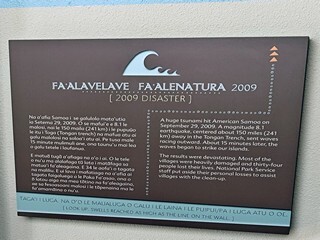
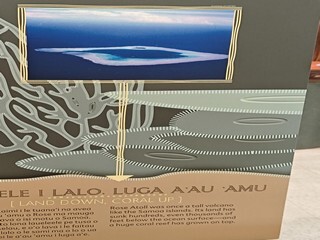
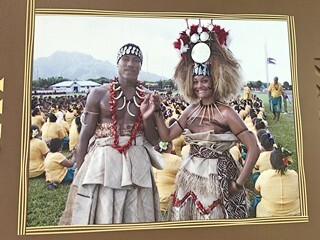
and then set off to get to the north side of the island to enter the park and to do two hikes. Enroute we stopped at two view points to see the cockscomb:
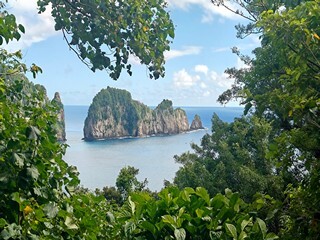
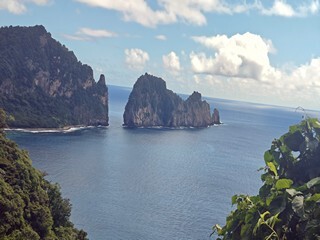
Upon arriving at the end of the paved road, we parked the bike and walked about 300m to the sea for these views and sounds:
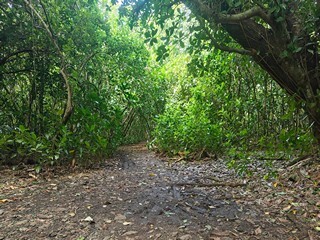
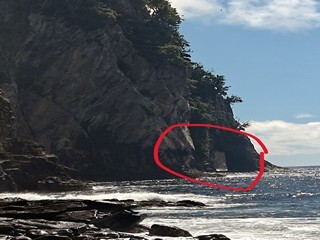
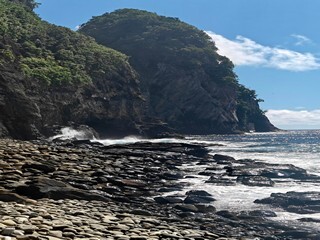
It was really quite a beautiful day with the odd very short sprinkle. Our plan was to do a second hike that would take us to another rocky beach on the other side of this part of the island but when we reached the trail-head, there was no sign of the trail; it was all overgrown and hard to find so we gave up.
We went back to the south side of the island to drive to the “end of the road” in an eastward direction mostly right along the coast and it was an amazing drive.
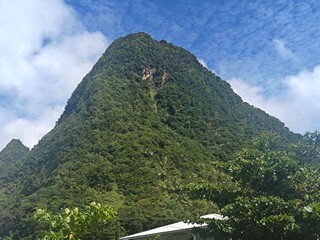
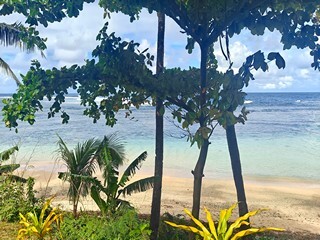
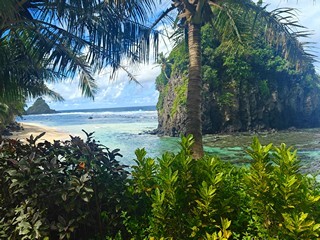
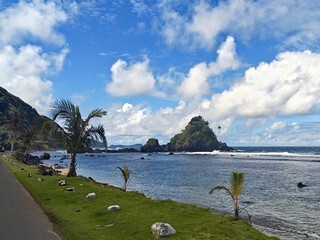
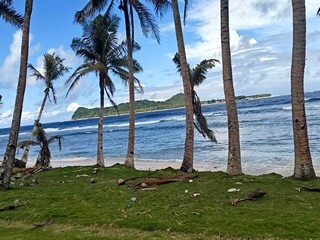
Upon reaching the village of Onenoa, we got to the literal end of the road:
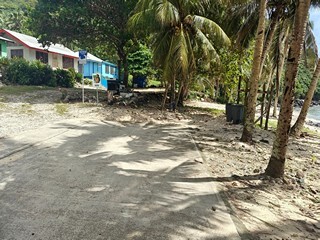
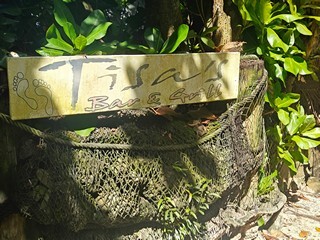
We turned around and the plan was to stop at Tisa’s Barefoot Bar for lunch and drinks. We arrived there just after 1pm and it was closed with no hours posted! Darn.
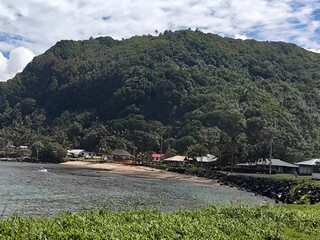
New plan: we drove back into Pago Pago stopping at an overlook of the harbour:
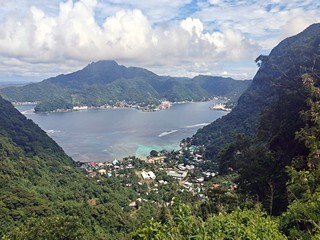
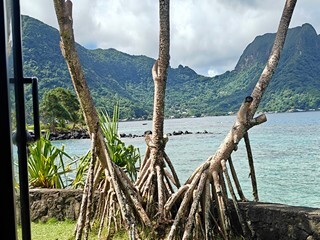
and looked for a bar/restaurant with a sea view and ended up at the other hotel in town, Sadie’s, which had a cafe on the water called “Goat Island”.
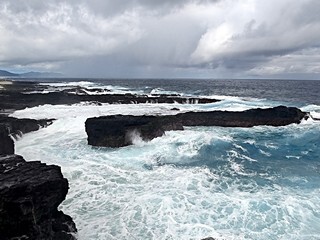
After lunch we continued westward, past our hotel to the Turtle and Shark Lookout to watch the waves crash on the short volcanic cliffs:

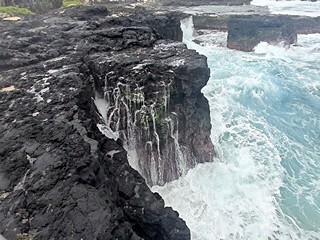
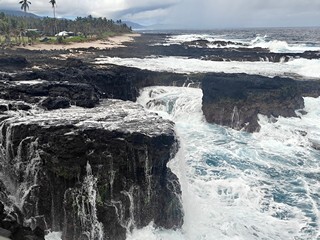
We were back at the hotel by 3:30 and Doug returned the motorbike. We sat in the lobby which is quite large with tables and couches, with all the other people who were also on that late flight to Hawaii. We were quite sweaty and decided to change after sneaking in a shower at the hotel pool bathroom. They told us at the front desk when we checked in that once we check out we cannot use the pool but said nothing about the shower/bathroom by the pool (nor did we ask!) and we managed to get it done without towels as they wouldn’t give us pool towels either but at least we felt cleaner.
So we hung around the lobby till 8:30 and took the shuttle over to the airport then. We had been unsuccessful trying to check in online so we didn’t want to leave it too long to get to the airport; our seats had been randomly selected and we are not seated together which we hope to change as well. Check in was busy but not crazy and the attendant was able to seat us together despite the flight being full. We took off a half hour late but landed more or less on time.
Funny thing, while they were telling us about the delayed departure, the announcement said “Be ready to power board”! This meant no travel documents were needed, just your boarding pass and they would board us as quickly as possible AND make sure you did not have more than your allotted carry on bags (do not have 3 bags).
We were seated in the row that backs on to the bathroom so it was a busy area and trying to sleep on a plane is difficult for us in the first place but add random airplane toilet flushing, and we got no sleep. To top it off, Fran’s monitor did not work so no movies for her but she mostly just tried to rest anyway.
In American Samoa we drove a total of 111 km / 70 miles.
This link will take you to all our photos of our time on this island.
Our Thoughts on American Samoa:
- not set up for tourism really – only two main hotels, few public beaches
- main attraction for tourists (including us) seems to be the National Park and it’s not all that accessible unless you are into long, difficult mountain hikes
- there are car rental options but they are very pricey
- naturally, many customs, buildings and such like Samoa
- decent infrastructure – the airport runways are much more modern than Samoa, main roads are quite good around the city, similar state out of the cities as Samoa
- people are quick to smile and wave – we were definitely an oddity on a motorbike as we drove around
- lots of American flags around
In American Samoa we were at around 14 degrees south of the equator – still not as far north as the northernmost point we visited in Australia!
Fun Facts about American Samoa:
- American Samoa is closer to New Zealand that the continental US!
- American Samoa offers a wide range of goods and drinks that highlight the islands flavours from fish to coconut dishes.
- Bats are the only native species of mammals found in American Samoa.
- 80% of the economy is dependent on the two US tuna canneries.
- Quick action in 1918 fully prevented the country from the Spanish Flu outbreak.
- The National Park of Samoa is the only US national park south of the equator.
- Weather stations detect rain 300 days out of 365 each year in American Samoa.
- The main island of Tutuila has the largest concentration of fast food restaurants and is the biggest purchaser of fast food in the entire South Pacific.
- American Samoa has earned the nickname “Football Island,” as the islands produce more American football players than anywhere else in the world. A young male from American Samoa is 56 times more likely to play in the NFL than a young male in the United States.
- About three fourths of the American Samoa population is considered obese, which is the highest rate in the world.

